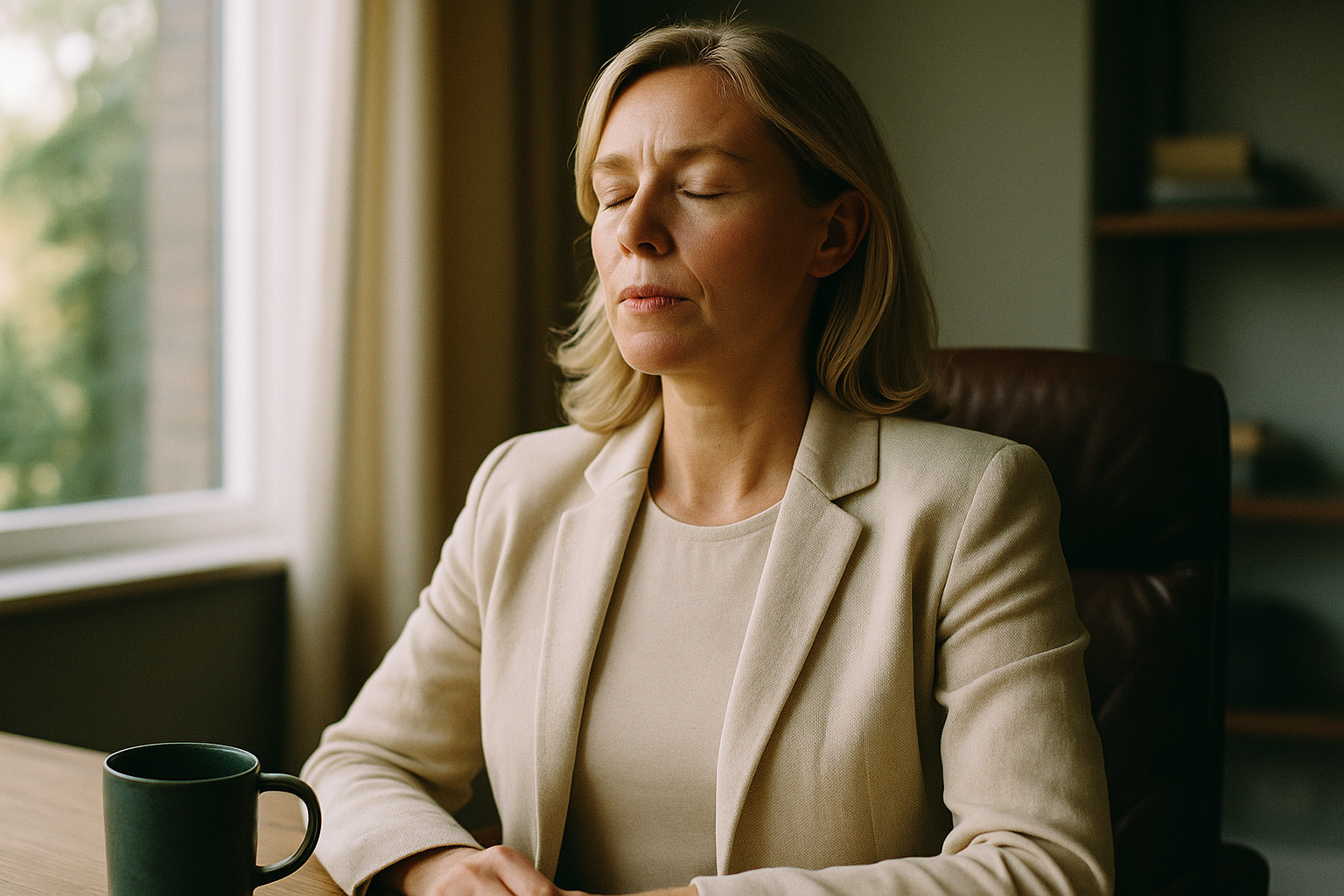
You already know breathing helps.
You've heard it a hundred times.
And yet — in the middle of a board presentation, a difficult conversation, a 6am inbox spiral — you forget every technique you've ever learned and just... white-knuckle through it.
The best breathing technique to stop anxiety isn't the one with the most scientific-sounding name.
It's the one that actually works on your nervous system at the moment you need it most.
And most people have never been taught why it works — which is exactly why they can't use it under pressure.
This article changes that.
Why Anxiety Doesn't Respond to Willpower
Anxiety isn't a thinking problem. It's a body problem.
When your nervous system detects threat — real or perceived — it shifts into sympathetic activation.
Heart rate climbs.
Muscles tighten.
Digestion halts.
Blood moves to your limbs.
Your prefrontal cortex, the part responsible for clear thinking and measured decision-making, goes partially offline.
This is your threat response doing exactly what it evolved to do.
The problem is that your nervous system cannot distinguish between a predator and a passive-aggressive email from your CFO at 11pm.
Both register as danger.
Both trigger the same cascade.
And here's the part no one tells you: you cannot think your way out of a physiological state.
You have to breathe your way out.
Not metaphorically.
Literally.
The breath is the only part of your autonomic nervous system you can consciously control.
That makes it the fastest lever you have.
What Have You Already Tried That Hasn't Worked?
Most people have attempted some version of "just breathe deeply" during a moment of anxiety.
They take a big inhale.
Hold it. Let it out.
And feel... nothing.
Or worse, they feel more tense.
There's a reason for that.
Deep inhales — particularly big chest breaths — actually activate the sympathetic nervous system.
They signal the body to do more, take in more oxygen, prepare for action.
When you're already anxious, taking a massive inhale can amplify the sensation rather than reduce it.
Box breathing is popular.
Four counts in, hold, four counts out, hold.
It's useful for some things — particularly sustained focus and stress inoculation before a high-stakes event.
But box breathing is a training tool.
Under acute anxiety, the hold phases can feel suffocating.
For many people, it makes things worse.
Then there's meditation app breathing — the kind with a slow circle expanding on a screen.
Fine.
Gentle.
Completely useless in the parking lot before a difficult conversation.
The issue isn't that these techniques are wrong.
The issue is that most people don't understand the underlying mechanism — so they can't adapt, troubleshoot, or apply them with precision.
The Reframe: Your Exhale Is the Brake Pedal
Here is the single most important piece of nervous system science you will ever learn about breathing.
Your inhale speeds your heart rate up. Your exhale slows it down.
This is not metaphor.
This is physiology.
It's called respiratory sinus arrhythmia — the natural fluctuation of heart rate across the breathing cycle.
Every breath you take, your heart rate rises slightly on the inhale and falls slightly on the exhale.
The vagus nerve — the primary pathway of your parasympathetic nervous system — is activated most powerfully on a long, slow exhale.
This means the best breathing technique to stop anxiety fast is not about how much air you take in. It's about how long you let it out.
Longer exhale than inhale. That's the mechanism. Everything else is detail.
If you want to understand how the vagus nerve fits into all of this, this guide on vagus nerve activation through breathwork goes deeper into the physiology and gives you a complete executive-level breakdown.
The Best Breathing Technique to Stop Anxiety Fast: Physiological Sigh
The technique with the strongest current evidence for rapid anxiety reduction is called the physiological sigh.
It's not new.
Your body already does it involuntarily — the double-inhale followed by a long sigh that happens when you've been holding tension for too long.
Infants do it. Animals do it. You've done it thousands of times without realising it was a nervous system reset.
Stanford neuroscientist Andrew Huberman and his colleagues published research in 2023 in Cell Reports Medicine comparing several breathing protocols.
The physiological sigh outperformed box breathing and mindfulness meditation for immediate anxiety reduction.
Here is how you do it.
Step One: Double Inhale Through the Nose
Take a full inhale through the nose.
At the top of that inhale, before you exhale, take a second sharp sniff in through the nose — filling your lungs as completely as possible.
This double inhale re-inflates collapsed alveoli in the lungs, allowing for maximum gas exchange.
It sets up the exhale to be as effective as possible.
Step Two: Long, Slow Exhale Through the Mouth
Release the breath slowly through the mouth.
Let it be longer than feels natural.
Empty your lungs completely.
The exhale should be roughly twice the length of the inhale.
If your double inhale took three seconds, aim for six to eight seconds on the exhale.
Step Three: Return to Normal Breathing
You don't need to repeat this endlessly.
One to three physiological sighs is enough to shift your autonomic state.
That's it. No app.
No mat.
No quiet room.
You can do this in a meeting, at a traffic light, in an elevator, in a bathroom stall thirty seconds before you walk into something hard.
When to Use It and When to Use Something Else
The physiological sigh is your emergency brake.
It is not a long-term regulation strategy on its own.
Use it when anxiety is acute — when you feel the chest tightening, the thoughts accelerating, the composure starting to slip.
It works within thirty to sixty seconds for most people.
For chronic baseline dysregulation — waking up anxious, feeling wired but exhausted all day, snapping at people you love — you need something more sustained.
A pattern of breathwork practice that trains your nervous system over time, not just interrupts it in the moment.
If that sounds like you, the article on somatic practices for nervous system regulation when you have no time is the right next read.
It maps out what a real practice looks like for someone with an actual schedule.
There is also a slower, more deliberate technique worth knowing.
Extended Exhale Breathing (4-7-8 or 4-6 Ratio)
If you have a few minutes — at your desk, before bed, in a parked car — a sustained extended-exhale practice compounds the effect of the physiological sigh.
Inhale for four counts through the nose.
Exhale for six to eight counts through the mouth.
Repeat for four to eight cycles.
This isn't the same as box breathing.
There is no hold.
The emphasis is entirely on lengthening the exhale relative to the inhale.
Over several minutes, this drops cortisol measurably and shifts heart rate variability in the direction of recovery.
It is particularly effective in the evening if you're someone who arrives home still carrying the nervous system load of the day — which is more common than most people admit.
If that pattern is familiar, this piece on why you're bringing work stress home explains the physiological mechanism behind why the day doesn't end when you walk through the door.
The Deeper Problem Beneath the Anxiety
Here is something worth sitting with.
If you are searching for the best breathing technique to stop anxiety fast, the anxiety itself is not the core problem.
It is a signal.
Anxiety at this level — the kind that follows you from meeting to meeting, that wakes you at 3am, that hums underneath every accomplishment — is a symptom of a nervous system that has been running in high-alert for too long without adequate recovery.
Breathing techniques work.
They are real, evidence-based, and immediately useful.
But they are not the same as addressing what's driving the dysregulation in the first place.
For many high-functioning professional women, that root cause is not stress in the ordinary sense.
It's a body that has been asked to perform at capacity for years without the physiological conditions for genuine recovery.
That distinction matters — because the solution is different.
The difference between acute stress and the kind of chronic dysregulation that lives in your tissues is explained in full in the article on high-functioning exhaustion vs. burnout.
If you recognise yourself in that description, read it before you try to optimise your way out of this with more techniques.
A Simple Practice You Can Start Today
You don't need a protocol. You need a starting point.
For one week, commit to this single practice.
Every morning, before you look at your phone, before you speak to anyone, before the day claims you: three physiological sighs.
Double inhale through the nose. Long exhale through the mouth. Three times.
This takes less than ninety seconds.
It sets your nervous system baseline before the day compounds it. It is not a cure.
It is a beginning — and beginnings matter more than people think.
From there, you build.
This Is What We Help You Do Systematically
The Sovereign Executive System exists for women who are done patching themselves together with tips and techniques — and are ready to rebuild their nervous system from the ground up.
SOMA, the first phase of the framework, works directly with physiological regulation: breath, sleep architecture, nervous system baseline, and the body's actual capacity for recovery.
Not as theory.
As a structured, sequenced practice that fits inside a real professional life.
If you want to understand the full framework before committing to anything, the Sovereign Executive System Map is available for $7. It lays out the entire three-phase approach — what it is, how it works, and how to know if it's right for where you are right now.
Or if you're ready to go deeper immediately, the SOMA Foundations programme builds the physiological foundation your nervous system has been missing — starting with breath, and moving through every lever that determines how regulated, resourced, and resilient you actually are.
Frequently Asked Questions
What is the best breathing technique to stop anxiety fast?
The physiological sigh — a double inhale through the nose followed by a long exhale through the mouth — has the strongest current research support for immediate anxiety reduction.
It works by activating the vagus nerve and shifting the body from sympathetic to parasympathetic dominance within thirty to sixty seconds.
How many times should I do the physiological sigh?
One to three repetitions is typically sufficient for acute anxiety.
More than that isn't harmful, but the shift usually happens within the first two sighs.
If you feel no change after five cycles, the anxiety may be rooted in a deeper dysregulation that requires a more sustained practice rather than a single technique.
Why does breathing slowly help with anxiety?
Slow breathing — particularly with an extended exhale — directly activates the vagus nerve, which is the main communication pathway of the parasympathetic nervous system.
This signals the body that the threat has passed and allows heart rate, cortisol, and muscle tension to drop.
The mechanism is physiological, not psychological.
Can the best breathing technique to stop anxiety replace medication or therapy?
Breathwork is a powerful nervous system tool, but it is not a clinical intervention and should not replace professional treatment for anxiety disorders.
For many high-functioning women, breathwork is most effective as part of a broader physiological regulation practice — addressing sleep, movement, recovery, and baseline nervous system tone — alongside any appropriate professional support.
Why does deep breathing sometimes make anxiety worse?
Large inhales — especially chest breathing — activate the sympathetic nervous system, which can amplify anxiety rather than reduce it. This is why technique matters: the goal is a long exhale, not a big inhale.
If deep breathing has made you feel worse in the past, you were likely over-emphasising the inhale.
How long does it take to see lasting results from breathwork practice?
Immediate effects — reduced heart rate, lower tension — can happen in under a minute.
Lasting changes to your nervous system baseline, including improved heart rate variability and lower resting cortisol, typically require consistent practice over four to eight weeks.
Short daily practice compounds far more effectively than occasional long sessions.
Disclaimer
The content in this article — including any breathing protocols, somatic tools, nervous system frameworks, and physiological concepts — is provided for educational and informational purposes only.
It is not medical advice and is not intended to diagnose, treat, cure, or prevent any condition.
The Sovereign Executive methodology, including the SIC Protocol™, the Neural Reset, and the Snap Point framework, are coaching tools developed through lived experience and long-term physiological study.
They are designed to support high-functioning women in building physiological resilience — not to replace clinical care.
If you are managing a medical condition, a diagnosed anxiety or mood disorder, or are under the supervision of a licensed healthcare provider, please consult your provider before applying any protocol described here.
Client stories and outcomes shared on this platform reflect individual results.
They are real, and they matter.
They are not a guarantee that you will experience the same outcome.
Your results will depend on your consistency, your starting point, and a range of factors unique to you.
All content on this platform is the intellectual property of Stephanie Chang Ramos / The Sovereign Executive.
All rights reserved.
Disclaimer
The content in this article — including any breathing protocols, somatic tools, nervous system frameworks, and physiological concepts — is provided for educational and informational purposes only. It is not medical advice and is not intended to diagnose, treat, cure, or prevent any condition.
The Chang Method™, including the SIC Protocol™ and the Neural Reset, are coaching tools developed through lived experience and long-term physiological study. They are designed to support high-functioning women in building physiological resilience — not to replace clinical care.
If you are managing a medical condition, a diagnosed anxiety or mood disorder, or are under the supervision of a licensed healthcare provider, please consult your provider before applying any protocol described here.
Client stories and outcomes shared on this platform reflect individual results. They are real, and they matter. They are not a guarantee that you will experience the same outcome. Your results will depend on your consistency, your starting point, and a range of factors unique to you.
All content on this platform is the intellectual property of Stephanie Chang Ramos / The Chang Method. All rights reserved.