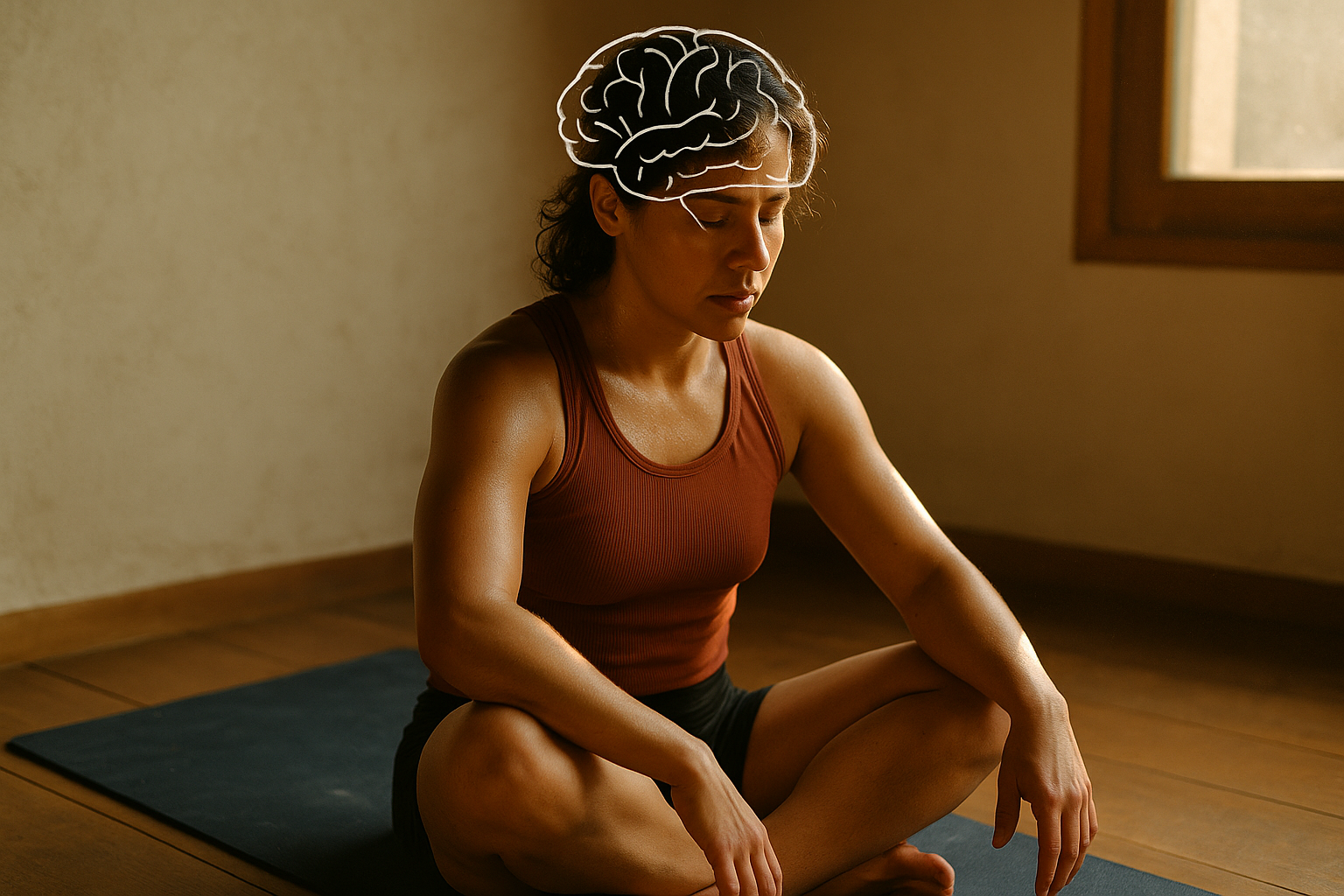
Your brain is not broken.
But it has reorganized itself around the assumption that the emergency is permanent.
That is not a metaphor.
That is a structural change — one you can see on a scan, measure in a blood panel, and feel in the way your body braces before the day even starts.
Brain healing after burnout and neuroplasticity research now confirm what the smartest sports scientists have known for years: the nervous system does not recover through more effort.
It recovers through inputs that signal safety.
And slow, deliberate movement is one of the most direct signals you can send.
This is not about yoga.
It is not about "gentle movement for self-care." It is about the actual mechanics of how your brain rewires itself — and why everything you have tried so far probably skipped the step that matters most.
The Problem Is Not Stress. It Is What Stress Has Done to Your Brain's Architecture.
There is a version of exhaustion that rest does not fix.
You sleep ten hours and wake up tired.
You take the vacation and spend it in survival mode.
You stare at the ceiling at 2 AM running a performance review in your own head — for a meeting that already ended hours ago.
This is not laziness.
This is not a mindset problem.
This is what happens when the stress response has been running long enough that your brain stops treating it as a response and starts treating it as a default setting.
Here is what is actually happening inside your body.
Chronic stress shrinks the hippocampus — the region responsible for memory, context, and emotional regulation.
It over-activates the amygdala — the threat-detection center that decides whether something is dangerous before your rational brain even gets a vote.
And it weakens the prefrontal cortex — the part that lets you pause before reacting, choose your words, and feel like yourself.
This is brain healing burnout neuroplasticity in reverse: the stress has literally reshaped your neural architecture in the direction of high alert.
Which means the fix has to be physiological.
Not motivational.
Not strategic.
Physiological.
Why Everything You Have Tried Has Not Fixed It
You have probably tried some version of the following.
More sleep.
A productivity system.
A meditation app.
A weekend retreat that helped for three days and then evaporated when Monday arrived.
Maybe therapy — which helped you understand the pattern without giving you the tools to interrupt it in real time.
None of these failed because you did them wrong.
They failed because they addressed the symptoms while the structural problem kept running underneath.
Productivity systems assume the problem is organizational.
Mindset work assumes the problem is cognitive.
Vacations assume the problem is circumstantial — that if you just remove yourself from the context long enough, you will reset.
But if the nervous system has already reorganized around a permanent threat posture, removing the context does not remove the threat posture.
You take it with you on the plane.
You feel it in the hotel room.
You feel it on the beach.
As one client put it: "The vacations feel like survival missions rather than recovery."
That is not a vacation problem. That is a nervous system architecture problem.
And it requires a structural solution.
If you want to understand what is happening at the hormonal level underneath the exhaustion, this article on the HPA axis explains why burnout is a hormonal crisis before it is anything else.
The Reframe: Your Brain Can Rebuild. But Not Through Force.
Neuroplasticity is the brain's capacity to change its own structure based on repeated inputs.
This is genuinely good news.
The hippocampus can regrow.
The prefrontal cortex can strengthen.
The amygdala can calm down.
The threat posture your nervous system adopted can be updated.
But here is what the research is clear on: that process requires a specific kind of input.
Not more intensity.
Not more discipline.
Not "pushing through" to prove you are strong enough.
It requires inputs that the nervous system reads as safe.
Think about what happens when you push through exhaustion to do a hard workout.
Your body produces more cortisol.
Your system stays in fight-or-flight.
You might feel accomplished for an hour — and then feel worse than before.
That is not a failure of willpower.
That is your nervous system responding accurately to what you just asked it to do: work harder under threat conditions.
Slow movement works differently.
Deliberate, low-intensity movement — movement with attention, with breath, with enough pace that you can feel what is happening — sends a different signal.
It says: the emergency is not permanent.
You can be here.
You are not running from anything right now.
And over time, with repetition, that signal starts to update the architecture.
This is how brain healing burnout neuroplasticity actually works in practice.
Not through a single session.
Through consistent, repeated inputs that gradually shift the nervous system's baseline assumption about the world.
What Slow Movement Actually Does to the Brain
Let us be specific about the mechanisms, because this is not just feel-good science.
It activates the vagus nerve. Slow, rhythmic movement — especially movement that coordinates breath — stimulates the vagal pathways that run from the brainstem to the heart, lungs, and gut.
Vagal activation is the most direct route from sympathetic arousal (fight-or-flight) to parasympathetic recovery (rest-and-digest).
If you want to understand more about this mechanism, this article on the vagus nerve and chronic stress goes deeper on why burnout breaks this system.
It increases BDNF — brain-derived neurotrophic factor. BDNF is essentially fertilizer for neurons.
It supports the growth of new neural connections and is critical for hippocampal repair.
High-intensity exercise also produces BDNF, but the cortisol cost can offset the benefit in someone whose stress axis is already compromised.
Slow, sustained movement produces BDNF without the cortisol spike.
It restores interoceptive awareness. Interoception is your ability to read your own body's signals — to notice tension before it becomes pain, to feel anxiety in your chest before it becomes a reaction.
Chronic stress degrades this signal.
You stop being able to read yourself.
Slow movement, done with attention, rebuilds the connection between sensation and awareness.
You start to feel yourself again.
It interrupts the rumination loop. When you are moving slowly enough to require attention — balance, coordination, breath pacing — your brain cannot simultaneously run the 2 AM performance review.
The prefrontal cortex gets a real break.
Not a suppression.
A genuine interruption.
This is what distinguishes slow movement from passive rest.
Rest removes input.
Slow movement replaces one kind of input — threat — with a different kind: safety, presence, capacity.
How This Works in Three Phases
The Chang Method builds this in a specific sequence because sequence matters.
SOMA — the body first. Before any identity work, before any goal-setting, before any conversation about what you want your life to look like — the body has to be able to register safety.
Breathwork, nervous system stabilization, and slow movement create the physiological foundation.
Without it, every other intervention operates on a dysregulated substrate.
The insights do not stick.
The intentions do not hold.
KINES — movement as reclamation. Once the nervous system has started to downregulate, movement becomes a tool for something more than regulation.
It becomes a way to reclaim time — to feel your body as yours again, rather than a vehicle you are managing from the outside.
This is where the brain healing burnout neuroplasticity process accelerates.
The brain starts to update not just its threat posture but its identity template.
You stop experiencing yourself as someone running from something and start experiencing yourself as someone inhabiting a body that is capable.
VIVENS — aliveness, not just function. The third phase is where the reconnection to who you are outside your roles becomes possible.
Not as a concept.
As a felt experience.
When the body trusts the environment, when movement has become something you do with your body rather than to it, the question of what you actually want — not what is expected, not what is next on the list — becomes answerable.
This is not a linear path with a clean endpoint.
It is a practice.
But it has a direction.
What This Looks Like in Real Life
Hannah came in with daily panic attacks.
Low confidence.
No ability to say no to the next demand on her calendar.
After consistent work with breathwork and structured movement practice, the panic attacks stopped.
She set boundaries at work and in relationships.
Her own words: "The biggest change is my confidence — to be assured of myself."
That is not a motivational outcome.
That is a structural one.
The nervous system stopped running the emergency, and the woman underneath it had room to show up.
Mia came in exhausted and without direction — drained by work, overwhelmed by the dual load of career and family, no sense of what she actually wanted anymore.
Over the course of the work, she stopped needing to do everything perfectly.
She relocated to a work situation that actually fit her life.
Her own words: "I am feeling proud of myself."
That is what happens when the brain heals.
Not just that anxiety decreases.
Identity comes back online.
Stacy came looking specifically for a natural solution to chronic cortisol spikes — no medication, just tools that worked in real time.
What changed for her was not a single technique.
It was awareness. "Awareness of my stress response changed everything." Once she could read herself accurately, she could intervene before the spike instead of recovering from it afterward.
This is brain healing burnout neuroplasticity in practice: not a dramatic breakthrough, but a steady accumulation of moments where you choose your response instead of running your reflex.
If you want to understand what physiological recovery actually looks like over time, this article on rebuilding physiological resilience maps the full process.
The Entry Point: One Commitment That Compounds
The hardest part of starting is not the movement itself.
It is trusting that something slow and deliberate can actually change something that has felt so structural and so fixed.
It can.
But only if you give it repetition.
One session tells your nervous system something new.
Twenty sessions start to update the architecture.
Sixty sessions build a new baseline.
The goal is not to feel better for an hour.
The goal is to shift what your nervous system assumes is true about the world — from "the emergency is permanent" to "I can be here, and I am okay."
That shift is available to you.
It is not quick.
But it is real.
And it is built through exactly the kind of slow, intentional movement that probably sounds too simple to work — until you feel what it actually does to your body over time.
Ready to Find Out Where You Actually Are?
If any of this sounds like your body, the best starting point is understanding your specific pattern — not a generic nervous system article, but your actual stress architecture right now.
The six-question quiz takes ninety seconds.
It gives you a clear read on where your nervous system is currently running and what kind of input would actually shift it.
Take the quiz here — ninety seconds, six questions, a real answer.
Frequently Asked Questions
How long does brain healing from burnout actually take?
There is no single answer, but the research on neuroplasticity suggests meaningful structural change requires consistent repetition over weeks and months — not a single retreat or a few good nights of sleep.
What changes quickly is your ability to interrupt the stress response in real time; what takes longer is updating the nervous system's baseline assumption about the world.
Does slow movement really work for brain healing burnout neuroplasticity, or is intense exercise better?
Both produce BDNF, the neurochemical critical for brain healing burnout neuroplasticity and hippocampal repair.
The difference is that high-intensity exercise also produces cortisol — which, in someone whose stress axis is already compromised, can offset the benefit.
Slow, deliberate movement produces the neurological benefit without the cortisol cost, making it a more reliable entry point when the system is already overloaded.
Can I start this while I am still in a high-pressure job?
Yes — and that is exactly when it matters most.
The tools here are designed to work inside your existing life, not after you have cleared the calendar or changed the job.
A fifteen-minute transition practice, a thirty-second breath intervention before a meeting — these are not lifestyle luxuries.
They are real-time physiological tools that work under pressure.
Why hasn't therapy fixed this if it's a brain issue?
Therapy is valuable for understanding patterns and processing experience.
What it typically does not address is the subcortical level — the brainstem and body-level responses that happen before the rational brain gets a vote.
Brain healing burnout neuroplasticity at that level requires body-based inputs: breath, movement, somatic awareness.
Talk alone cannot reach the architecture that stress has changed.
What is the difference between slow movement and just resting?
Rest removes input — it is passive.
Slow movement replaces one kind of input (threat, urgency, performance) with a different kind (presence, safety, felt capacity).
The brain needs that replacement signal, not just the absence of stress, in order to update its baseline.
This is why complete stillness often does not feel restoring when the nervous system is running high — it has nothing to update itself with.
How do I know if my nervous system is still in a stressed state even when I feel okay?
Common signs include waking up already tense, difficulty feeling genuinely present in enjoyable moments, reactions to small things that feel disproportionate, and a rest that never quite restores.
If any of those patterns sound familiar, this article on the physiological signs your nervous system is still in burnout breaks down the specific markers to look for.
Disclaimer
The content in this article — including any breathing protocols, somatic tools, nervous system frameworks, and physiological concepts — is provided for educational and informational purposes only. It is not medical advice and is not intended to diagnose, treat, cure, or prevent any condition.
The Chang Method™, including the SIC Protocol™ and the Neural Reset, are coaching tools developed through lived experience and long-term physiological study. They are designed to support high-functioning women in building physiological resilience — not to replace clinical care.
If you are managing a medical condition, a diagnosed anxiety or mood disorder, or are under the supervision of a licensed healthcare provider, please consult your provider before applying any protocol described here.
Client stories and outcomes shared on this platform reflect individual results. They are real, and they matter. They are not a guarantee that you will experience the same outcome. Your results will depend on your consistency, your starting point, and a range of factors unique to you.
All content on this platform is the intellectual property of Stephanie Chang Ramos / The Chang Method. All rights reserved.