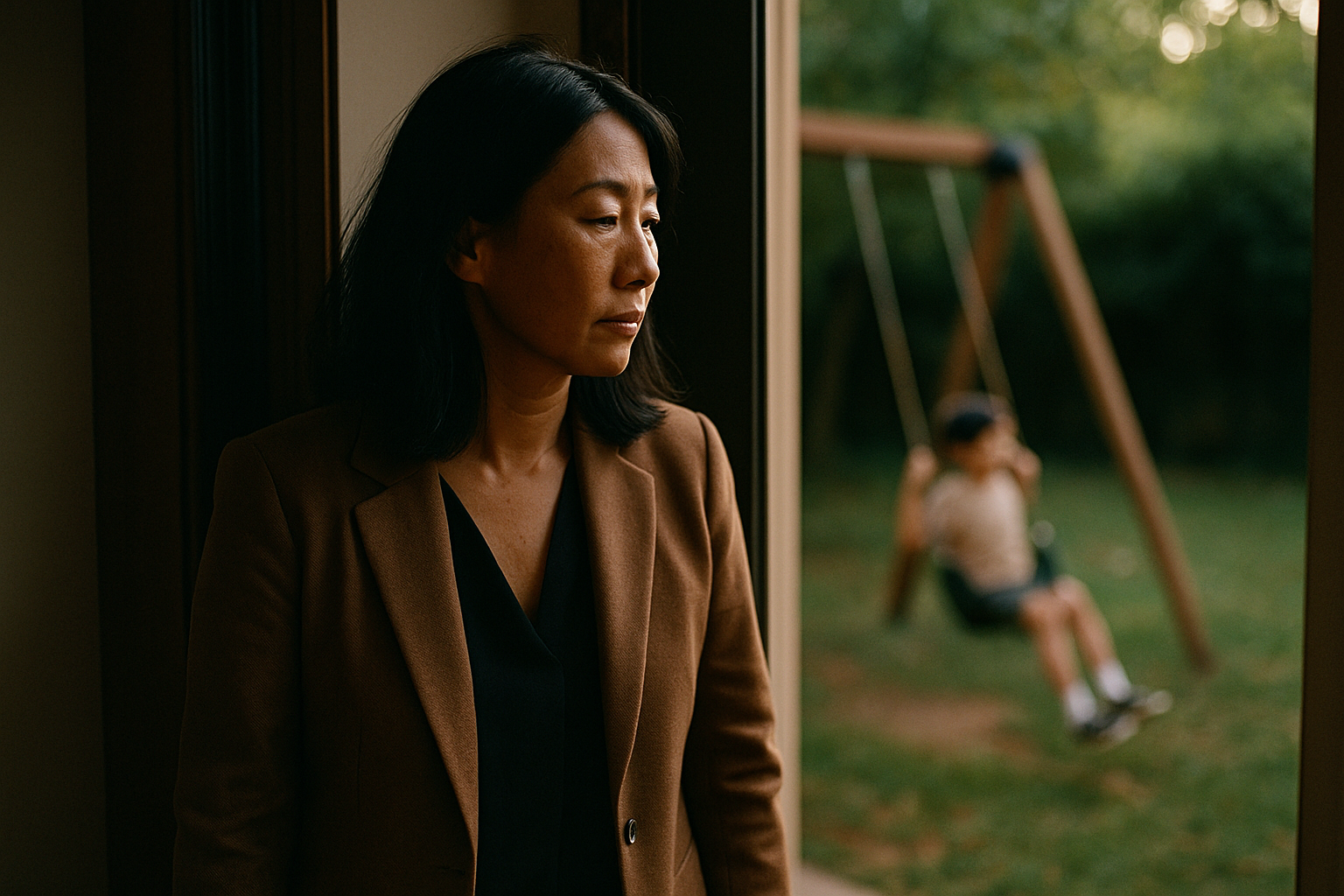
You were there for the recital.
You took the photo.
You even smiled.
But somewhere between the performance and the parking lot, you realized you hadn't actually been present for a single second of it.
That's the part no one warns you about.
Not that you'd miss events.
You're too organized for that.
You show up. You're physically present.
You do all the things a devoted mother does.
But you're missing your children's childhood — and you can't stop running long enough to do anything about it.
That distinction — between showing up and being there — is the thing that wakes you at 2 AM with a feeling you can't name but can't shake.
The Pain Underneath the Performance
You're not a neglectful mother. You're the opposite.
You've built your career specifically so your children have more.
More opportunity.
More security.
More of what you didn't have, or everything you did have, carefully preserved and handed forward.
You show up. You plan. You attend.
And yet.
There's a moment — usually quiet, usually after everyone else is asleep — when you do the math.
Your eldest is already nine.
You can feel the years compressing.
The window of them actually wanting to be near you, actually needing you in the small daily ways, is not infinite.
You know this. It makes it worse.
Because even knowing it, you can't seem to slow down.
Your phone is on the counter during dinner.
Your mind is running three agendas behind your eyes while your child tells you about their day.
You catch yourself nodding along while drafting a response to an email you haven't opened yet.
This is what it means to be missing your children's childhood while always running — not absent in body, but hollowed out in the moments that count most.
Why Everything You've Tried Hasn't Fixed It
You've tried the usual things.
Phone-free dinners.
Weekend unplugging.
Scheduled "quality time" that feels like a meeting with better snacks.
You've read the articles.
You've tried being more mindful.
You've told yourself — firmly, sincerely — that you'll be more present starting Monday.
It lasts about four days.
Then a deadline shifts, a crisis lands in your inbox, or just the ordinary volume of what you carry reasserts itself.
And you're back to functioning on the surface while somewhere deeper, you're still running.
The reason these strategies fail isn't a lack of discipline or desire.
It's because they treat the symptom.
The scattered attention, the inability to land in a moment — those are downstream effects.
The root is in your nervous system, not your schedule.
Your body has been trained, over years of high performance, to stay in a state of low-grade activation.
Alert.
Ready.
Scanning.
This is what made you effective.
It's also what makes genuine presence nearly impossible, even when you desperately want it.
You can put the phone in another room.
But you cannot willpower your way out of a nervous system that doesn't know how to stop running.
If you want to understand why rest and downtime aren't solving this, this article on why you can't recover energy even after vacation explains the physiological piece in plain terms.
What's Actually Happening in Your Body
Here's the reframe.
You don't have a presence problem. You have a regulation problem.
Presence — real, felt, embodied presence — is a physiological state.
It requires your nervous system to be in a specific window: calm enough to receive what's in front of you, not bracing for the next thing.
High-performing women who carry the kind of load you carry — career, children, partnership, the invisible architecture of family life — often can't access that state easily.
Not because they don't love their children.
Because their bodies have learned that slowing down means falling behind.
So the system never fully disengages.
You're at the school play and your threat-detection system is quietly running a background check on your calendar.
You're reading bedtime stories and some part of your brain is itemizing tomorrow.
You're hugging your child and registering the hug but not feeling it — not really.
This is not a character flaw.
This is what sustained high-functioning exhaustion does to the body over time.
The difference between high-functioning exhaustion and burnout matters here — because most women in this state aren't burned out.
They're still producing.
They're still showing up. But the cost is paid in exactly these moments: the ones that matter most and can't be recovered.
Is It Possible to Stop Running Without Stopping Everything?
Yes. But not the way you've been trying.
The goal isn't to become a different kind of professional.
It isn't to scale back your ambition or rearrange your priorities into a Pinterest-worthy version of balance.
You don't need a simpler life.
You need a regulated nervous system that can shift states — that can move from executive mode to mother mode to self mode without each transition costing you an hour of mental friction.
That shift is trainable.
Not through mindset work alone.
Not through breathing apps and gratitude journals, though those aren't without value.
Through consistent, body-based practice that teaches your system it is genuinely safe to slow down — that the world will not unravel in the three minutes you're fully present at the dinner table.
This is the foundation of somatic work: teaching the body what the mind already knows but can't seem to enact.
If you're new to this approach, somatic healing for working moms, explained simply is a useful place to start.
A Framework for Coming Back to the Moments That Matter
There are three places this work happens. All three are necessary.
1. The transition
The space between work and home is where most of this is lost or recovered.
Most high-performing mothers treat the transition as a logistical handoff — close the laptop, pick up the children, begin the second shift.
There is no actual switching of states.
The activation level that served you in the boardroom follows you directly into the kitchen.
Creating a genuine transition ritual — one that uses breath, movement, or somatic anchoring to signal a real state change — is the single highest-leverage habit in this area.
Not a long ritual.
Sometimes three minutes is enough.
But it has to be embodied, not just behavioral.
The specific mechanics of how to build this are in our guide on how to create a work-to-home transition ritual that actually works.
2. The micro-moment practice
You don't need hour-long presence windows.
You need to be able to arrive in a moment fully — even if only for 90 seconds.
This means learning to feel your body in real time.
To notice when your attention has pulled forward into planning mode and gently return it. Not as a discipline exercise, but as a practiced physical skill — like a muscle you've taught to activate on cue.
Eye contact that lasts a full breath.
A hand on a small shoulder with actual sensation registered.
The sound of your child's voice actually received, not processed in the background while your brain runs ahead.
These are not soft skills.
They are nervous system skills.
And they improve with practice.
3. The underlying restoration
The reason the micro-moments are so hard to access is often structural.
When you're running a significant sleep deficit, carrying unprocessed stress in the body, and operating at near-capacity most of your waking hours, there isn't much regulation left to draw on. The tank is dry before you even sit down at dinner.
Real restoration — the kind that refills the nervous system, not just the surface energy level — is the foundation everything else rests on. Without it, presence practices are like trying to give from an empty account.
The intention is there.
The resources aren't.
What Changes When the Running Slows
Women who do this work describe a specific shift.
Not that they become different mothers.
Not that they suddenly have more time.
But that the time they have starts to register differently — in their bodies, in their memories, and in their children.
One client described it this way: "I wasn't doing more.
I was actually there for what I was already doing.
My daughter noticed within a week.
She started talking to me differently — like she trusted I was listening."
That's what's at stake in the question of missing your children's childhood while always running.
It isn't about quantity of time.
It's about whether the time you're in it counts — for you, and for them.
The calendar years of your children's childhood are fixed.
You cannot add more.
But the quality of your presence inside those years is still entirely within reach.
The women who understand this — who stop trying to fix it with scheduling and start working at the level of the nervous system — often describe a grief that lifts.
Not because they get the years back.
But because they stop losing the ones that are left.
You were built for this level of life.
What you were not built for is carrying it alone, in a body that never gets to exhale.
The Next Step If This Is Where You Are
If you've read this far, something in it landed.
You're not looking for permission to care less about your career.
You're looking for a way to stop missing your children's childhood — not by running less, but by learning to actually arrive when you do.
SOMA is the program built for exactly this.
It works at the level of the nervous system — not with productivity hacks or scheduling advice, but with the body-based practices that make genuine presence possible for women carrying the load you carry.
The work happens in your actual life, not in a retreat or a sabbatical.
It's designed for women who cannot stop.
It just teaches your system that stopping — even briefly, even in the margins — is safe.
If you want to understand what that looks like in practice, start with a consultation.
This is the conversation that changes what the next five years of your children's childhood actually feel like — for both of you.
Book a discovery call and find out if SOMA is the right fit for where you are right now.
Frequently Asked Questions
Is feeling like I'm missing my children's childhood while always running a sign of burnout?
Not necessarily.
Many women who feel this way are still highly functional — they're producing, managing, and showing up across every domain.
What they're experiencing is more accurately described as high-functioning exhaustion combined with a nervous system that can't shift states easily.
Burnout involves collapse; this involves a kind of constant forward motion that never lands anywhere.
Why can't I just decide to be more present? I know what I'm missing.
Knowing and being able to enact are two different things when the nervous system is involved.
Presence is a physiological state, not a decision.
Your body has been trained to stay activated, and willpower alone can't override that conditioning — which is why intention without somatic practice tends to last only a few days before the old patterns reassert themselves.
My children seem fine. Should I still be worried about missing their childhood?
Children are remarkably adaptive, and yours may genuinely be thriving.
But the cost of always running and missing your children's childhood isn't only carried by them — it's carried by you.
The grief of not being present for your own life, including the life you're sharing with them, accumulates quietly and tends to surface later.
Addressing it now is less about fixing a crisis and more about recovering something that's still available.
How long does it take to notice a difference with somatic practice?
Many women notice something shift within two to three weeks of consistent practice — not a complete transformation, but a measurable difference in how quickly they can transition states and how much of a given moment they actually register.
The deeper structural changes in nervous system regulation typically emerge over three to six months of regular work.
Is this just mindfulness by another name?
There's overlap, but somatic work is more specifically body-focused and physiologically grounded than most mindfulness approaches.
Where mindfulness often works through observation and attention, somatic practice works through physical sensation, movement, and nervous system regulation.
For women who have found mindfulness helpful but insufficient, somatic work tends to reach the layer that mindfulness couldn't.
Can I do this work while still maintaining my career at full capacity?
Yes — and it's designed for exactly that.
The goal isn't to reduce what you carry but to change how your body relates to carrying it. Most of the practice integrates into the margins of your existing life: transitions, morning anchors, micro-moments throughout the day.
You don't need a different life.
You need a different relationship with the nervous system running underneath this one.
Disclaimer
The content in this article — including any breathing protocols, somatic tools, nervous system frameworks, and physiological concepts — is provided for educational and informational purposes only.
It is not medical advice and is not intended to diagnose, treat, cure, or prevent any condition.
The Sovereign Executive methodology, including the SIC Protocol™, the Neural Reset, and the Snap Point framework, are coaching tools developed through lived experience and long-term physiological study.
They are designed to support high-functioning women in building physiological resilience — not to replace clinical care.
If you are managing a medical condition, a diagnosed anxiety or mood disorder, or are under the supervision of a licensed healthcare provider, please consult your provider before applying any protocol described here.
Client stories and outcomes shared on this platform reflect individual results.
They are real, and they matter.
They are not a guarantee that you will experience the same outcome.
Your results will depend on your consistency, your starting point, and a range of factors unique to you.
All content on this platform is the intellectual property of Stephanie Chang Ramos / The Sovereign Executive.
All rights reserved.
Disclaimer
The content in this article — including any breathing protocols, somatic tools, nervous system frameworks, and physiological concepts — is provided for educational and informational purposes only. It is not medical advice and is not intended to diagnose, treat, cure, or prevent any condition.
The Chang Method™, including the SIC Protocol™ and the Neural Reset, are coaching tools developed through lived experience and long-term physiological study. They are designed to support high-functioning women in building physiological resilience — not to replace clinical care.
If you are managing a medical condition, a diagnosed anxiety or mood disorder, or are under the supervision of a licensed healthcare provider, please consult your provider before applying any protocol described here.
Client stories and outcomes shared on this platform reflect individual results. They are real, and they matter. They are not a guarantee that you will experience the same outcome. Your results will depend on your consistency, your starting point, and a range of factors unique to you.
All content on this platform is the intellectual property of Stephanie Chang Ramos / The Chang Method. All rights reserved.