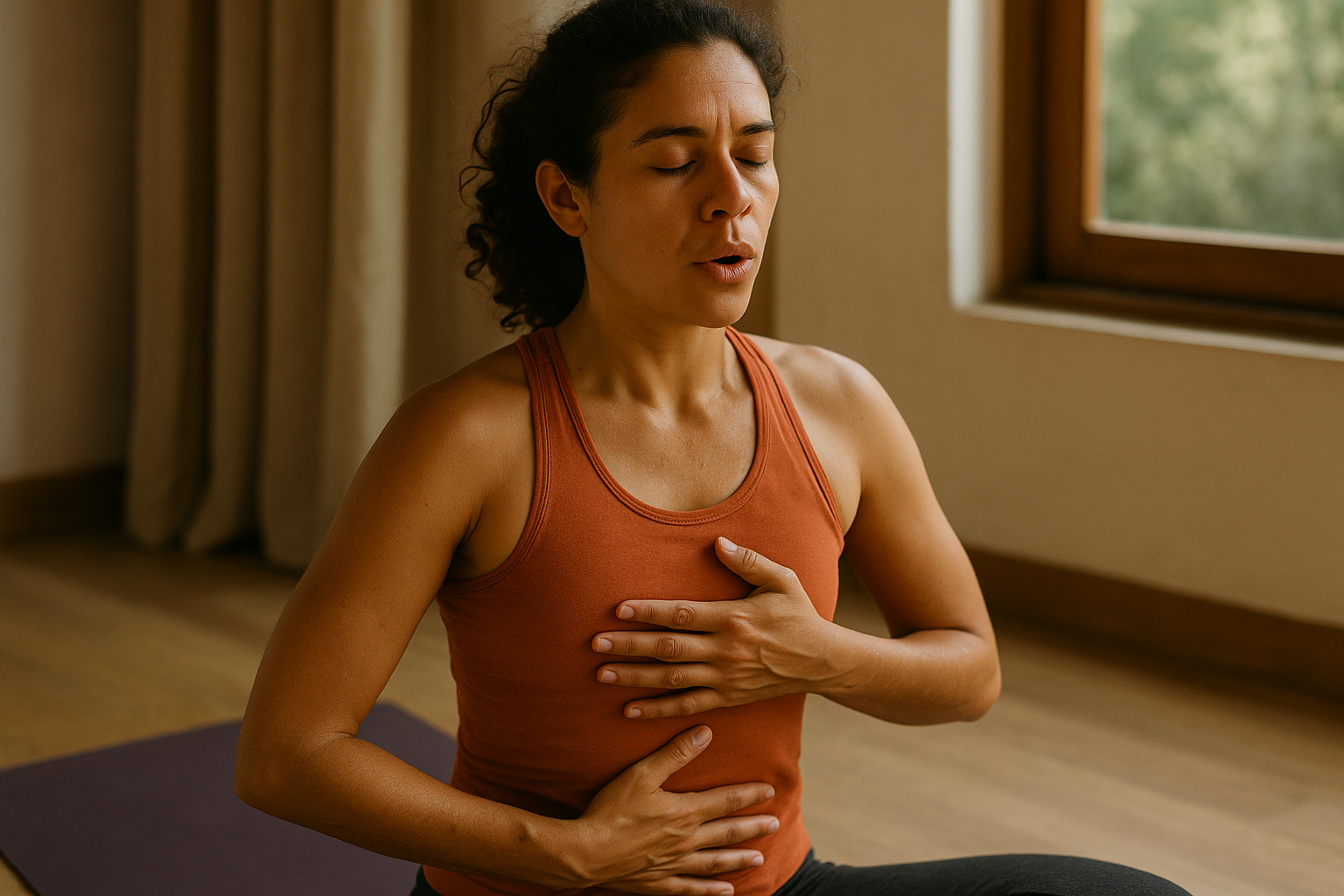
You cannot think your way out of a nervous system response.
That is not a motivational line. That is physiology.
When the overwhelm hits — the meeting that ran over, the child who won't stop, the email that arrived at exactly the wrong moment — your thinking brain is not the one running the show anymore.
Your body took over.
And your body does not respond to logic or willpower or a deep breath you take because someone told you to calm down.
It responds to specific signals.
And you can send those signals in under 60 seconds with quick breathwork for stress.
You just need to know which ones.
Here are five.
All of them take less than a minute.
All of them work through the same mechanism: your breath is the one autonomic function you can consciously override.
Change it, and you change your internal state in real time.
Why Your Nervous System Stops Responding to "Just Breathe"
There is a reason "just take a deep breath" feels useless in the middle of a spiral.
It is not that breathing doesn't work.
It is that most people breathe the wrong way under stress — they inhale more, faster, chest-breathing through the nose or mouth, which actually keeps the sympathetic nervous system engaged.
The signal your body is waiting for is the exhale.
Specifically, a slow, complete exhale — because that is what activates the vagus nerve, which is the express lane to your parasympathetic state. Chronic stress suppresses this system over time, which is why the deeper your exhaustion, the less effective one random deep breath feels.
Quick breathwork for stress is not about inhaling more oxygen.
It is about using the exhale — and the pause that follows it — to send a deliberate physiological signal that the emergency is over.
That signal takes less than 60 seconds to land.
What Is Actually Happening When You Feel Overwhelmed
Before the five techniques, a fast framing so you know what you are actually solving.
Overwhelm is not a scheduling problem.
It is not a character flaw.
It is a nervous system event — your stress hormones have accumulated past the threshold where your body can metabolize them quietly, and now your system is in fight-or-flight whether or not anything dramatic is actually happening.
This is why a spilled drink can send you over the edge. It is not the drink.
It is the accumulated load your nervous system has been carrying all day — and the drink was just the moment it crossed the line.
The techniques below do not address the root cause of that accumulation.
That is a longer conversation.
What they do is interrupt the cascade before it becomes a full physiological event — or bring you back down after one has already started.
Think of them as circuit breakers, not cures.
Why Existing Solutions Miss the Mark
You have probably tried breathing before.
Maybe you downloaded a meditation app and used it twice.
Maybe you have a reminder on your phone that says "breathe" that you dismiss every morning without thinking about it.
Maybe you went on a vacation specifically to recover and came home just as depleted as when you left. The vacation felt like a survival mission rather than recovery.
None of that failed because you failed.
It failed because those solutions are built on the assumption that if you know breathing helps, you will do it in the moment it matters.
But the moment it matters is exactly when you have the least access to your prefrontal cortex — the part of your brain that makes deliberate choices.
What you need are techniques so simple, so short, and so physically specific that your body can execute them when your thinking brain is barely online.
These are those techniques.
The 5 Quick Breathwork Techniques for Stress and Overwhelm
1. The Quick Reset (20–30 seconds)
This is the most versatile tool here.
You can do it in a meeting, in a car, in a bathroom stall, or between two sentences of an argument.
Exhale fully through your mouth — let it all go, no controlled elegance required.
Hold naturally after the exhale. Do not force it. Just let the pause exist.
Inhale slowly through your nose.
Repeat two or three cycles. That is it.
The mouth exhale matters.
It is a stronger signal to your vagus nerve than a nasal exhale.
The hold after the exhale — the natural pause before the next inhale — is where the physiological shift actually happens.
Do not skip it.
This is what Brad used.
Before, he was tense in meetings, managing work anxiety through the day.
After learning this one technique, he relaxed.
He started genuinely enjoying work more.
Not because the work changed.
Because he stopped running the meetings at a physiological threat level.
2. The Extended Exhale (30–60 seconds, 3 cycles)
This one is slightly longer but produces a deeper shift.
Inhale through your nose for four counts, letting your belly expand first, then your ribs, then your chest.
Exhale through your nose for six to eight counts — twice as long as the inhale.
Repeat three times.
The ratio is what matters.
Inhale to exhale at roughly 1:2.
The extended exhale activates the parasympathetic branch of your nervous system more reliably than any other single variable in breathing.
Use this one when you have thirty seconds of privacy — before walking into a high-stakes conversation, before picking up your kids, before getting on a call you are dreading.
3. The OODA Pause (4–10 seconds)
This is the smallest intervention on the list. Four to ten seconds. One breath.
But it requires something: noticing.
You notice the stimulus — the tone of voice, the message notification, the rising heat in your chest.
You take one deliberate inhale-exhale before you respond.
You choose your response from that space.
That single breath is not about calm.
It is about inserting a gap between what happened and what you do next. Most explosive moments happen because that gap collapses — stimulus and reaction blur into one automatic event.
The OODA Pause makes the gap visible again.
It sounds too small to matter.
It is not.
Learning to notice the moment before you react is a skill.
This is how you practice it.
4. The Physiological Sigh (under 10 seconds)
This is the fastest technique here and the most underused.
Inhale fully through your nose.
At the top of the inhale, take one quick, short sniff to top off your lungs completely.
Exhale fully and slowly through your mouth.
One cycle. That is all you need.
The double inhale fully inflates the small air sacs in your lungs that partially collapse under stress, releasing a burst of carbon dioxide on the exhale that directly down-regulates your stress response.
This is something your body does spontaneously during sleep and after crying — your nervous system already knows this move.
You are just doing it deliberately.
Use it the moment you feel the overwhelm starting.
Not after it peaks.
At the first sign.
5. The Box Pause (45–60 seconds)
This one introduces a hold on both ends of the breath — after the inhale and after the exhale — which produces a more grounding effect than techniques that only use the exhale hold.
Inhale through your nose for four counts.
Hold for four counts.
Exhale through your nose for four counts.
Hold for four counts.
Repeat three to four cycles.
The hold after the inhale is what makes this technique different.
It builds your tolerance for discomfort — the ability to sit inside a charged moment without immediately reacting to it. Over time, that tolerance is one of the most practical things you can build.
Use this one when you need to come back to center rather than just stop a reaction.
Good for the tail end of a difficult conversation, or when you need to transition out of work mode and actually arrive at home.
When to Use Which Technique
You do not need all five. You need one or two that you actually use.
If you are mid-conversation or mid-meeting and cannot be obvious about it: The OODA Pause or the Physiological Sigh.
If you have thirty seconds of privacy and something has just thrown you off: The Quick Reset.
If you are transitioning between roles — work to home, meeting to dinner, office to bedtime — and need to actually land in the next moment: The Extended Exhale or the Box Pause.
The goal is not to feel Zen.
The goal is to not react from a state your body chose without your input.
What Quick Breathwork for Stress Actually Builds Over Time
These techniques work immediately. That is real and that matters.
But the more important thing is what happens if you use them consistently.
Stacy came in managing chronic cortisol spikes.
She was looking for a natural solution — something that did not involve medication.
After learning the Quick Reset and the Extended Exhale, the shift was not just that the techniques worked in the moment.
It was that her awareness of her own stress response changed.
She could feel the buildup earlier.
Which meant she could intervene earlier.
Which meant the spikes stopped getting as high.
"Awareness of my stress response changed everything," she said. "I wanted natural tools, not medication."
That is what consistent quick breathwork for stress practice actually produces: not just relief in the moment, but a rebuilt relationship with your own internal state.
You stop being surprised by your reactions.
You stop living in cleanup mode after each explosion.
You start having a second between what happens and what you do about it.
Yvonne noticed it first as physical relaxation — less tension she had been carrying for so long she had stopped noticing it. Then as something harder to name: she started trusting herself more. Resetting your nervous system is not just a stress management strategy.
It is a foundation for being able to trust your own read on your own life again.
Hannah eliminated daily panic attacks.
Not by managing them.
By building a practice that changed the baseline her body returned to between the hard moments.
None of that happened from a one-time technique.
It happened from a technique used daily, repeatedly, until the nervous system started to reorganize around a different default.
The One Thing That Makes These Techniques Actually Work
Repetition before you need them.
Every technique on this list is most effective when your body has already practiced it in a calm state.
When the overwhelm hits and your prefrontal cortex goes offline, your body will execute what it has already learned — not what you are trying to remember in real time.
Practice the Quick Reset on a Tuesday morning when nothing is wrong.
Practice the OODA Pause before a low-stakes conversation.
Run through the Box Pause while you are waiting for something.
The practice is the preparation.
Not the theory, not the intention — the actual physical repetition.
Somatic work functions this way: it is learned in the body, not stored in the mind.
That is what makes it available under pressure.
Ready to Find Out What's Actually Going On With Your Nervous System?
These five techniques are real.
They work.
And they are a starting point, not a complete picture.
If you find yourself needing them multiple times a day — if the overwhelm keeps coming back regardless of how many resets you do — that is a signal.
Not that you are doing it wrong.
That the accumulation underneath is structural, and a 60-second technique can interrupt it but not clear it.
The six-question quiz at the link below takes ninety seconds.
It will tell you where your nervous system is actually operating and what is most worth addressing first.
No pitch, no sales call required.
Just a clearer picture of what you are actually dealing with — so you are solving the right problem.
Frequently Asked Questions
How quickly does quick breathwork for stress actually work?
The physiological shift can happen within 20 to 30 seconds when you use a technique that includes a slow exhale and a natural hold.
You are directly activating your vagus nerve, which is the fastest pathway to your parasympathetic nervous system — and it does not require minutes of meditation to engage.
Can I do these techniques in public without looking strange?
Yes — especially the OODA Pause (one quiet breath before responding) and the Physiological Sigh (one double inhale and a slow exhale).
Neither requires closing your eyes or visible effort.
The Quick Reset is also discreet enough for most settings, particularly if you turn slightly away.
Why do I feel like breathing exercises don't work on me?
Most likely because the technique you tried was inhale-focused, or because you practiced it for the first time in the middle of a high-stress moment when your body had no prior pattern to fall back on. Quick breathwork for stress works best when the body has rehearsed it in calm moments first — so the nervous system can execute it automatically under pressure.
Is there a best time of day to practice these techniques?
Morning is the highest-leverage window because it establishes your physiological baseline before any stress accumulates.
But the transition moments during the day — before a meeting, between work and home, before a difficult conversation — are when these techniques create the most immediate, practical value.
What is the difference between these breathwork techniques and regular deep breathing?
Regular deep breathing usually means inhaling more, which can actually increase physiological arousal if done without a long exhale.
These techniques are specifically designed around exhale length, breath holds, or inhale patterns that send a precise signal to your autonomic nervous system — not just more air, but a specific physiological cue.
Will these techniques fix chronic overwhelm?
They will interrupt it and give you a moment of genuine relief — and that is real and worth having.
But if overwhelm is your daily baseline, not a temporary spike, the techniques are managing a structural problem, not resolving it. That requires looking at what is driving the accumulation, not just addressing the peaks.
Disclaimer
The content in this article — including any breathing protocols, somatic tools, nervous system frameworks, and physiological concepts — is provided for educational and informational purposes only. It is not medical advice and is not intended to diagnose, treat, cure, or prevent any condition.
The Chang Method™, including the SIC Protocol™ and the Neural Reset, are coaching tools developed through lived experience and long-term physiological study. They are designed to support high-functioning women in building physiological resilience — not to replace clinical care.
If you are managing a medical condition, a diagnosed anxiety or mood disorder, or are under the supervision of a licensed healthcare provider, please consult your provider before applying any protocol described here.
Client stories and outcomes shared on this platform reflect individual results. They are real, and they matter. They are not a guarantee that you will experience the same outcome. Your results will depend on your consistency, your starting point, and a range of factors unique to you.
All content on this platform is the intellectual property of Stephanie Chang Ramos / The Chang Method. All rights reserved.