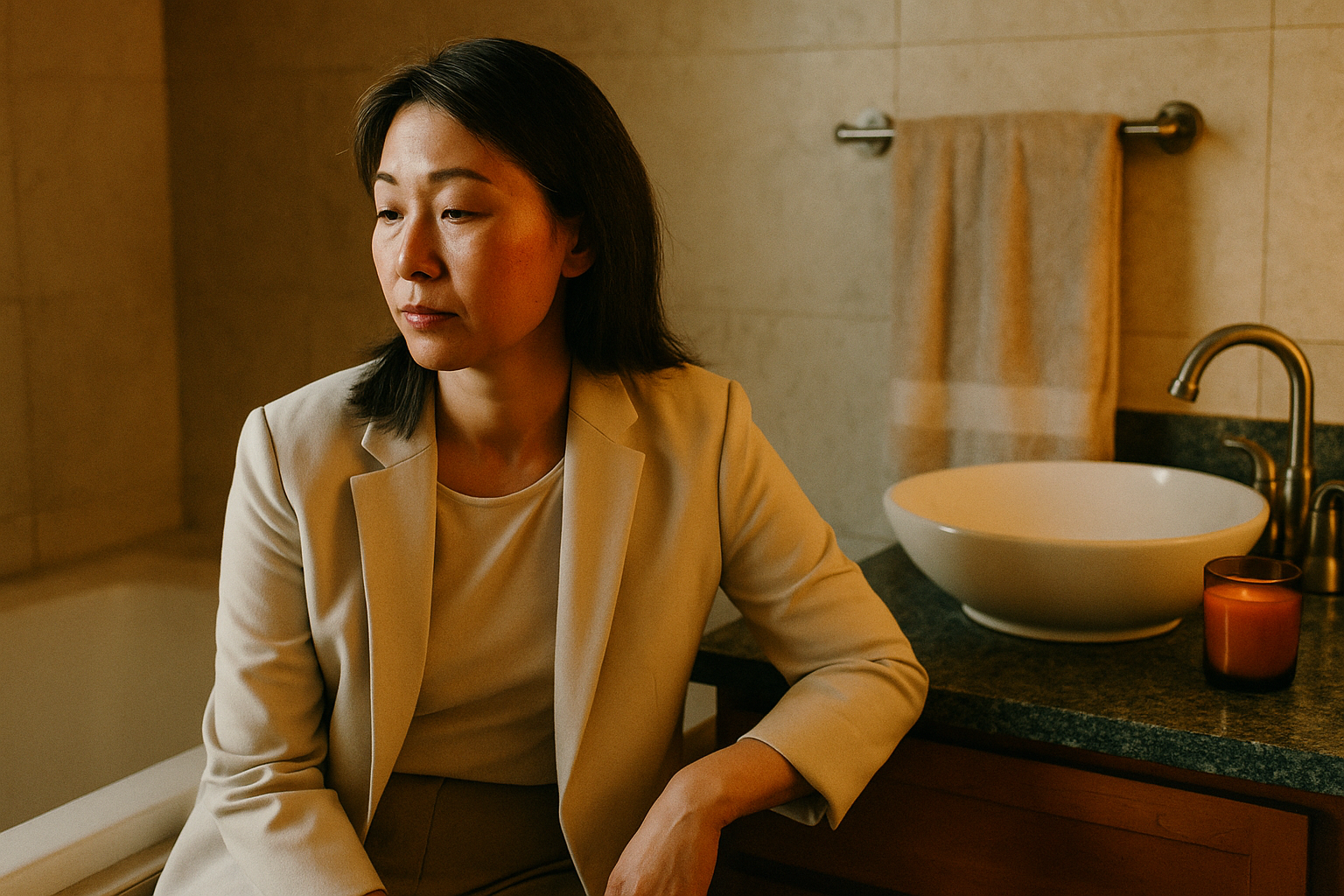
You took the weekend off.
You booked the massage.
You said no to the Sunday email check.
And on Monday morning you woke up just as depleted as before.
If self-care doesn't fix burnout, the wellness industry has been lying to you — and you've been blaming yourself for not doing it right.
You haven't been doing it wrong. The tool is wrong for the problem.
The Gap Between What You're Told and What You Actually Feel
You know what burnout looks like from the outside.
You've read the articles.
You've ticked the boxes: sleep hygiene, boundaries, gratitude journals, evening walks.
And still.
You lie awake at 2am with a mind that won't stop cycling.
You get through school drop-off and the board meeting and dinner and bedtime, and somewhere around 9pm you realize you haven't felt anything real all day.
Not tired. Not energized. Just… processed.
This is the experience that self-care content never talks about.
The high-achieving woman who is technically doing everything right — and still running on fumes.
Because the problem isn't that you haven't rested enough.
The problem is that your nervous system no longer knows how to receive rest.
And a bath doesn't fix that.
Why Does Self-Care Fail Women Who Are Actually Burning Out?
Here's what the wellness industry gets wrong: it treats burnout like a deficit of pleasant inputs.
You're tired — add rest.
You're stressed — add calm activities.
You're disconnected — add presence practices.
But burnout at the level most high-achieving women experience isn't a deficit.
It's a dysregulation.
Your body's stress-response system has been running at high output for so long that it has recalibrated around that output as normal.
Your cortisol patterns have shifted.
Your sleep architecture has changed.
Your nervous system interprets stillness as threat — because stillness means you've stopped moving, and stopping feels dangerous when your entire identity is built on momentum.
When you try to fix that with a spa day, you're putting premium fuel in a car that's been running hot for three years.
The engine doesn't suddenly become fine.
The engine needs a different kind of attention.
This is why physiological solutions to burnout exist as a separate category entirely from self-care.
They're not the same conversation.
What You've Already Tried — And Why It Hasn't Stuck
Let's name it plainly.
You've probably tried therapy.
Maybe it helped you understand why you push yourself so hard.
Maybe it gave language to patterns that had been running unconsciously for decades.
But understanding your burnout hasn't made it better — and if you're honest, you already knew that.
You can articulate the root cause with clinical precision while still snapping at your kids the moment you walk through the door.
You've probably tried the morning routine.
The 5am wake-up, the cold water, the journaling, the intention-setting.
It worked for about eleven days.
Then a late flight, a sick child, a crisis call, and the whole architecture collapsed.
You've probably tried the vacation.
Two weeks off.
You spent the first four days unable to stop checking your phone.
Days five through eight felt almost good.
Then the dread of return set in, and you came back more depleted than when you left.
None of these failed because you lacked discipline or commitment.
They failed because they were all trying to solve a physiological problem with behavioral interventions.
The body doesn't heal through intention. It heals through regulation.
The Real Problem Isn't Your Schedule — It's Your Baseline
Here is the reframe that changes everything:
Burnout isn't something that happened to you last quarter.
It's something your body has been building toward for years — and it has now become your baseline state.
When your nervous system spends long enough in high-alert mode, it stops experiencing that as stress.
It starts experiencing it as home.
Rest doesn't feel restful.
Quiet feels wrong.
Ease feels like a problem waiting to happen.
This is why you wake up already exhausted and anxious every morning — not because the day has started badly, but because your body never fully discharged from yesterday.
Or the day before.
Or the year before that.
Self-care doesn't fix burnout because self-care assumes your body still knows what restoration feels like.
For many high-achieving women, that knowledge has gone offline.
The system doesn't remember how to return to baseline because it hasn't been there in years.
This isn't a mindset problem.
It isn't a prioritization problem.
It is a biological recalibration problem.
And it requires a biological recalibration solution.
What Actually Works: Recalibration, Not Reward
The shift from self-care to recovery is a shift from reward to recalibration.
Self-care says: you've worked hard, here's something nice.
Recalibration says: your system has drifted from its optimal range, here's how we bring it back.
Real recovery for high-achieving women works across three domains — and these mirror the three phases of the SOMA · KINES · VIVENS framework.
SOMA addresses the body's structural state: the nervous system, the hormonal patterns, the sleep architecture.
KINES addresses movement and discharge — the way the body processes and releases stored stress.
VIVENS addresses vitality and identity: the question of what you're recovering toward, not just from.
Most self-care lives entirely in SOMA and never touches KINES or VIVENS.
You rest the body without discharging it. You soothe the surface without addressing what's stored underneath.
You can read more about how these three phases work together — because understanding the framework is the first step toward using it correctly.
But the practical shift starts with a single question: am I trying to add something pleasant, or am I trying to change my physiological baseline?
If the answer is the former, you're doing self-care.
If the answer is the latter, you're doing recovery.
Practical Differences That Matter in Real Life
This isn't abstract. Here's what it looks like in practice.
Self-care says: take a bath to relax before bed.
Recovery says: your cortisol peaks at 10pm because your nervous system is running an inverted rhythm — let's address that pattern directly with breath sequencing and light exposure shifts.
Self-care says: say no to more things so you have space.
Recovery says: your capacity to say no is itself a stress response — let's work on the underlying nervous system regulation so that boundaries don't feel like confrontations.
Self-care says: journal your feelings.
Recovery says: your body is holding a year's worth of unprocessed activation — let's create a somatic discharge practice that actually moves that energy through.
The difference isn't effort.
High-achieving women are not short on effort.
The difference is precision.
You've been applying general wellness to a specific physiological problem.
It's like using a general painkiller for a structural injury — it takes the edge off but does not fix what's broken.
What Women Say Once They Stop Relying on Self-Care Alone
The women who move through this work describe a consistent shift.
Not a sudden surge of energy.
Not a dramatic transformation.
Something quieter and more durable than that.
They describe waking up and feeling like the night actually happened — like sleep did something.
They describe a moment in the middle of a hard conversation where they notice they're still regulated.
They describe, sometimes with a kind of wondering embarrassment, that they laughed at something and it felt real.
Not performed.
Real.
One woman — a finance director, two children, twelve years at the top of her field — described it this way: "I kept waiting for self-care to work.
I kept thinking I just needed more of it. More rest, more quiet, more space.
It wasn't until I stopped trying to add things and started actually working on my baseline that anything shifted.
It felt less like wellness and more like maintenance.
Like finally fixing the foundation instead of just redecorating."
That's the distinction. Self-care redecorates. Recovery rebuilds.
And for women who have been running on a compromised foundation for years, decoration was never going to be enough.
Where to Begin When Self-Care Has Already Failed You
If you've read this and recognized yourself — if self-care doesn't fix burnout for you and you've known it for a while — the next step is not another wellness intervention.
The next step is an honest assessment of where your system actually is.
Not how tired you feel today.
Not whether last week was harder than usual.
But: what is the actual baseline your nervous system has established?
What is your resting state — not your ideal state, but the one your body defaults to at 7pm on a Tuesday when nothing particular has happened?
That baseline is the thing that needs to change.
And it can change.
That's not optimism — it's physiology.
Nervous systems are plastic.
They recalibrate.
They can learn a new normal.
But they need the right inputs. Not more pleasant ones. Different ones.
You've Tried Resting. Now Try Recovering.
The Sovereign Executive System is built for exactly this: the woman who has already done the self-care work and knows it isn't enough.
It starts with a $7 system map — a diagnostic framework that shows you where your depletion is actually rooted and what phase of recovery your body needs right now.
Not a quiz.
Not a generic report.
A structured map of the SOMA, KINES, and VIVENS domains applied to where you are today.
If you're ready to stop decorating and start rebuilding, start with the system map.
It's the most honest $7 you'll spend on your health this year.
Frequently Asked Questions
Why does self-care feel good in the moment but never actually fixes burnout long-term?
Self-care addresses the surface — it adds pleasant inputs to a depleted system.
But if your nervous system has recalibrated around chronic stress, it can no longer fully receive those inputs.
The problem isn't the quality of the self-care; it's that the underlying physiological baseline hasn't changed.
How is burnout recovery different from just resting more?
Rest assumes your body knows how to restore itself — burnout means it often doesn't.
Recovery is a directed process of recalibrating your nervous system, hormonal rhythms, and stress-response patterns.
It requires specific inputs, not just the absence of demands.
Is burnout really a physiological problem or a mindset problem?
It's both — but the physiological component almost always needs to be addressed first.
You can develop extraordinary insight into your patterns in therapy while your cortisol rhythm, sleep architecture, and nervous system activation remain dysregulated.
The body has to be brought back into range before the mindset work can fully land.
Can high-achieving women recover from burnout without stepping back from their careers?
Yes — and for most high-achieving women, that's the only realistic option.
The goal isn't to reduce your ambition; it's to build a physiological foundation robust enough to sustain it. Self-care doesn't fix burnout at this level, but targeted recovery work can happen alongside a demanding career when it's approached systematically.
How long does real burnout recovery take?
It depends on how long the dysregulation has been building and which systems are most affected.
Most women begin noticing real shifts — in sleep quality, emotional regulation, and baseline energy — within six to twelve weeks of targeted work.
Full recalibration typically takes longer, but the early changes are often dramatic compared to years of self-care attempts.
Where do I start if I've already tried everything and nothing has worked?
Start with an honest assessment of your current physiological baseline — not how you feel on good days, but what your body defaults to. From there, identifying which of the three recovery domains (nervous system, movement and discharge, or vitality and identity) is most depleted gives you a clear starting point rather than another general wellness plan.
Disclaimer
The content in this article — including any breathing protocols, somatic tools, nervous system frameworks, and physiological concepts — is provided for educational and informational purposes only.
It is not medical advice and is not intended to diagnose, treat, cure, or prevent any condition.
The Sovereign Executive methodology, including the SIC Protocol™, the Neural Reset, and the Snap Point framework, are coaching tools developed through lived experience and long-term physiological study.
They are designed to support high-functioning women in building physiological resilience — not to replace clinical care.
If you are managing a medical condition, a diagnosed anxiety or mood disorder, or are under the supervision of a licensed healthcare provider, please consult your provider before applying any protocol described here.
Client stories and outcomes shared on this platform reflect individual results.
They are real, and they matter.
They are not a guarantee that you will experience the same outcome.
Your results will depend on your consistency, your starting point, and a range of factors unique to you.
All content on this platform is the intellectual property of Stephanie Chang Ramos / The Sovereign Executive.
All rights reserved.
Disclaimer
The content in this article — including any breathing protocols, somatic tools, nervous system frameworks, and physiological concepts — is provided for educational and informational purposes only. It is not medical advice and is not intended to diagnose, treat, cure, or prevent any condition.
The Chang Method™, including the SIC Protocol™ and the Neural Reset, are coaching tools developed through lived experience and long-term physiological study. They are designed to support high-functioning women in building physiological resilience — not to replace clinical care.
If you are managing a medical condition, a diagnosed anxiety or mood disorder, or are under the supervision of a licensed healthcare provider, please consult your provider before applying any protocol described here.
Client stories and outcomes shared on this platform reflect individual results. They are real, and they matter. They are not a guarantee that you will experience the same outcome. Your results will depend on your consistency, your starting point, and a range of factors unique to you.
All content on this platform is the intellectual property of Stephanie Chang Ramos / The Chang Method. All rights reserved.