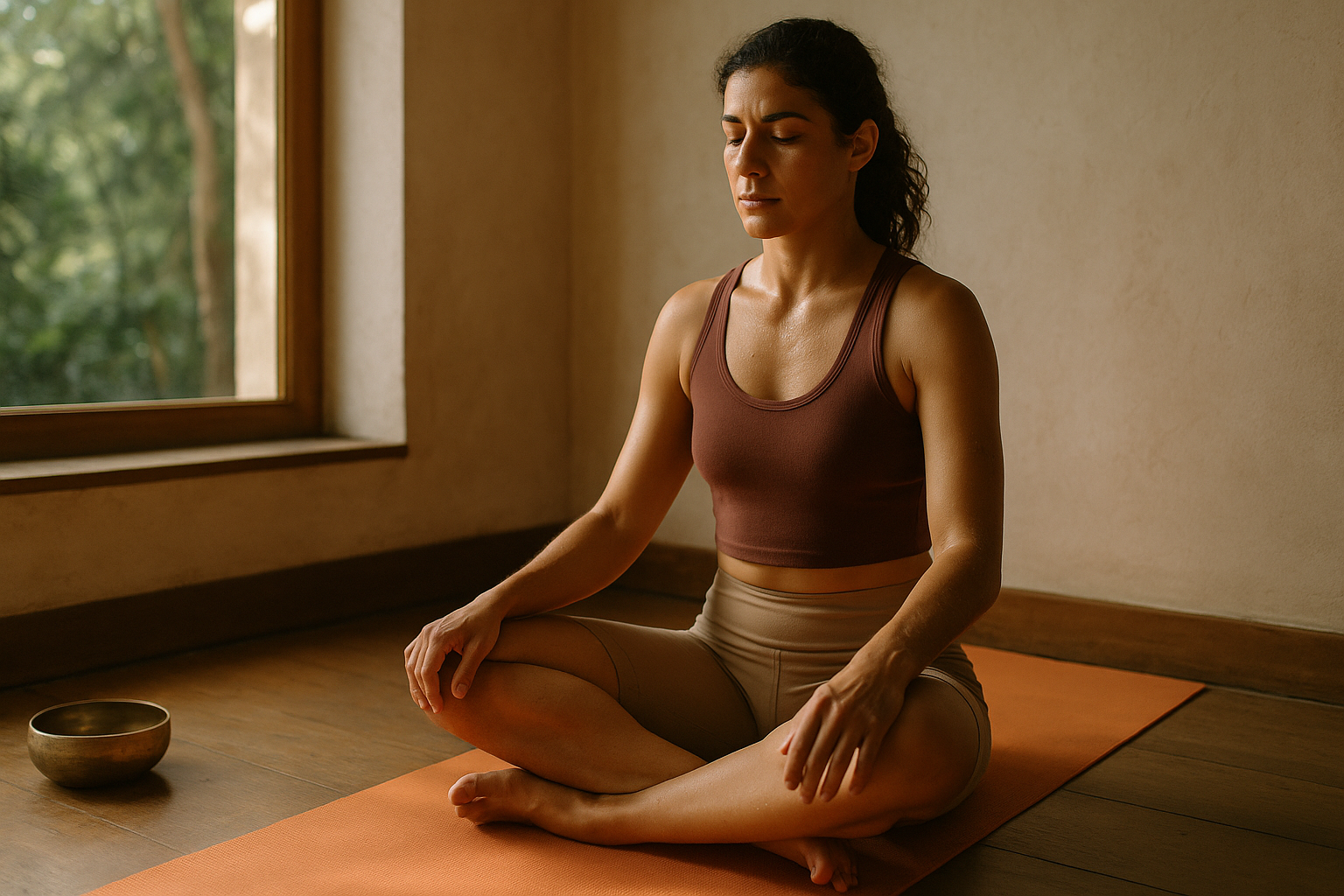
You have tried the yoga class.
You have done the stretching routine before bed.
You have rolled out your mat on Sunday mornings and called it recovery.
And you still wake up Monday feeling like you never stopped.
That is not a discipline problem. That is a targeting problem.
Not every movement practice reaches the part of you that is actually exhausted.
Your muscles are not the issue.
Your nervous system is. And until the movement you are doing speaks directly to that system, you will keep stretching a body that is still running a silent emergency underneath the surface.
Somatic movement burnout recovery works differently from yoga or stretching — not because it is more intense, but because it targets a completely different layer.
This article breaks down exactly what each practice does, what each one misses, and how to know which one your body actually needs right now.
Why Your Body Feels Like It Belongs to Someone Else
There is a specific kind of exhaustion that does not respond to rest.
You sleep eight hours and wake up heavy.
You take a vacation and spend the first four days unable to actually land in it. You sit down to do nothing and your chest is still tight, your jaw still clenched, your mind still running the performance review at 2 AM.
This is what structural exhaustion looks like from the inside.
It is not caused by too many tasks on your list.
It is caused by a nervous system that has been running at high alert for so long that high alert has become its resting state.
When that happens, the body stops feeling like yours.
You are present in body, quietly disappearing in spirit.
You go through the motions of a yoga class or a stretch sequence, and none of it touches the thing that is actually wrong.
Because the thing that is actually wrong is not in your hamstrings.
What Stretching Actually Does (and What It Doesn't)
Stretching is not a recovery tool. It is a maintenance tool.
When you stretch, you are lengthening muscle tissue, improving range of motion, and reducing the mechanical tension that builds up from sitting, moving, or training.
All of that is real and worth doing.
But stretching has no direct pathway to your autonomic nervous system.
It does not signal safety to the part of your brain that decides whether the emergency is still on. It does not discharge accumulated stress hormones.
It does not move you out of a sympathetic state and into a parasympathetic one in any reliable, measurable way.
A woman who is white-knuckling through every day through sheer force of will can stretch for thirty minutes and walk away just as keyed up as when she started — now just slightly more flexible.
Stretching is fine.
It is just not what you need when your nervous system has reorganized itself around the assumption that the emergency is permanent.
What Yoga Does (and Where It Falls Short for Burnout Recovery)
Yoga is closer to the target. Significantly closer.
A well-sequenced yoga class — particularly one that includes breathwork, slow transitions, and time in parasympathetic-activating postures — can genuinely shift your nervous system state.
The combination of breath, movement, and intentional attention is real medicine for a dysregulated body.
So why do so many women leave a yoga class feeling temporarily better and then find the exhaustion has returned by Tuesday morning?
Two reasons.
First, most yoga classes are not sequenced for nervous system recovery.
They are sequenced for physical challenge, flexibility, or spiritual experience.
The breathwork is often an afterthought — three minutes at the start and five minutes of savasana at the end.
That is not enough intervention for a nervous system running a silent emergency.
Second, yoga is largely externally directed.
A teacher cues you, you follow.
Your body moves through the postures but your internal experience — the actual signals your body is sending you — is often not part of the practice.
You learn to perform the shape.
You do not necessarily learn to read what is happening underneath it.
For a woman who is already a master at performing competence while something breaks down inside, yoga can inadvertently reinforce the exact pattern she is trying to escape.
She executes the class flawlessly. She just never arrives in her body to do it.
What Is Somatic Movement — and Why Does It Hit Differently?
Somatic movement is not a single practice.
It is a category of movement that prioritizes internal sensation over external form.
The word somatic comes from the Greek soma — body.
Somatic movement practices ask you to pay attention to what your body is actually doing and actually feeling, rather than what shape it is making from the outside.
This distinction matters more than it sounds.
When you do somatic movement, you are not trying to achieve a posture.
You are tracking sensation — where there is tension, where there is ease, what shifts when you change your breath, what your body wants to do if you stop directing it and start listening to it.
That internal tracking is precisely what activates the nervous system's capacity for self-regulation.
It is the difference between going through the motions and actually inhabiting the movement.
Somatic movement burnout recovery works because it targets the layer that is actually dysregulated: the autonomic nervous system, the stress-response architecture, the body's ability to read and respond to its own signals before they become a crisis.
It does not ask you to perform recovery. It asks you to experience it.
What Does Somatic Movement Actually Look Like in Practice?
This is where people get confused.
Somatic movement does not always look dramatic or rigorous.
It is not always a specific named modality.
It can look like slow, exploratory movement through a joint — not forcing range, just noticing where resistance lives and breathing into it rather than pushing through it.
It can look like shaking — literally allowing the body to vibrate and discharge held tension the way animals do after a stress response.
Undignified and remarkably effective.
It can look like floor work that has no fixed sequence — moving toward what feels right in this moment, not what the pose is supposed to look like.
It can look like breathwork done in the body rather than as a mental exercise — feeling the breath expand the ribs laterally, noticing where the belly doesn't want to release, staying curious about that resistance rather than forcing through it.
And it can look like pole training, or CrossFit, or a dance class — if the person doing it is tracking internal sensation rather than external performance.
The form matters less than the orientation.
The practice that rebuilds a dysregulated nervous system is the one that keeps asking: what do I actually feel right now?
Does This Mean You Should Drop Yoga and Stop Stretching?
No. That is not the point.
Stretching has value for tissue health and injury prevention. Keep it.
Yoga — practiced with real breathwork integration and internal attention — can absolutely be part of somatic recovery.
The problem is not yoga.
The problem is yoga as performance, yoga as another thing to execute correctly, yoga as the wellness equivalent of crossing something off the list.
The question is not which practice you are doing.
The question is whether the practice you are doing is teaching your nervous system something new — or just keeping the machine running.
If you leave your movement practice feeling like you performed it rather than inhabited it, it is not doing the recovery work you need.
See also: Somatic Burnout Recovery: What It Is, Why It Works, and How to Start — a fuller breakdown of the somatic framework and why it reaches the root cause when other approaches don't.
The Nervous System Is the Missing Variable in Every Failed Recovery Attempt
Here is what most movement-as-recovery advice gets wrong.
It treats the body as a mechanical system — tight muscles, low energy, poor sleep — and prescribes mechanical solutions: stretch the muscles, raise the heart rate, improve the sleep hygiene.
But structural exhaustion is not a mechanical problem.
It is a regulatory problem.
The nervous system has lost its ability to shift between states — between activation and recovery, between alert and ease, between the boardroom and the dinner table.
No amount of stretching teaches the nervous system how to do that.
No yoga class that does not address breathwork and internal sensation teaches the nervous system how to do that.
Somatic movement burnout recovery works because it directly trains the regulatory capacity — the ability to notice what state you are in, shift toward ease deliberately, and return to that shift repeatedly until it becomes the new baseline.
That is not a metaphor.
That is what the research on vagal tone, autonomic flexibility, and interoception actually shows.
If you want to go deeper on the physiology: Chronic Stress and Your Vagus Nerve: How Burnout Breaks Your Body's Built-In Calm Switch lays out exactly how this breaks down and what rebuilds it.
What Clients Actually Experience When Movement Becomes Somatic
Stacy came in managing chronic cortisol spikes and looking for a natural solution — not medication, not another productivity system.
What shifted things was not a new workout routine.
It was awareness of the stress response itself, paired with breath-based tools that she could apply in real time.
She describes it directly: "Awareness of my stress response changed everything.
I wanted natural tools, not medication."
That is what somatic work produces.
Not a calmer exercise class.
A different relationship with your own internal state — one where you can read what is happening before it escalates, and intervene before the snap point arrives.
Hannah came in with daily panic attacks, low confidence, and an inability to set limits at work or in her relationships.
The nervous system regulation work — including breathwork and somatic-based practice — gave her the physiological ground to stand on. She describes the result as "an empowering process.
I am listening to myself more.
I know what I truly want and do not want."
Neither of them needed a more advanced stretching routine.
They needed movement that spoke to the layer that was actually broken.
For more on what the physiological rebuild actually looks like after years of overperforming: How to Rebuild Physiological Resilience After Years of Overperforming.
How to Know Which Practice You Need Right Now
Here is a practical frame.
If you feel physically tight but mentally calm, stretching is appropriate.
Address the tissue.
You are fine.
If you feel physically fine but mentally cluttered, a well-sequenced yoga practice with real breathwork integration will help.
Address the breath-body connection.
Give it time.
If you feel like you cannot remember a single present moment this week — if rest does not restore you, if you wake up already behind, if your evenings feel like survival rather than arrival — you are dealing with structural exhaustion.
That requires somatic movement burnout recovery work.
The goal is not to calm down during class.
The goal is to rebuild your nervous system's capacity to regulate itself across the whole day.
That is a different target. It needs a different tool.
Where to Start If You Have Been Sedentary
The most common barrier is this: women in structural exhaustion have often stopped moving entirely.
Not because they are lazy — because their body has been sending signals that there is nothing left to give, and they have been overriding those signals for months.
Starting back does not require a big commitment.
It requires a low-threshold entry — something the body can say yes to without it feeling like another demand on an already depleted system.
That is the entire logic behind Move First: a 28-day on-demand program built for the woman who has been sedentary and needs to come back into her body without it feeling like a performance.
Two movement sessions.
Two breathwork sessions.
A sound healing bonus.
One 30-minute call at the end to make sure the practice holds.
Not a transformation program.
A first step that is actually sized right for where you are.
Not sure where you are in this?
The six-question quiz at quiz.schangramos.com takes ninety seconds and gives you a clear read on what your nervous system actually needs right now — whether that is somatic movement, breathwork, something else, or all three.
Take it before you sign up for another yoga class you will have to white-knuckle your way through.
Frequently Asked Questions
What exactly is somatic movement, in plain language?
Somatic movement is any movement practice where your primary focus is on internal sensation — what your body actually feels — rather than the external shape or performance of the exercise.
It trains your nervous system to read and respond to its own signals, which is the core skill missing in burnout recovery.
Can somatic movement burnout recovery work alongside yoga?
Yes, absolutely.
Somatic movement burnout recovery is not in competition with yoga — it is an orientation you can bring into many practices, including yoga.
The key is whether your yoga practice includes genuine breathwork integration and asks you to track internal sensation, not just execute postures correctly.
How long does it take to feel a difference with somatic movement?
Some people notice a shift in autonomic state — feeling genuinely calmer, not just temporarily distracted — within a single session.
Structural change in how the nervous system regulates across the whole day typically takes consistent practice over several weeks.
The short interventions (like a breath-based reset before a meeting) can work in under thirty seconds once the skill is trained.
Is stretching useless for burnout recovery?
Not useless — just not sufficient on its own.
Stretching addresses tissue tension and range of motion, which are real and worth maintaining.
What it does not do is directly train autonomic regulation.
If structural exhaustion is the problem, stretching alone will not touch the root cause.
What if I'm too exhausted to start a movement practice at all?
That is exactly the state somatic movement is designed for.
It does not require intensity or duration — it requires attention.
A five-minute floor practice with breathwork can be a legitimate starting point.
The goal is to give your nervous system a signal of safety, and that does not need to be strenuous to work.
How does breathwork fit into somatic movement burnout recovery?
Breathwork is the fastest direct lever into the autonomic nervous system — the one function you can consciously control to shift your internal state in real time.
In somatic movement burnout recovery, breath is not a warm-up or a cool-down.
It is woven into the movement itself, because the combination of physical sensation and conscious breath is what trains the nervous system to regulate, not just respond.
Disclaimer
The content in this article — including any breathing protocols, somatic tools, nervous system frameworks, and physiological concepts — is provided for educational and informational purposes only. It is not medical advice and is not intended to diagnose, treat, cure, or prevent any condition.
The Chang Method™, including the SIC Protocol™ and the Neural Reset, are coaching tools developed through lived experience and long-term physiological study. They are designed to support high-functioning women in building physiological resilience — not to replace clinical care.
If you are managing a medical condition, a diagnosed anxiety or mood disorder, or are under the supervision of a licensed healthcare provider, please consult your provider before applying any protocol described here.
Client stories and outcomes shared on this platform reflect individual results. They are real, and they matter. They are not a guarantee that you will experience the same outcome. Your results will depend on your consistency, your starting point, and a range of factors unique to you.
All content on this platform is the intellectual property of Stephanie Chang Ramos / The Chang Method. All rights reserved.