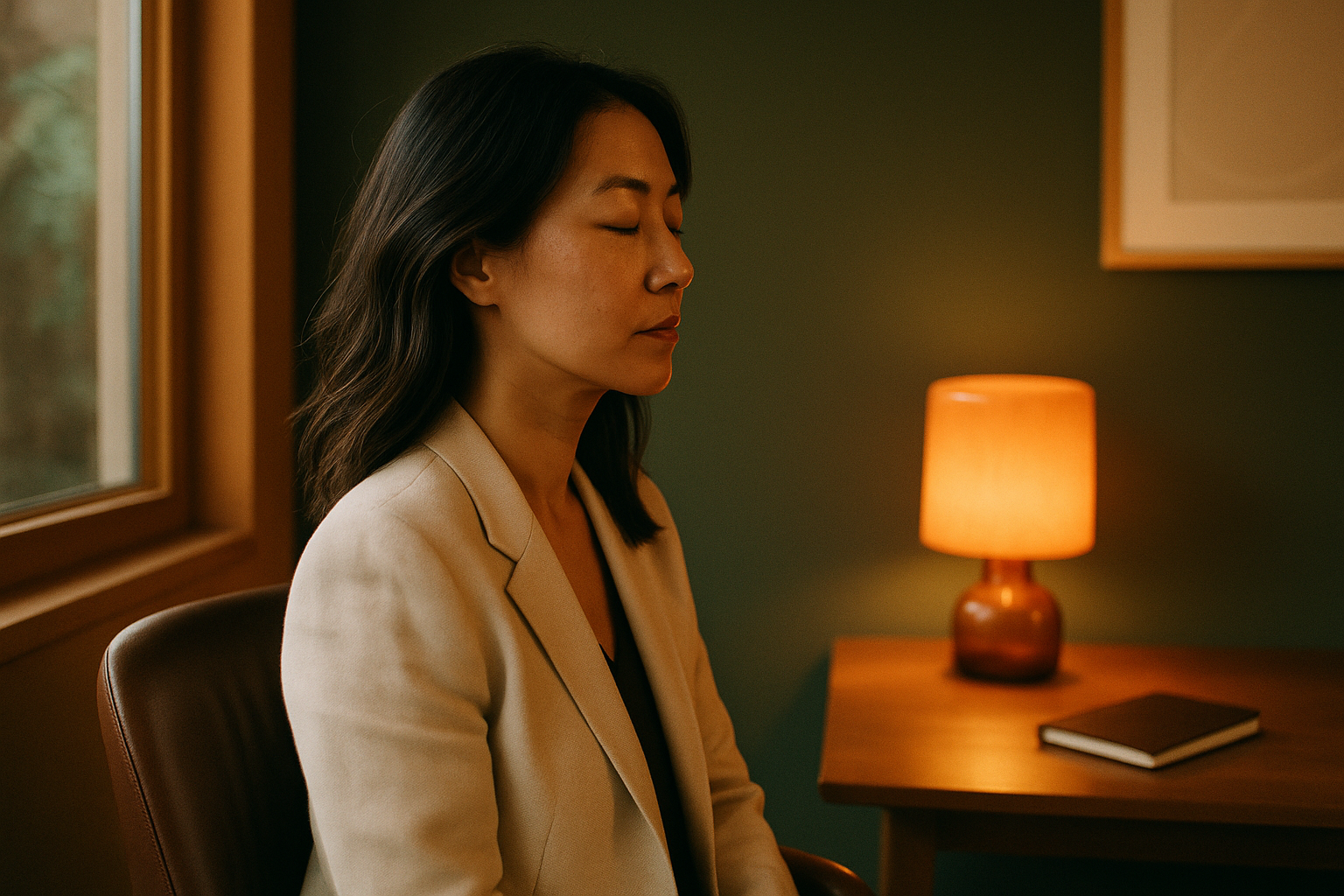
Something quietly shifted in 2025 — and by 2026, it had become undeniable.
High-achieving women stopped asking how do I get more done and started asking a harder, more honest question: why do I feel so dead inside? Spark reclamation — the deliberate act of recovering aliveness, not just output — has become one of the defining movements among executive women this year.
And it is not a trend.
It is a correction.
The Productivity Trap That Stole a Generation of Energy
For the better part of two decades, high-achieving women were handed a deal.
Perform.
Optimize.
Produce.
Be the last one standing at the end of every hard season.
The deal promised that if you worked hard enough, long enough, smart enough — the reward would arrive.
It didn't.
What arrived instead was a specific kind of exhaustion that sleep cannot fix.
A flatness behind the eyes.
A growing inability to feel genuinely excited about anything — not even the things you fought hard to build.
You hit milestones and felt nothing.
You cleared inboxes and felt hollow.
You celebrated promotions from a place that felt oddly distant from joy.
This is not burnout in the clinical sense, though burnout is real and present.
This is something older and quieter.
It is the slow erosion of the spark — the animating life force that made you you, before you became so efficient at being everything to everyone.
If this lands somewhere in your chest, you are not alone.
And you are not broken.
You are simply overdue for a reckoning with what productivity actually cost you.
What Does It Actually Feel Like to Lose Your Spark?
It doesn't announce itself loudly.
There's no single morning where you wake up and think: today I lost my vitality.
It happens in accumulation.
In the small surrenders that seemed reasonable at the time.
You stop reading for pleasure because there's no time.
You cancel the dinner with the friend who actually sees you because your schedule is unmanageable.
You sit in a meeting where two years ago you would have been the most energized person in the room — and you feel nothing but mild impatience to get it over with.
You used to feel alive. Now you are performing aliveness from memory.
The cruel irony is that from the outside, everything looks fine.
You are still delivering.
Still leading.
Still present at the school play, still sharp in the board meeting, still making it all work.
But you know. Something essential has gone quiet.
That quiet is the cost of prioritizing productivity over vitality for too long.
And in 2026, a growing number of women are refusing to keep paying it.
Why Every Fix You've Tried Has Only Managed the Symptoms
You have not been passive about this. That is worth naming.
You downloaded the sleep apps.
You started the morning routine.
You tried the supplements, the cold plunges, the meditation retreats, the therapy sessions, the digital detoxes.
Some of it helped — temporarily.
Some of it added yet another item to the performance checklist and quietly made things worse.
The problem with most wellness interventions is that they treat vitality as a resource to be topped up rather than a state to be restored from the inside out.
A green smoothie does not resolve a nervous system that has been running in threat-response mode for three years.
A better calendar app does not address the fact that every hour of your day is allocated to someone else's needs, and nothing is allocated to the regeneration of you.
And the productivity optimization frameworks — the ones that promised to give you back time — mostly just created higher expectations of what you could produce in the hours they freed up.
You didn't get rest. You got a more efficient extraction of your energy.
The fixes failed because they were solving the wrong problem.
They were asking: how do we get more from this person? Not: how do we give this person back to herself?
The Real Problem: You've Been Optimizing a Depleted Engine
Here is the reframe that changes everything.
Vitality is not a byproduct of productivity.
Productivity is a byproduct of vitality.
When you are genuinely alive — curious, embodied, rested at a cellular level, connected to what actually matters to you — your output is not just higher.
It is qualitatively different.
It carries authority.
It carries originality.
It carries the unmistakable energy of someone who is fully present.
But we have been running the equation backwards for decades.
We have been treating human energy as an input to be maximized rather than a living system to be honored.
The result is a generation of extraordinarily capable women operating at a fraction of their actual power — not because they lack discipline or drive, but because the engine underneath all that drive has been systematically neglected.
Waking up already exhausted before the day begins is not a scheduling problem.
It is a signal from a system that has been asked to give without being restored.
Spark reclamation — the real movement behind vitality over productivity in 2026 — starts with accepting that signal as information, not weakness.
What Spark Reclamation Vitality Over Productivity Actually Looks Like in Practice
This is not a call to slow down, check out, or abandon ambition.
The women leading this shift are not retreating. They are recalibrating.
They are making a different set of non-negotiables.
Not fewer commitments — different ones.
Commitments to the conditions under which they are actually capable of their best work and their deepest presence.
What does that look like concretely?
It looks like protecting early mornings not for email, but for the kind of slow, undemanded time that lets the nervous system genuinely reset.
Not a productivity stack.
A stillness stack.
The difference is felt within two weeks.
It looks like creating a real transition ritual between work and home — not a five-minute breath in the car park, but a genuine physiological decompression that tells your body the threat of the day is over.
It looks like choosing movement that actually feels good in the body rather than movement that punishes it into compliance.
It looks like honest accounting of what is draining you — not just the obvious things, but the chronic low-level obligations you have agreed to out of guilt, habit, or the fear of disappointing someone who would survive your boundary just fine.
And beneath all of it, it looks like recovering the physical substrate of aliveness: a regulated nervous system, a body that feels safe to inhabit, a relationship with your own interior experience that is not mediated entirely by what you have to produce next.
The Framework: SOMA · KINES · VIVENS
The most effective approach to spark reclamation works in three phases, each addressing a different layer of depletion.
The first is SOMA — the body as the foundation.
Before anything else changes, the nervous system must shift out of chronic sympathetic activation.
This is not a metaphor.
It is a biological prerequisite for vitality.
When the body is running in low-grade threat response, the spark cannot return — because the system is allocating all available resources to survival, not aliveness.
The second is KINES — restoring the relationship between movement, sensation, and energy.
Not exercise as punishment or performance.
Movement as information.
Learning to read the body's signals accurately so you stop overriding them and start working with them.
The third is VIVENS — the restoration of meaning, identity, and genuine desire.
This is where women discover that the spark they thought they had lost was never gone.
It was buried under years of performing, delivering, and deferring the parts of themselves that didn't fit the role.
You can read more about how this framework works in practice in the full breakdown of the SOMA · KINES · VIVENS recovery framework.
The key insight is that these phases are sequential for a reason.
You cannot reclaim the spark by starting at meaning.
You have to start in the body.
Vitality is not a mindset shift.
It is a physiological event that mindset can then support — not the other way around.
What Women Are Reporting When They Make This Shift
The change is not dramatic in the way wellness marketing tends to promise.
It is quieter and more permanent than that.
Women who commit to spark reclamation over productivity optimization report a specific cluster of shifts.
Their sleep becomes genuinely restorative rather than just unconscious.
Their patience with their children becomes real rather than effortful.
They begin to notice — often with some surprise — that their work is actually getting better, not worse, despite the fact that they are doing less of it at the edges.
They report a return of curiosity.
The ability to be interested in something for no productive reason.
The capacity to feel joy that isn't earned and doesn't need justifying.
And they describe a specific quality of presence — a sense of being in their life rather than managing it from a slight remove.
That is the spark.
Not excitement.
Not peak performance.
Not productivity metrics.
Just the quiet, unmistakable sense of being alive and present in your own existence.
This is what spark reclamation — prioritizing vitality over productivity in 2026 — is actually about.
Not doing less.
Being more.
You Don't Have to Earn Your Aliveness
The deepest lie that high-achieving culture tells women is that vitality is a reward for performance.
Rest when you've earned it. Enjoy it when you've delivered.
Feel alive when you've justified it.
That lie keeps the engine running. And it keeps burning the person inside it.
In 2026, the most grounded, effective, and genuinely powerful women in leadership are not the ones who optimized hardest.
They are the ones who stopped outsourcing their energy to the next deadline and started protecting it as the source of everything — their leadership, their presence, their relationships, their capacity to do the work that actually matters.
The spark was never lost.
It was waiting for you to stop running long enough to find it.
Ready to Reclaim Yours?
If this resonates — if you recognize the flatness this article describes and you are done managing it with another app or optimization hack — there is a structured path forward.
The SOMA · KINES · VIVENS program was built specifically for high-achieving women who are done performing wellness and ready to actually recover it. It works at the level of the nervous system first, the body second, and identity third — in the sequence that actually creates lasting change.
This is not another productivity framework dressed up in wellness language.
It is a genuine recalibration of the system that makes everything else possible.
If you are ready to stop managing depletion and start restoring vitality, begin with a complimentary Discovery Call. We will identify exactly where your spark went, and map the most direct path to getting it back.
Frequently Asked Questions
What exactly is spark reclamation, and how is it different from burnout recovery?
Spark reclamation is the active process of restoring genuine aliveness — curiosity, embodied energy, and presence — not just managing the absence of exhaustion.
Burnout recovery typically focuses on reducing stress and restoring function, but spark reclamation goes further: it aims to return you to a state of vitality that may have been absent for years, not just weeks.
The distinction matters because the interventions are different.
Why is spark reclamation vitality over productivity becoming such a focus in 2026 specifically?
A critical mass of high-achieving women has now had long enough to test the productivity-first model to its logical conclusion — and the results are in. The promise that performance would eventually deliver wellbeing has not held.
In 2026, spark reclamation vitality over productivity reflects a generation-wide recalibration: the recognition that vitality is the foundation of performance, not its reward.
How long does it realistically take to feel a difference when prioritizing vitality?
Most women begin to notice a shift in nervous system regulation — better sleep quality, less reactive mornings, a slight easing of background anxiety — within two to four weeks of consistent practice.
The deeper restoration of identity and genuine desire, the later phases of the SOMA · KINES · VIVENS framework, typically becomes clear over three to six months.
Is this approach suitable for women who are still in demanding careers and cannot step back?
Yes — and in fact, it was designed for exactly that context.
This is not about reducing ambition or stepping back from leadership.
It is about restoring the internal conditions that make sustained, high-quality leadership possible without self-destruction.
The practices integrate into real life rather than requiring a life overhaul.
Can I reclaim my spark without a formal program — just by making lifestyle changes?
Lifestyle changes create the conditions for restoration, but without addressing the underlying nervous system dysregulation, most changes remain surface-level and temporary.
Many women find that they know exactly what they should be doing — and still cannot make it stick, because the physiological state driving their behavior has not shifted.
Structured support accelerates and deepens what lifestyle changes alone often cannot sustain.
What is the first practical step toward prioritizing vitality over productivity?
The most effective first step is an honest audit of where your energy is actually going — not your time, your energy — and identifying the two or three chronic drains that are not delivering proportionate value.
Alongside that, beginning a simple daily practice of physiological decompression, even ten minutes of deliberate stillness with no input, creates an immediate signal to the nervous system that the emergency is not permanent.
From there, the path becomes clearer.
Disclaimer
The content in this article — including any breathing protocols, somatic tools, nervous system frameworks, and physiological concepts — is provided for educational and informational purposes only.
It is not medical advice and is not intended to diagnose, treat, cure, or prevent any condition.
The Sovereign Executive methodology, including the SIC Protocol™, the Neural Reset, and the Snap Point framework, are coaching tools developed through lived experience and long-term physiological study.
They are designed to support high-functioning women in building physiological resilience — not to replace clinical care.
If you are managing a medical condition, a diagnosed anxiety or mood disorder, or are under the supervision of a licensed healthcare provider, please consult your provider before applying any protocol described here.
Client stories and outcomes shared on this platform reflect individual results.
They are real, and they matter.
They are not a guarantee that you will experience the same outcome.
Your results will depend on your consistency, your starting point, and a range of factors unique to you.
All content on this platform is the intellectual property of Stephanie Chang Ramos / The Sovereign Executive.
All rights reserved.
Disclaimer
The content in this article — including any breathing protocols, somatic tools, nervous system frameworks, and physiological concepts — is provided for educational and informational purposes only. It is not medical advice and is not intended to diagnose, treat, cure, or prevent any condition.
The Chang Method™, including the SIC Protocol™ and the Neural Reset, are coaching tools developed through lived experience and long-term physiological study. They are designed to support high-functioning women in building physiological resilience — not to replace clinical care.
If you are managing a medical condition, a diagnosed anxiety or mood disorder, or are under the supervision of a licensed healthcare provider, please consult your provider before applying any protocol described here.
Client stories and outcomes shared on this platform reflect individual results. They are real, and they matter. They are not a guarantee that you will experience the same outcome. Your results will depend on your consistency, your starting point, and a range of factors unique to you.
All content on this platform is the intellectual property of Stephanie Chang Ramos / The Chang Method. All rights reserved.