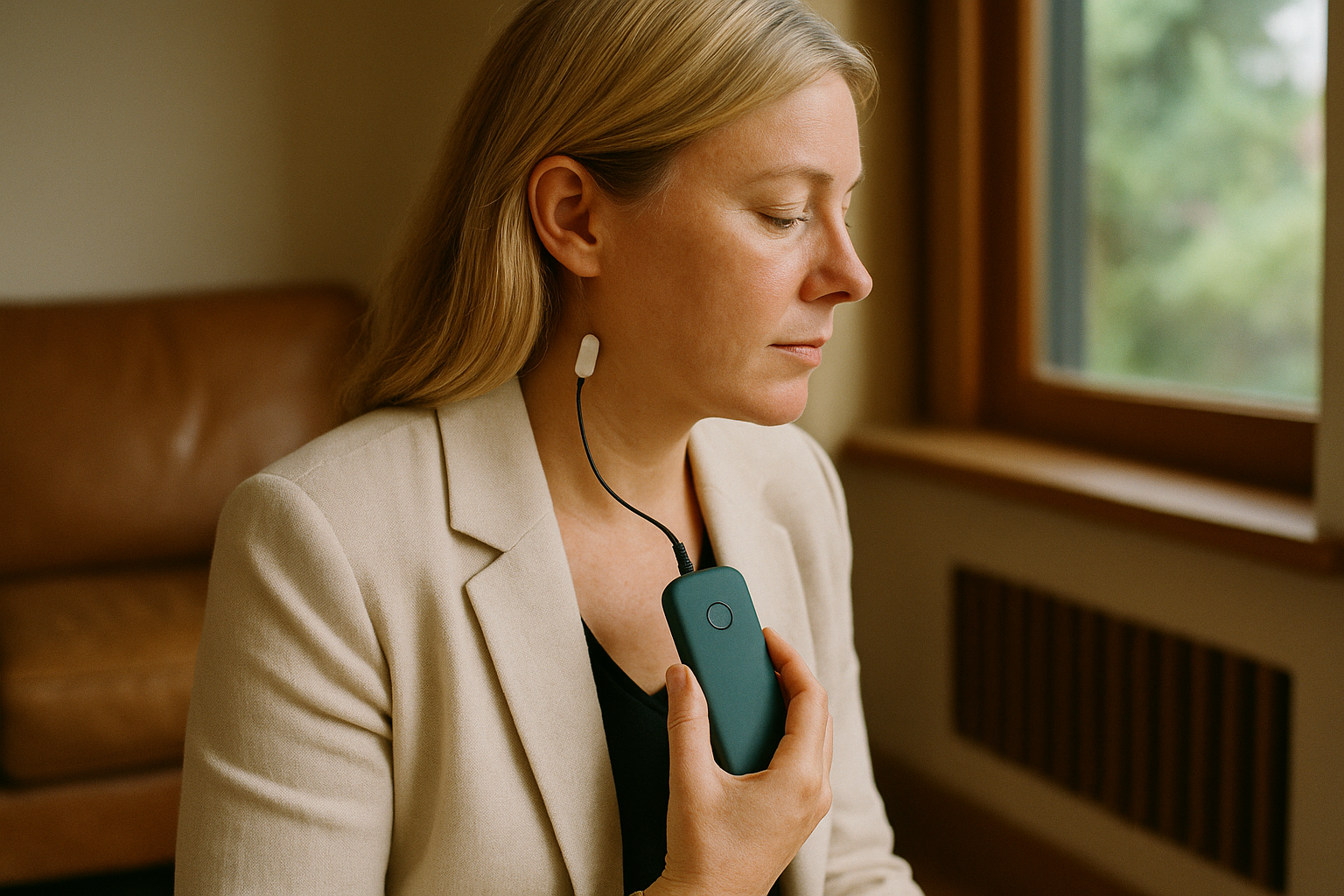
There is a device sitting in someone's bathroom drawer right now.
Cost her $300.
She used it for eleven days.
Then she went back to sleeping four hours, answering emails at midnight, and waking up at 3am with her heart already racing.
She wasn't doing it wrong.
The device just wasn't the problem it was solving.
Vagus nerve stimulation for burnout has become the wellness world's favourite answer to a question nobody is asking correctly.
The question isn't how do I activate my vagus nerve. The question is why is my nervous system stuck in threat mode, and what would actually move it out? Those are very different problems.
They require very different answers.
Why Burnout Isn't Just a Stress Problem
Most people arrive at vagus nerve practices because they've already tried the obvious things.
They've reduced their workload — or tried to. They've taken the holiday.
They've downloaded the meditation app.
They've done the therapy.
And none of it has fully resolved the thing they can feel in their body: a low hum of threat that never quite turns off.
That hum is not psychological. It's physiological.
Burnout at its core is a nervous system that has been running in high-alert mode for so long it has stopped recognising safety as real.
The threat response — the surge of cortisol, the shallow breathing, the tight jaw, the hypervigilance — has become the default state.
Not the exception.
The permanent setting.
The vagus nerve is the longest nerve in your body.
It runs from your brainstem down through your heart, lungs, and gut.
It is the primary channel through which your brain receives signals from your body — and through which it sends signals back.
When it's functioning well, it acts as a brake on your stress response.
It pulls you back from activation.
It restores baseline.
In chronic burnout, that brake is worn.
Not broken — worn.
And stimulating it can help.
But stimulating it while the underlying conditions remain unchanged is like pressing the brake on a car that's still accelerating.
You need to understand both: the brake, and what's driving the speed.
What Does Vagus Nerve Stimulation for Burnout Actually Mean?
The term covers a wide range of interventions — from FDA-cleared clinical devices to breathing exercises you can do in your car.
That range matters, because the mechanisms are genuinely different.
Clinical and electrical devices
Transcutaneous auricular vagus nerve stimulation (taVNS) — devices that apply a mild electrical current to the outer ear — has shown real promise in clinical research.
These aren't the consumer wellness gadgets you'll find on Instagram.
The research-grade versions are used in studies on depression, inflammation, epilepsy, and autonomic nervous system dysfunction.
Consumer devices inspired by this research — including several that have gained significant traction in high-performance wellness circles — vary enormously in whether they replicate the stimulation parameters that produce measurable results.
Most don't.
The frequency, waveform, and electrode placement in the studies that showed benefit are specific.
A device that approximates these factors loosely may produce a mild relaxation response.
It is unlikely to produce clinically meaningful vagal tone improvement in someone with chronic burnout.
That doesn't mean they're useless.
A brief parasympathetic nudge can still interrupt a stress cycle in the moment.
But as a recovery intervention for burnout — as a way to actually rebuild a depleted nervous system — electrical devices used casually are not sufficient.
Breathwork
This is where the evidence is strongest, most consistent, and most accessible.
Slow, diaphragmatic breathing — particularly with an extended exhale — directly stimulates the vagus nerve via the baroreflex.
When you slow your breathing to around five to six breaths per minute and make the exhale longer than the inhale, you increase heart rate variability (HRV), which is the clearest measurable marker of vagal tone.
This isn't metaphor.
This is mechanism.
The exhale activates your parasympathetic system.
The inhale activates your sympathetic.
When exhale dominates, the brake engages.
The catch is consistency.
A single session of slow breathing moves the needle in that moment.
Sustained practice — daily, over weeks and months — is what begins to rebuild baseline vagal tone.
That's different from using a breathing exercise when you're already dysregulated and hoping to feel better in five minutes.
Read more about how this works in practice: Breathwork for Cortisol Regulation: How It Works and Why It Matters.
Cold exposure
Cold water on the face, cold showers, or brief cold immersion activates the dive reflex — a strong parasympathetic response mediated by the vagus nerve.
This is one of the most immediate ways to interrupt a heightened threat state.
For someone in burnout, cold exposure done correctly can produce a meaningful moment of nervous system reset.
But the key phrase is done correctly. Jumping into a cold plunge when your system is already dysregulated and treating the adrenaline rush as recovery is a mistake many high-performers make.
The goal is not another activation spike.
The goal is the recovery window that follows.
Humming, chanting, and singing
The vagus nerve innervates the muscles of the larynx and pharynx.
Vocalisation — particularly sustained humming or toning — creates vibration in the tissues through which the vagus nerve runs.
This produces a genuine, if mild, stimulatory effect.
It also requires a level of present-moment engagement that itself interrupts the rumination loop.
Two mechanisms for the price of one.
This sounds strange to most of the executives who eventually find it useful.
That's fine.
It works anyway.
Social engagement
According to polyvagal theory, the ventral vagal system — the most evolved branch of the vagus nerve — is activated specifically through co-regulation with other safe humans.
Eye contact, prosodic speech, facial expression, physical proximity to someone you trust.
This is worth sitting with.
Because many burned-out executives have unconsciously withdrawn from exactly the connections that would help regulate them.
The isolation feels like self-protection.
Physiologically, it's compounding the problem.
What to Skip (And Why the Wellness Industry Gets This Wrong)
The market for vagus nerve products has exploded.
You will find vibrating pillows, tuning forks, essential oil blends, earbuds, TENS devices, and supplement stacks all claiming to stimulate or "tone" your vagus nerve.
Most of them are capturing a real concept and attaching it to an ineffective product.
The real concept is correct: vagal tone is a trainable physiological quality.
A nervous system that has lost its capacity to recover can rebuild that capacity over time with the right inputs.
But a tuning fork held near your ear is not a meaningful input.
A supplement that "supports vagal tone" is marketing language, not physiology.
An earpiece that vibrates gently while you sleep may produce a relaxation response — but if you're waking up at 3am because your cortisol curve is dysregulated, the root problem remains untouched.
The harder truth is that the nervous system does not recover from gadgets.
It recovers from sustained, repeated experiences of safety — in the body, in relationship, and in the conditions of daily life.
That takes longer than eleven days.
It also works.
If you've already tried the gadgets and are still exhausted, this article is worth reading.
The Real Problem: Why Stimulation Without a Container Doesn't Hold
Here is the reframe that changes everything for most of the women who arrive in this work.
Vagus nerve stimulation is not a treatment.
It is a signal.
What your nervous system does with that signal depends entirely on its baseline capacity — its ability to receive the signal, integrate it, and shift state in response.
In a nervous system with good baseline regulation, a single slow breathing session can produce a meaningful shift that holds for hours.
In a chronically dysregulated nervous system, the same session produces a brief softening and then snaps back to baseline.
Not because the practice failed.
Because the container isn't built yet.
Building that container is the actual work.
It involves understanding your personal threat patterns — the specific conditions, relationships, and internal states that activate your stress response most reliably.
It involves gradually increasing your window of tolerance, which is your nervous system's capacity to move through activation without becoming overwhelmed or collapsing.
And it involves building the somatic awareness to notice what's happening in your body in real time, so you can intervene earlier in the cycle — before dysregulation becomes entrenched.
This is what somatic introspection capacity training actually develops — and why it produces lasting changes where vagus nerve gadgets don't.
What a Systematic Approach Actually Looks Like
The executives who see durable recovery from burnout don't pick one intervention and repeat it. They build a physiology of recovery — a set of conditions and practices that consistently move their nervous system toward regulation, over time, across contexts.
That looks like this:
Daily breathwork as a non-negotiable baseline. Not a long practice.
Five minutes of slow, exhale-extended breathing in the morning before anything activating.
This is the foundation.
It creates a consistent daily signal to the nervous system that safe states are accessible.
Real social engagement, not performed connection. At least one interaction per day with someone who genuinely feels safe — where the mask can come off and the nervous system actually co-regulates, rather than continuing to perform.
Cold exposure used strategically. As a reset tool in high-activation moments, not as another performance metric.
Thirty seconds of cold water on the face before a difficult conversation.
A two-minute cold shower at the end of a dysregulating day.
HRV monitoring used wisely. Not to optimise.
To observe.
Your HRV score tells you where your nervous system is today.
It is data, not a verdict.
Used well, it helps you make smarter decisions about when to push and when to pull back — which is itself a form of nervous system training.
Structured decompression at the end of the workday. The transition from work to home — or from work to evening — is one of the most important nervous system moments in a burned-out executive's day.
Most people skip it entirely.
A brief physical or somatic practice at that transition point can interrupt the carryover of threat state into the home environment.
More on that transition specifically: The 15-Minute Decompression Ritual After Work.
None of these is a device.
All of them work.
The difference is time horizon.
These practices don't produce a dramatic immediate shift.
They produce a slow, cumulative rebuilding of the nervous system's baseline — which is precisely what burnout eroded.
A Note on What Recovery Actually Feels Like
Women who are beginning to genuinely recover from burnout often describe a moment they didn't expect: the first time they felt quiet without waiting for something to go wrong.
Not relaxed.
Not happy.
Just — neutral.
Safe.
Present, without the background hum of threat.
That moment doesn't come from a device.
It comes from a nervous system that has been given, repeatedly and consistently, evidence that it doesn't need to stay on guard.
Vagus nerve stimulation for burnout — done correctly, in the right sequence, within a real recovery framework — is one of the tools that helps create that evidence.
But it is a tool.
The recovery is yours to build.
Ready to Build the Container, Not Just Stimulate the Nerve?
If you've been trying individual practices and still feel stuck, it's usually not the practices that are the problem.
It's the absence of a system — a real framework for rebuilding nervous system capacity from the ground up, built around the specific patterns your physiology has developed over years of high-performance stress.
That's what the Sovereign Executive Method is designed to do. Not wellness.
Not therapy.
A structured physiological and somatic recovery process for high-functioning women who have already tried everything else.
If you want to understand whether this work is right for where you are now, start with What Is the Sovereign Executive Method — and Who Is It For.
Or if you're ready to explore working directly, the Integration Lab and Private Advisory are the two places this work happens — and that article will help you understand which one fits your situation.
Frequently Asked Questions
Does vagus nerve stimulation for burnout actually work?
Vagus nerve stimulation for burnout can be a meaningful part of recovery — but only within a broader framework that addresses why the nervous system became dysregulated in the first place.
Used in isolation, most stimulation techniques produce temporary relief rather than lasting change.
The practices with the strongest evidence base are breathwork, cold exposure, and consistent social co-regulation.
How long does it take to see results from vagus nerve practices?
Single sessions can produce an immediate, brief shift in how you feel.
Meaningful, lasting improvements in vagal tone — measurable via HRV — typically take six to twelve weeks of consistent daily practice.
The nervous system rebuilds slowly, which is why consistency matters far more than intensity.
Are consumer vagus nerve stimulation devices worth buying?
Most consumer devices do not replicate the stimulation parameters used in clinical research, so their physiological impact is limited.
They may produce a mild relaxation response, which has some value, but they are unlikely to produce the deeper nervous system recalibration that burnout recovery requires.
Think of them as a nudge, not a solution.
What is the single most effective vagus nerve practice for burnout?
The evidence most consistently points to slow, diaphragmatic breathing with an extended exhale — sometimes called resonance frequency breathing or coherence breathing.
Done daily at around five to six breaths per minute, it directly increases HRV and activates the parasympathetic brake.
It requires no equipment, costs nothing, and works.
Why do I feel calm during a vagus nerve practice but dysregulated again within an hour?
This is the most common experience in the early stages of nervous system recovery, and it reflects a low window of tolerance — the nervous system's capacity to hold a regulated state.
Vagus nerve stimulation for burnout works best when it's part of a systematic approach to gradually widening that window, not just a spot intervention when things feel bad.
Can burnout damage the vagus nerve permanently?
Chronic stress and burnout reduce vagal tone — the functional responsiveness of the vagus nerve — but this is not permanent damage.
It is a reversible pattern of dysregulation.
With consistent, appropriate inputs over time, vagal tone can be rebuilt.
Recovery is real.
It just takes longer than most people are told.
Disclaimer
The content in this article — including any breathing protocols, somatic tools, nervous system frameworks, and physiological concepts — is provided for educational and informational purposes only.
It is not medical advice and is not intended to diagnose, treat, cure, or prevent any condition.
The Sovereign Executive methodology, including the SIC Protocol™, the Neural Reset, and the Snap Point framework, are coaching tools developed through lived experience and long-term physiological study.
They are designed to support high-functioning women in building physiological resilience — not to replace clinical care.
If you are managing a medical condition, a diagnosed anxiety or mood disorder, or are under the supervision of a licensed healthcare provider, please consult your provider before applying any protocol described here.
Client stories and outcomes shared on this platform reflect individual results.
They are real, and they matter.
They are not a guarantee that you will experience the same outcome.
Your results will depend on your consistency, your starting point, and a range of factors unique to you.
All content on this platform is the intellectual property of Stephanie Chang Ramos / The Sovereign Executive.
All rights reserved.
Disclaimer
The content in this article — including any breathing protocols, somatic tools, nervous system frameworks, and physiological concepts — is provided for educational and informational purposes only. It is not medical advice and is not intended to diagnose, treat, cure, or prevent any condition.
The Chang Method™, including the SIC Protocol™ and the Neural Reset, are coaching tools developed through lived experience and long-term physiological study. They are designed to support high-functioning women in building physiological resilience — not to replace clinical care.
If you are managing a medical condition, a diagnosed anxiety or mood disorder, or are under the supervision of a licensed healthcare provider, please consult your provider before applying any protocol described here.
Client stories and outcomes shared on this platform reflect individual results. They are real, and they matter. They are not a guarantee that you will experience the same outcome. Your results will depend on your consistency, your starting point, and a range of factors unique to you.
All content on this platform is the intellectual property of Stephanie Chang Ramos / The Chang Method. All rights reserved.