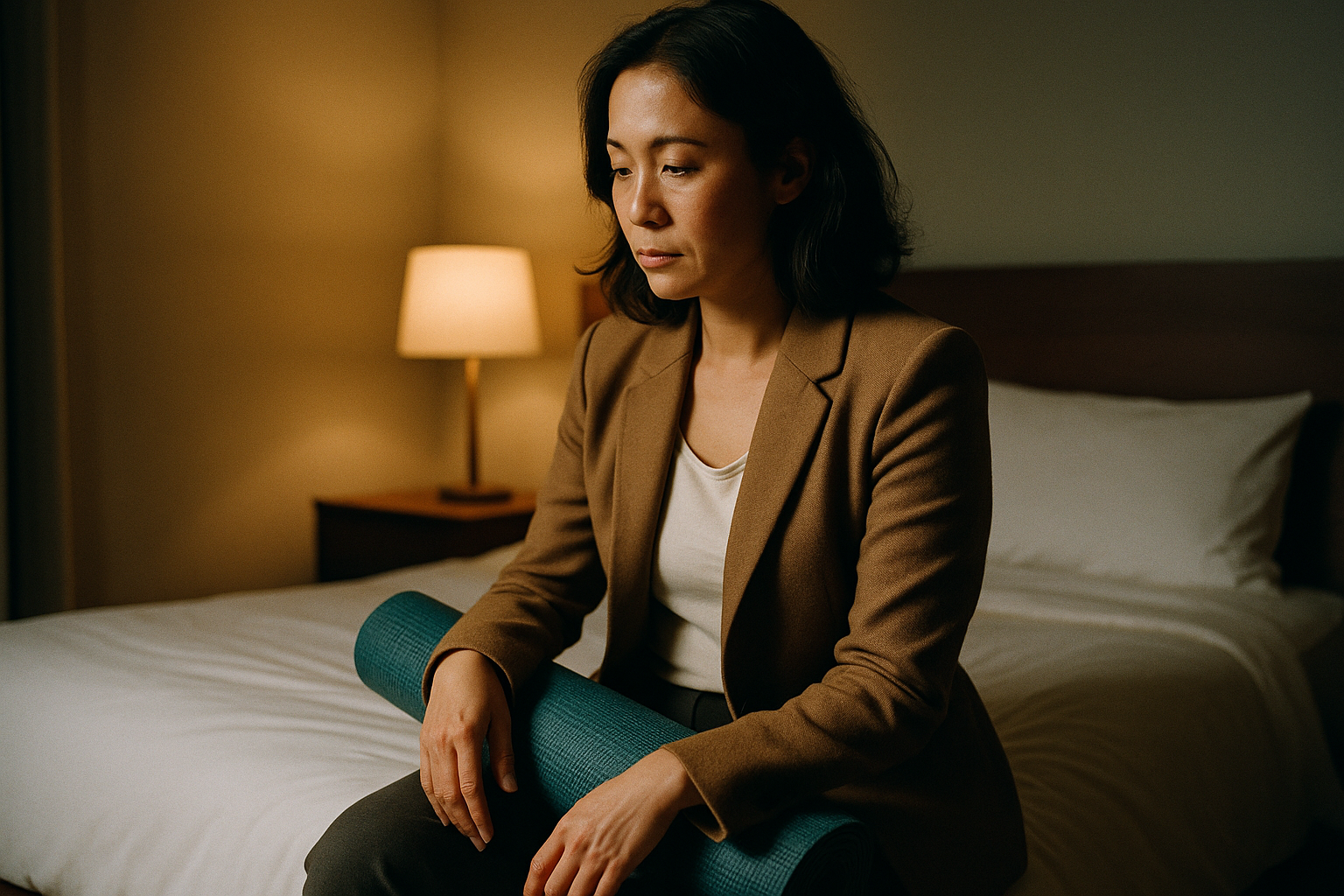
You do everything right.
Dim the lights at 9pm.
Roll out the mat.
Forty minutes of yin, a few minutes of breath work, maybe some legs-up-the-wall.
And yet — you wake at 3am with your mind running.
You hit the alarm exhausted.
Your sleep tracker says you got almost no deep sleep.
Again.
There is a real chance your bedtime yoga routine is the problem.
Not because yoga is bad.
Because of when it activates your nervous system — and what happens in the hour after that matters more than what happens on the mat.
This is not a case against yoga.
This is a case for understanding the biology behind bedtime yoga deep sleep nervous system timing — and why doing the right thing at the wrong moment can quietly sabotage the recovery you are working so hard to get.
The Problem: You Are Wired and Tired at the Same Time
Most high-performing women I work with share a specific pattern.
They are exhausted by 7pm.
But they cannot sleep until midnight.
And when they do sleep, it is light, fragmented, unsatisfying.
The medical term is hyperarousal.
The lived experience is: your body is done, but your nervous system has not got the memo.
After years of operating in high-stakes environments — board rooms, complex decisions, constant context-switching — your nervous system has been trained to stay alert.
It has learned that switching off is a liability.
It has essentially forgotten how.
This is not a discipline problem.
It is not a magnesium deficiency.
It is a nervous system regulation problem, and it lives in the body — not in your bedtime schedule.
If you want to understand the full picture of why this happens, this article on why exhaustion persists even after doing everything right explains the underlying mechanism in detail.
Why Your Evening Yoga Practice May Be Making Things Worse
Here is what most yoga teachers — and most sleep articles — do not tell you.
Yoga is not inherently calming.
It is a physical practice that involves attention, effort, body awareness, and in many styles, mild physical exertion.
Even gentle yoga requires your nervous system to stay online.
Tracking sensations.
Holding positions.
Following cues.
For a nervous system that is already running hot from a ten-hour workday, that sustained attention — even quiet, meditative attention — can act as stimulation rather than wind-down.
There is also the issue of cortisol.
Physical activity, even mild, causes a small cortisol release.
For most people in a well-regulated state, this is not a problem.
But for executives and leaders operating in a state of chronic physiological stress, cortisol clearance is already impaired.
A small bump at 9pm can delay sleep onset by 60 to 90 minutes and compress the slow-wave deep sleep that should dominate the first half of your night.
Research published in the journal Sleep Medicine Reviews is clear: core body temperature and cortisol must fall for deep sleep to initiate.
Anything that delays that fall — including light exercise, intense breath work, and sustained mental focus — pushes deep sleep later.
And later often means less.
There is also a subtler issue.
Many popular bedtime yoga sequences include pranayama techniques — kapalabhati, breath of fire, extended holds — that are physiologically activating.
They raise heart rate variability in the short term, but they also stimulate the sympathetic branch of the nervous system before the parasympathetic can take over.
For a dysregulated nervous system, this is like stepping on the accelerator before engaging the brake.
The Failed Solutions You Have Already Tried
You have probably tried adjusting the style.
Switched from vinyasa to yin.
Moved from yin to restorative.
Maybe you added a yoga nidra track at the end.
Maybe you downloaded a new app.
Maybe you bought a better mat and moved to the bedroom instead of the living room.
Some of it helped a little. None of it fixed the problem.
That is because these are all surface-level interventions.
They tweak the tool without addressing the state the tool is being applied to.
The question is not which style of yoga you are doing.
The question is: what state is your nervous system in when you begin — and what does it need at that point in the evening to actually move toward deep sleep?
These are completely different questions.
And they require a different framework to answer.
The Reframe: It Is Not the Practice — It Is the State You Bring to the Practice
Your nervous system operates in distinct modes.
Simplified: sympathetic activation (mobilised, alert, ready to act) and parasympathetic activation (safe, still, able to digest and restore).
Deep sleep — and specifically slow-wave sleep, which is where physical restoration, memory consolidation, and growth hormone release happen — requires a full shift into parasympathetic dominance.
Your heart rate drops.
Your core temperature drops.
Your cortisol drops.
Your body stops scanning for threat.
For most executives, that shift does not happen automatically at 10pm just because the workday is technically over.
The nervous system takes time — sometimes hours — to downregulate after sustained high-stakes engagement.
When you step onto your yoga mat at 9pm in a sympathetically dominant state, your yoga practice does not automatically produce parasympathetic activation.
It meets you where you are.
And where you are is still partially mobilised.
The reframe is this: your evening routine needs to start with state change, not with movement.
Yoga can be part of that.
But only if your nervous system has already begun to descend — and only if the specific techniques you choose support descent rather than sustained engagement.
This is what getting your nervous system out of survival mode actually looks like in practice.
It is not about finding the right pose.
It is about creating the right physiological conditions before the pose.
What the Science Actually Says About Nervous System Timing and Sleep
Here is the framework that matters.
Your body has a sleep pressure system (adenosine buildup) and a circadian timing system (light-driven cortisol and melatonin cycles).
Deep sleep quality depends on both.
But there is a third variable most sleep advice ignores: autonomic nervous system state at sleep onset.
Studies using heart rate variability as a proxy for autonomic state consistently show that individuals with lower pre-sleep HRV — meaning more sympathetic dominance — spend less time in slow-wave sleep and report lower subjective sleep quality, regardless of total sleep duration.
In plain language: you can be in bed for eight hours and still get almost no restorative deep sleep if your nervous system never fully downregulated before you closed your eyes.
This is the mechanism behind what clients describe as waking up more tired than when they went to bed.
The hours were there.
The depth was not.
The practical implications are specific.
First, the timing of any physical or attentional practice in the evening matters.
The research suggests a minimum 90-minute buffer between any mild physical activation and sleep onset — longer for individuals with chronic sympathetic bias.
Second, the sequence matters more than the practice itself.
If movement comes before a genuine physiological wind-down, it can extend the downregulation window rather than shorten it. Movement should be early in the evening, not last.
Third, the breath techniques used in the final 30 minutes before bed should be specifically chosen for parasympathetic activation — not general breath awareness, not energising pranayama, but extended exhale techniques with slow rhythm and low effort.
For a deeper dive on this, breathwork for cortisol regulation explains exactly how specific breathing patterns affect your stress hormone timing — and which ones to use when.
A Practical Evening Protocol That Works With Your Nervous System
This is not about removing yoga from your life.
It is about placing it correctly.
6:30 – 7:30pm: Movement window. If you want to practise yoga, do it here.
Gentle flow, yin, restorative — all fine.
Let your body move.
Let the day metabolise physically.
But finish before the final 90-minute window before your target sleep time.
7:30 – 8:30pm: Transition zone. This is where most people skip straight to a screen or more activity.
Instead: lower the lights aggressively.
Eat your last meal early and lightly.
Avoid effortful conversation or decision-making.
Let the nervous system begin its natural descent.
This is the phase where your body temperature and cortisol need permission to drop.
8:30 – 9:30pm: Parasympathetic anchoring. This is your final 60 minutes before sleep onset.
Not yoga.
Not breath of fire.
Not a podcast that requires concentration.
Instead: extended exhale breathing (4 counts in, 8 counts out), body scan done lying still, or a simple progressive muscle relaxation sequence.
No screens.
Warm, dim light only.
The goal is not relaxation as a feeling — it is parasympathetic activation as a physiological state.
9:30pm: Sleep onset. Your body is already descending.
You are not trying to fall asleep — you are completing a process that began three hours ago.
The difference between this protocol and your current routine is not dramatic on paper.
But the effect on deep sleep architecture is significant — because you are now working with your nervous system's timing instead of against it.
What Changes When You Get the Timing Right
When executives shift to this approach, the first thing that changes is usually not how long they sleep.
It is the quality of the first two to three hours.
Slow-wave deep sleep is front-loaded.
It is supposed to dominate the first sleep cycle.
When your nervous system is still partially activated at sleep onset, that first cycle is shallow.
And once that window passes, you cannot recover it — the second half of the night is REM-dominant regardless.
Getting your bedtime yoga deep sleep nervous system sequencing right means that first sleep cycle is actually restorative.
You wake at 3am and stay asleep instead of lying there with a running mind.
You hit the alarm and feel — not perfectly rested, but genuinely closer to it.
One client, a senior partner at a professional services firm, had been doing a nightly 45-minute yoga nidra practice immediately before sleep for eight months.
She was baffled by her consistently poor sleep tracker data.
When we moved her practice to early evening and replaced the pre-sleep window with extended exhale breath work and a structured body scan, her HRV improved within two weeks.
Her deep sleep percentage, previously sitting at 8–11%, moved to 19–23%.
She described it as the first time in years she had woken up and not immediately felt behind.
The practice did not change. The timing did.
This Is What Sovereign Recovery Actually Looks Like
There is a version of rest that is performative.
You do the things that look like rest — the yoga, the herbal tea, the journaling.
And you wake up exhausted anyway, confused about what you are doing wrong.
And there is a version of rest that is physiological.
Where you understand what your nervous system actually needs, in what order, at what point in the evening — and you build your routine around that biology instead of around cultural ideas about what a healthy bedtime should look like.
The second version requires understanding your nervous system as a system — not as a mood, not as a stress level, but as a biological infrastructure that has specific requirements for genuine recovery.
If you are interested in going further with this — understanding the full picture of how your nervous system is driving your sleep, your energy, your capacity to lead — the work we do inside the Sovereign Executive Method is built on exactly this foundation.
Building physiological infrastructure for executive performance is not about more wellness rituals.
It is about understanding the operating system underneath everything you do — and finally giving it what it needs.
Ready to Build a Nervous System That Actually Recovers?
If you have tried every evening routine and still wake up exhausted, the problem is not your discipline.
It is not your choices.
It is that no one has helped you understand your nervous system's actual timing requirements — and built a protocol around your biology, not a generic template.
That is exactly what we do inside the Sovereign Executive Method.
Whether through the Integration Lab or Private Advisory, we map your physiological state and build the recovery architecture your nervous system has been missing.
You can start by exploring which format is right for you — or reach out directly if you know you are ready to stop guessing and start working with your biology.
The exhale you have been waiting for is not at the end of a yoga pose.
It is on the other side of understanding what your nervous system actually needs — and finally giving it that.
Frequently Asked Questions
Is bedtime yoga bad for deep sleep?
Bedtime yoga is not inherently bad — but the timing, style, and your nervous system state when you begin all determine whether it helps or hinders deep sleep.
For people with chronic sympathetic activation, yoga done too close to sleep onset can delay the physiological downregulation needed for slow-wave sleep, even when the practice feels calming.
How long before bed should I stop doing yoga?
The research suggests a minimum 90-minute buffer between any physical or attentional practice and your target sleep onset — longer if you have a chronically elevated stress response.
Moving yoga to early evening (before 7:30pm) and replacing the final 60 minutes with passive parasympathetic techniques tends to produce better deep sleep outcomes.
What breathing technique is best for sleep?
Extended exhale breathing — where the exhale is roughly twice the length of the inhale — is consistently supported by research for pre-sleep parasympathetic activation.
A simple 4-count inhale and 8-count exhale, done without effort or strain, is more effective than most pranayama techniques for supporting bedtime yoga deep sleep nervous system downregulation.
Why do I wake at 3am even when I feel like I fall asleep easily?
3am waking is often a sign that your first deep sleep cycle was compressed or shallow — meaning your nervous system did not fully downregulate before sleep onset.
When slow-wave sleep is insufficient in the first half of the night, the architecture shifts and the boundary between sleep stages becomes unstable in the early hours.
Addressing nervous system state before bed is usually more effective than trying to fix the 3am waking directly.
Can yoga nidra disrupt sleep if done right before bed?
Yoga nidra is a sustained attentional practice — and sustained attention, even relaxed attention, keeps the nervous system engaged in a way that can delay full parasympathetic onset.
For some people it works well; for those with chronic stress dysregulation, it can paradoxically delay sleep onset or reduce deep sleep depth.
Experimenting with moving it earlier in the evening often resolves the problem.
Is the bedtime yoga deep sleep nervous system connection different for high-stress executives?
Yes, meaningfully so. People who operate in sustained high-stakes environments develop a stronger sympathetic baseline — the nervous system adapts to staying alert.
This means the standard advice about calming evening routines often does not produce the expected results, because the physiological starting point is different.
The bedtime yoga deep sleep nervous system relationship requires more intentional sequencing and often a longer wind-down window than generic wellness guidance suggests.
Disclaimer
The content in this article — including any breathing protocols, somatic tools, nervous system frameworks, and physiological concepts — is provided for educational and informational purposes only.
It is not medical advice and is not intended to diagnose, treat, cure, or prevent any condition.
The Sovereign Executive methodology, including the SIC Protocol™, the Neural Reset, and the Snap Point framework, are coaching tools developed through lived experience and long-term physiological study.
They are designed to support high-functioning women in building physiological resilience — not to replace clinical care.
If you are managing a medical condition, a diagnosed anxiety or mood disorder, or are under the supervision of a licensed healthcare provider, please consult your provider before applying any protocol described here.
Client stories and outcomes shared on this platform reflect individual results.
They are real, and they matter.
They are not a guarantee that you will experience the same outcome.
Your results will depend on your consistency, your starting point, and a range of factors unique to you.
All content on this platform is the intellectual property of Stephanie Chang Ramos / The Sovereign Executive.
All rights reserved.
Disclaimer
The content in this article — including any breathing protocols, somatic tools, nervous system frameworks, and physiological concepts — is provided for educational and informational purposes only. It is not medical advice and is not intended to diagnose, treat, cure, or prevent any condition.
The Chang Method™, including the SIC Protocol™ and the Neural Reset, are coaching tools developed through lived experience and long-term physiological study. They are designed to support high-functioning women in building physiological resilience — not to replace clinical care.
If you are managing a medical condition, a diagnosed anxiety or mood disorder, or are under the supervision of a licensed healthcare provider, please consult your provider before applying any protocol described here.
Client stories and outcomes shared on this platform reflect individual results. They are real, and they matter. They are not a guarantee that you will experience the same outcome. Your results will depend on your consistency, your starting point, and a range of factors unique to you.
All content on this platform is the intellectual property of Stephanie Chang Ramos / The Chang Method. All rights reserved.