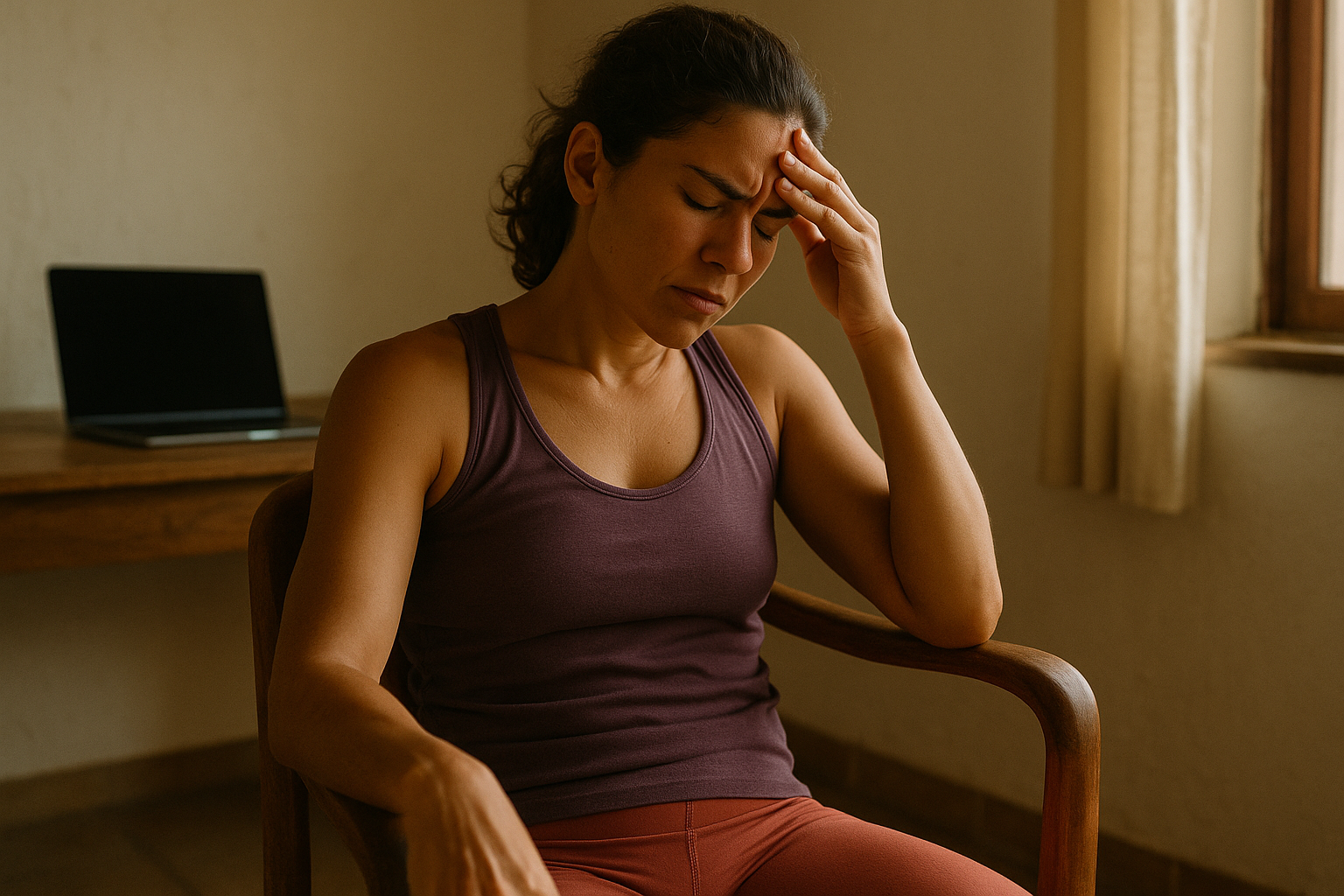
You are not bad at relaxing.
Your nervous system has stopped believing it is safe to.
That is a different problem. And it requires a different solution.
If you have ever found yourself lying in a bath, on a massage table, or in a hammock on a beach — and felt your mind running the same loop it runs at 2 AM on a Tuesday — you already know what that means.
The setting changed.
Your body did not.
This is what chronic stress does to the nervous system of women who have been running at full capacity for too long.
It does not just leave you tired.
It rewires the baseline.
The alert state stops being a response to something happening and starts being the default setting, permanently on, even when the threat is gone.
You cannot think your way out of that.
You cannot schedule your way out of it either.
Why Chronic Stress and Your Nervous System Create a Problem Rest Cannot Fix
Here is what is actually happening inside your body.
Your nervous system has two primary gears.
The sympathetic state — the one associated with threat, urgency, and action.
And the parasympathetic state — the one associated with safety, digestion, recovery, and genuine rest.
Under normal circumstances, you move between them throughout the day.
You face a challenge, your body mobilizes.
The challenge passes, your body returns to baseline.
But chronic stress interrupts that cycle.
When the demands never stop — when the emails keep arriving, when someone always needs something, when there is no clean break between one role and the next — your nervous system stops registering the return to safety.
It keeps the stress hormones elevated.
It keeps the system primed for the next emergency.
Over time, that primed state becomes the new normal.
Your body is not responding to stress anymore.
It has reorganized itself around the assumption that the emergency is permanent.
This is not a mindset issue.
This is not exhaustion you can sleep off.
This is structural — and it is running silently underneath everything you do, every single day.
The chest tightness before the day begins.
The anxiety spiral at 2 AM that has nothing particular to trigger it. The sense of being present in body but quietly disappearing in spirit.
These are not signs that something is wrong with you.
They are signs that your nervous system has been doing its job, without a break, for far too long.
Why Everything You Have Already Tried Has Not Worked
This is the part that matters most, and the part most wellness content skips entirely.
You have probably tried things.
Most women reading this have tried a lot of things.
The meditation app that felt impossible to sit with for five minutes.
The weekend retreat that worked beautifully until Monday morning.
The vacation that felt more like a survival mission than actual recovery.
The therapy sessions that validated what you were feeling but left you without anything concrete to do differently on a Tuesday at 4 PM.
None of them failed because you did them wrong.
They failed because they were solving the wrong problem.
Meditation apps assume your nervous system is calm enough to sit still and observe.
It is not.
Retreats create a temporary container of safety, but the container does not travel home with you.
Therapy addresses the cognitive layer — the stories, the patterns, the beliefs — but leaves the physiological layer untouched.
And the physiological layer is what is actually running the show.
When your body is locked in a chronic stress response, you cannot think or talk your way out of it. The nervous system is not a reasoning problem.
It is a body problem.
And it needs a body-based solution.
That is the missing piece.
Not more willpower, not a better productivity system, not a longer list of things to try.
A direct, deliberate intervention at the level where the problem actually lives.
If you want to understand why your nervous system developed the specific pattern it has, this article on nervous system types and stress responses is a useful place to start.
The Reframe: Your Exhaustion Is Not Seasonal. It Is Structural.
Here is the shift that changes everything.
You have been treating this like a circumstantial problem.
If the workload would ease up, if the kids would stop needing everything at once, if you could just get ahead of the inbox — then you would finally be able to rest.
But you have had easier weeks. And the body still did not relax.
That is because the problem is not your circumstances.
It is the architecture your nervous system has built in response to those circumstances, over months or years of sustained pressure.
The architecture does not update automatically when the pressure eases.
It has to be deliberately retrained.
That is not a harsh verdict.
It is actually a useful one, because it means this is something you can do something about — not by waiting for life to get calmer, but by working directly with the system that needs to change.
The women who figure this out are not the ones who finally cleared their calendar.
They are the ones who stopped waiting for external conditions to shift and started addressing the internal structure directly.
What a Body-First Approach to Chronic Stress Actually Looks Like
The entry point is breath.
Not because breathwork is a magic cure — it is not — but because breath is the one autonomic function you can consciously override.
Your heart rate, your digestion, your hormonal output — those are not under voluntary control.
But your breath is. And because the breath is directly connected to the vagus nerve, which governs the shift from sympathetic to parasympathetic, changing the breath changes the internal state in real time.
This is not a metaphor. It is physiology.
A slow exhale, longer than the inhale, signals the parasympathetic system to engage.
A natural pause after a full exhale activates what is called vagal braking — the body's own built-in brake on the stress response.
These are mechanisms, not mood strategies.
The Quick Reset is the simplest version: exhale fully through the mouth, hold naturally without forcing it, inhale slowly through the nose.
Two or three cycles.
Twenty to thirty seconds.
It works in a bathroom before a meeting.
It works in a car.
It works anywhere, because it does not require equipment or privacy or a specific state of mind.
The Extended Exhale Practice goes deeper: a full yogic breath with an exhale that lasts twice as long as the inhale.
Three to ten minutes.
Used in the morning, after work, or before anything high-stakes.
This is where accumulated stress hormones begin to discharge — not metaphorically, but biochemically, as the extended exhale signals the body that the threat has passed.
And then there is the transition itself — the daily moment that most women skip entirely.
The Coming-Home Practice is fifteen minutes of movement, breath, body scan, and intentional arrival.
Not a reward for a good day.
Not a luxury.
A physiological boundary between the mode you were in and the mode you are entering.
Because the boardroom does not leave your body just because you closed the laptop.
The stress hormones do not disappear when you walk through the front door.
You have to actively create the transition.
You can read more about how that works in practice in this article on the Coming-Home Practice.
Movement matters too — not as punishment, not as performance, but as a signal.
When the body moves in ways that feel regulated and intentional rather than driven and depleted, it communicates safety to the nervous system.
That signal compounds over time.
It is why movement is the real front door to this work, before any emotional or identity work is offered. More on that here.
What This Looks Like When It Actually Works
Stacy came in dealing with chronic cortisol spikes.
She had tried various approaches but wanted something she could use naturally, without medication.
What changed for her was not a dramatic breakthrough — it was the moment she understood her own stress response clearly enough to interrupt it before it peaked.
Her words: "Awareness of my stress response changed everything.
I wanted natural tools, not medication."
That is what the body-first approach actually produces.
Not a transformation that requires you to become a different person.
Awareness precise enough to create a pause.
And tools that work inside that pause.
Hannah came in with daily panic attacks, low confidence, and no ability to say no. After working with breath protocols and learning to recognize the Snap Point — the moment before the nervous system crosses the threshold — the panic attacks stopped.
She set boundaries.
Her confidence returned.
Her own words: "I am listening to myself more.
I know what I truly want and do not want.
The biggest change is my confidence — to be assured of myself."
Brad dealt with work anxiety and tension in meetings.
The anxiety was eliminated.
He genuinely enjoys work more.
Not because his job changed, but because his internal state changed.
None of these results came from thinking about stress differently.
They came from working with the nervous system directly — through breath, through body awareness, through building the capacity to recognize what is happening before it escalates.
That capacity is learnable.
It is not a personality trait some people have and others do not.
The Missing Piece, Named Plainly
If you cannot relax — really relax, not just sit still and perform relaxation — it is not because you are not trying hard enough or doing the wrong app or missing the right supplement.
It is because your nervous system has been running a silent emergency long enough that it stopped reading the all-clear signal.
It needs to be retrained to receive it. And that retraining happens through the body, not through more thinking about it.
The women who experience chronic stress and find their nervous systems genuinely shifting do not get there by finally clearing the calendar or finding the perfect morning routine.
They get there by building a direct, physical relationship with what their own body is doing — and learning to shift it, on purpose, in real time.
That is what all of this is. A way back into your body.
A way back into your own capacity to be present in the life you have already built.
It starts smaller than you think.
A single breath.
A fifteen-minute transition.
A body that slowly stops bracing for the next emergency.
You built a life worth being in. The goal is to actually be in it.
Ready to Know What Your Nervous System Actually Needs?
If you recognized yourself in any of this — the relentless alertness, the rest that does not restore, the sense that something structural is breaking down even when you cannot quite name it — the six-question quiz below will tell you exactly what your nervous system's current pattern is and what to address first.
It takes ninety seconds.
No sales pitch at the end.
Just a clear read on what is actually happening in your body, and where to start.
Frequently Asked Questions
Why can't I relax even when nothing stressful is happening?
This is one of the most common signs that chronic stress has restructured your nervous system's baseline.
When the system stays elevated long enough, it stops reading the absence of a threat as safety — it defaults to alert.
The body needs an active signal to shift back into the parasympathetic state, not just the removal of the stressor.
Is this a chronic stress problem or an anxiety disorder?
Many women experiencing chronic stress and a nervous system stuck in high alert are not dealing with a clinical anxiety disorder — they are dealing with a physiological pattern that developed in response to sustained pressure.
The distinction matters because the intervention is different: this kind of pattern responds to body-based regulation, not only to talk therapy or medication.
If you are unsure, a medical provider can help clarify, but the physiological tools described here are relevant to both.
How long does it take to actually shift the nervous system out of chronic stress?
You can shift your state in twenty to thirty seconds with a single breath protocol — that is real and immediate.
Shifting the baseline, so your default resting state is actually restful, takes consistent practice over weeks.
Most women notice a meaningful change in their reactivity and evening quality within two to four weeks of daily breathwork and deliberate transitions.
Why don't vacations or weekends fix this?
Because they create a temporary external container of safety, but they do not retrain the nervous system itself.
Chronic stress leaves a physiological imprint that does not reset just because the environment changes.
That is why the first Monday back can feel like the vacation never happened — the internal architecture is unchanged.
What is the quickest thing I can do right now if my body is locked up with tension?
Exhale fully through your mouth, let the breath hold naturally at the bottom without forcing it, then inhale slowly through your nose.
Repeat two or three times.
This is the Quick Reset — it activates the vagal brake on your stress response in under thirty seconds and does not require any particular setting or equipment.
I've tried meditation and it makes me more anxious. Is there something else?
Yes — and this is very common for women dealing with chronic stress and a dysregulated nervous system.
Sitting still and observing a busy mind can feel activating rather than calming when the system is already elevated.
Breath-led practices with a physical exhale focus (like the Quick Reset or Extended Exhale Practice) tend to be more accessible as a starting point because they give the nervous system something active to do, rather than asking it to quiet itself on command.
Disclaimer
The content in this article — including any breathing protocols, somatic tools, nervous system frameworks, and physiological concepts — is provided for educational and informational purposes only. It is not medical advice and is not intended to diagnose, treat, cure, or prevent any condition.
The Chang Method™, including the SIC Protocol™ and the Neural Reset, are coaching tools developed through lived experience and long-term physiological study. They are designed to support high-functioning women in building physiological resilience — not to replace clinical care.
If you are managing a medical condition, a diagnosed anxiety or mood disorder, or are under the supervision of a licensed healthcare provider, please consult your provider before applying any protocol described here.
Client stories and outcomes shared on this platform reflect individual results. They are real, and they matter. They are not a guarantee that you will experience the same outcome. Your results will depend on your consistency, your starting point, and a range of factors unique to you.
All content on this platform is the intellectual property of Stephanie Chang Ramos / The Chang Method. All rights reserved.