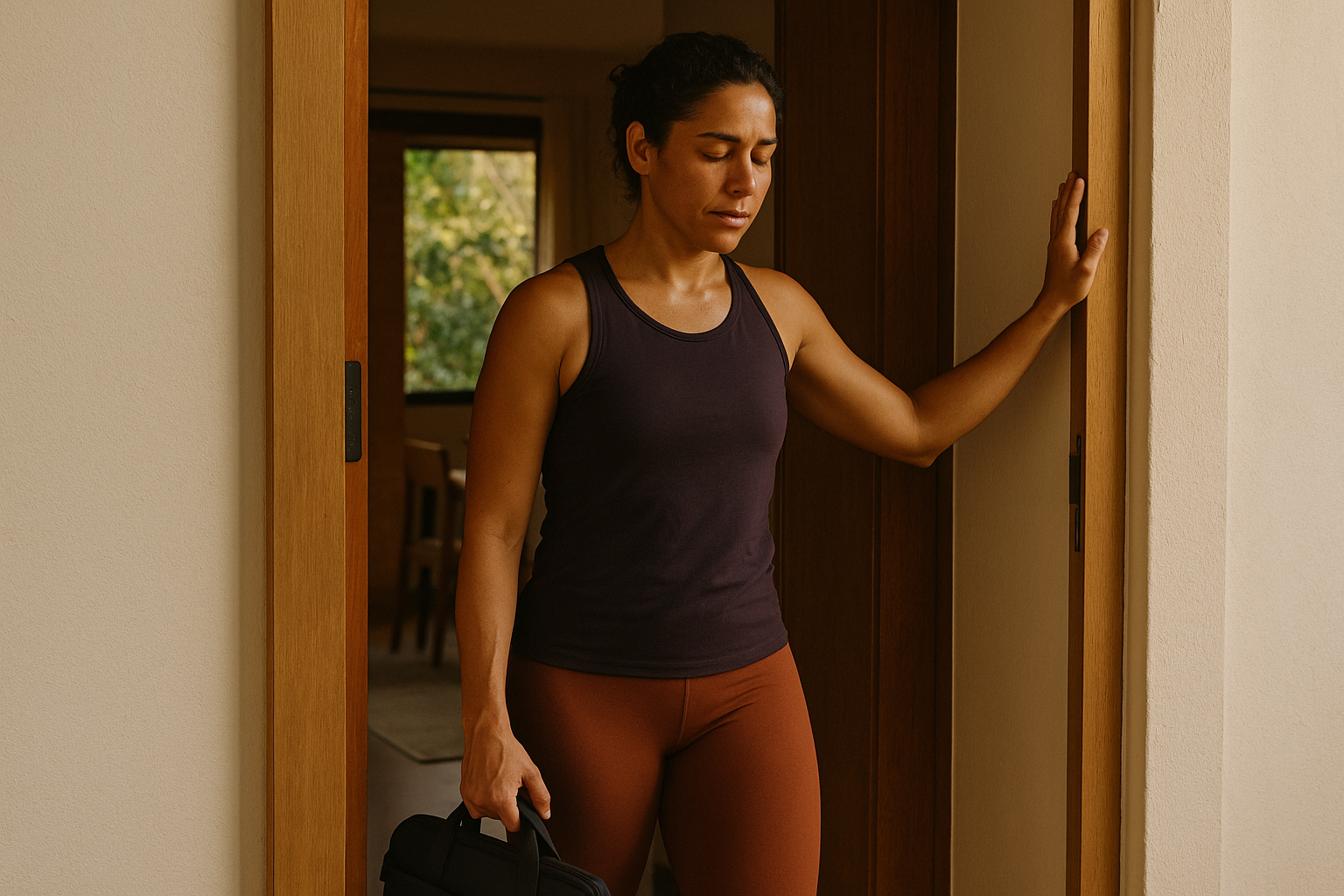
Closing the laptop does not end the workday. You know this.
You close it. You walk to the kitchen.
And the meeting you just left is still running somewhere behind your eyes.
The decision you need to make tomorrow is already loading.
The thing someone said at 4pm is replaying on a quiet loop.
Your body changed rooms. Your nervous system did not.
This is the problem with how most people think about the transition from work mode to home mode.
They think it is a location change.
Walk through the front door, and somehow the boardroom stays behind you.
But your stress axis does not know what a front door is. It responds to physiology, not geography.
So you arrive — physically — and everyone who needs you is already there.
And you have nothing left to give.
Not because you are a bad partner, or a bad parent, or a bad person.
Because you never actually arrived.
Why the Evening Keeps Belonging to Work
The evenings feel like they should be yours.
On paper, they are.
Work is done.
The calendar is clear.
But you are still operating in the same physiological state you were in at 2pm, managing seventeen things at once.
Your cortisol is still elevated.
Your breathing is still shallow.
Your body is still scanning for the next problem.
That is not a mindset issue. That is biology.
Cortisol — the primary stress hormone — does not drop the moment you stop working.
It has a half-life.
It lingers.
And when you have been running at high output all day, it has been accumulating since before your first meeting.
By evening, you are carrying the full weight of it without any deliberate way to set it down.
This is why you snap at a spilled drink that objectively does not matter.
This is why you are present in body and quietly disappearing in spirit.
This is why you can sit in the same room as the people you love most and feel completely unreachable to yourself.
The load did not come home with you by accident.
It came home because nothing told your nervous system the emergency was over.
Why Rest Alone Does Not Work
If the problem were tiredness, sleep would fix it. If the problem were stress, a quiet evening would fix it. But you have had quiet evenings.
You have had long weekends.
You have taken vacations that felt, in your own words, like survival missions rather than recovery.
And you came back just as depleted.
That is because rest is passive.
It removes demand.
But it does not discharge what has already accumulated in your system.
Cortisol does not metabolize through stillness alone.
The nervous system does not reset through the absence of stress — it resets through active, deliberate physiological intervention.
Scrolling your phone after work is not a transition.
It is a continuation.
A different screen, the same threat-scanning state.
A glass of wine is not a transition either.
It dulls the signal without clearing it. The cortisol is still there in the morning.
Even meditation — done passively, without the physical component — often does not reach deep enough into the body to shift what a full day of high-output work has built up.
What you need is not less stimulation.
What you need is a deliberate signal — a physiological message your nervous system can actually receive — that says: that context is closed.
This one is open.
The Real Problem: Your Body Does Not Know the Day Is Over
Here is the reframe that changes everything.
You are not bad at switching off.
You are not someone who cannot relax.
You do not have a personality problem or a discipline problem or a work-life balance problem.
You have a physiology that is doing exactly what it was designed to do — maintain alert readiness in a high-demand environment — and you have never given it a clear signal that the environment has changed.
The transition from work mode to home mode is not automatic.
It is not location-triggered.
It is not time-triggered.
It is physiologically triggered — or it does not happen at all.
Which means it is also learnable. Trainable. Repeatable.
That is what the Coming-Home Practice is.
What the Coming-Home Practice Actually Is
Fifteen minutes.
Four deliberate steps.
Done in sequence, every day, at the boundary between your work context and everything else.
Not a ritual for its own sake.
A physiological intervention that tells your nervous system — through movement, breath, body awareness, and intentional arrival — that the emergency is over.
Step one: five minutes of movement.
Not a workout.
Not performance.
A walk, a shake, a stretch — anything that moves your body through space and signals to your motor system that you are no longer in a seated, reactive, screen-facing state.
Physical movement is one of the fastest ways to begin metabolizing cortisol.
You do not need intensity.
You need motion.
Step two: five minutes of the Extended Exhale Practice.
Full yogic breathing.
Inhale through the nose with the whole body expanding — belly, then ribs, then chest.
Exhale for twice as long as the inhale.
This longer exhale is what activates the parasympathetic branch of your nervous system.
It is the physiological signal your body has been waiting for all day.
You are not breathing to relax.
You are breathing to discharge.
If you want to understand the science underneath why this works, this article on what breathwork actually does goes deeper on the mechanism.
Step three: three minutes of body scanning.
Not analysis.
Not problem-solving.
Just locating where the day is still sitting in your body.
Where is the tightness?
Where is the held breath?
Where are your shoulders?
This is not about fixing anything.
It is about acknowledging what is there so it stops running quietly in the background.
Step four: two minutes of intentional arrival.
This is where you make the crossing real.
You state — out loud or internally — who you are entering this next context.
Not your job title.
Not your output.
The person you are when you walk through that door.
A parent.
A partner.
Yourself.
Two minutes of deliberate naming is not soft.
It is the difference between walking into the evening as an extension of your workday and actually arriving somewhere new.
Where to Do It (Because You Will Ask)
The car.
A parking lot.
A park bench.
The stairwell of your building.
The few minutes between logging off and whoever needs you first.
The Coming-Home Practice does not require a quiet room, a yoga mat, or a blocked calendar slot.
It requires fifteen minutes and the understanding that those fifteen minutes are not optional — they are the mechanism by which the rest of your evening becomes yours.
You can do the movement portion while walking to your car.
You can do the breathwork in the driver's seat before you turn the key.
You can do the body scan on the train.
The arrival can happen before you open your front door.
The location is not the point. The sequence is the point.
Does It Actually Work?
Liliya came in with disrupted sleep and emotional dysregulation she could not trace back to any single cause.
What the Threshold Protocol — the earlier name for what is now the Coming-Home Practice — established was a clear physiological evening boundary.
A real landing point between her professional context and everything after it. The sleep restored.
The emotional state shifted toward hopefulness.
Not because anything in her life changed, but because her nervous system finally had a signal it could use.
That is not a dramatic story.
It is a structural one.
And structural changes are the ones that hold.
Maria — a business owner who could not relax, who dreaded her own vacation — learned to do the same thing in a single session.
Not through a long therapeutic process, but through one somatic intervention that gave her a felt sense of what it meant to actually set something down.
She went on vacation.
She enjoyed it.
Neither of these outcomes required a personality change.
They required a practice.
If you have been reading about nervous system tools for women who are completely at capacity, this is the specific tool for the seam between work and everything else.
Why Movement Has to Come First
Some people try to start with the breathwork and find they cannot settle into it. The mind is still racing.
The body is still braced.
The breath feels effortful.
That is because you cannot breathe your way out of a state your body has not physically shifted from yet.
Movement comes first because it works at the level of your motor system and your cortisol metabolism before breath can do its deepest work.
Five minutes of walking changes the physiological starting point for everything that follows.
It is not optional.
It is the door the rest of the practice opens through.
This is the same principle behind why movement is the front door to nervous system regulation more broadly — not a warm-up for the real work, but the mechanism itself. This article goes into that logic in more detail.
The Practice Is Not About Balance
Work-life balance implies a scheduling problem.
Rearrange the blocks and everything levels out.
The Coming-Home Practice is not a scheduling solution.
It is a physiological one.
You are not carving out evening time on a calendar.
You are creating the biological conditions under which your evening can actually exist for you.
Without those conditions, you can have all the free time in the world and still spend it running a silent emergency no one can see.
With them, fifteen minutes becomes the hinge point that determines whether the people on the other side of your front door get the version of you that is still at work, or the version of you that is actually there.
That is not a small thing.
For the women who have been doing this for months, it is the thing that made everything else possible — being present with their children, reconnecting with their partners, sleeping without waking at 2am, feeling like themselves again by the time dinner is on the table.
You built the life.
The Coming-Home Practice is how you actually get to live in it.
Start Here
If you are not sure where to begin — or whether the kind of exhaustion you are carrying is structural exhaustion or something else — take six questions and ninety seconds to find out.
The quiz at quiz.schangramos.com identifies where your nervous system is actually breaking down and what kind of intervention fits where you are right now.
No lengthy intake form.
No sales call.
Just a clear read on what is actually in the way.
The transition from work mode to home mode should not require willpower.
It should require a practice.
This is it.
Frequently Asked Questions
What if I only have five minutes, not fifteen?
Do the breathwork and the intentional arrival — those two steps alone give your nervous system a partial signal that the context has shifted.
Five minutes is better than none.
But fifteen minutes is where the full transition from work mode to home mode actually completes, so build toward it as soon as you can carve it out.
Does it matter where I do the Coming-Home Practice?
No. The practice works in a car, a park, a stairwell, or a bathroom.
What matters is that it happens between the end of work and your arrival in your next context — not after dinner, not once the kids are in bed.
The boundary has to be created at the actual seam, or it is not a boundary.
I have tried breathing exercises before and they do not seem to do much. Why would this be different?
Most breathing exercises are done without the movement component first, which means the nervous system is still in a braced state when the breath starts.
The Coming-Home Practice sequences movement before breath deliberately — the movement shifts your cortisol baseline, which is what allows the breathwork to actually land.
If breathwork has felt flat for you before, try the five minutes of movement first and notice the difference.
Can I do this on days when I work from home?
Yes — and it is arguably more important on those days.
When work and home share a physical space, the nervous system has no location cue to mark the transition from work mode to home mode.
The practice creates that boundary physiologically when geography cannot.
A short walk outside as your movement component works well for remote workers.
How long before I notice a difference?
Most people notice something within the first week — not a dramatic shift, but a felt sense of landing that was not there before.
The deeper changes in sleep quality and emotional steadiness tend to show up after two to three consistent weeks, because the nervous system is learning a new pattern, not just responding to a single intervention.
Is this related to the breathwork protocols I have seen mentioned elsewhere on the site?
Yes.
The Extended Exhale Practice used in step two of the Coming-Home Practice is the same protocol described in more depth in the breathwork articles — full yogic breath with a long exhale activating parasympathetic response. This article on breathwork techniques for overwhelm covers several variations you can draw from depending on how much time you have.
Disclaimer
The content in this article — including any breathing protocols, somatic tools, nervous system frameworks, and physiological concepts — is provided for educational and informational purposes only. It is not medical advice and is not intended to diagnose, treat, cure, or prevent any condition.
The Chang Method™, including the SIC Protocol™ and the Neural Reset, are coaching tools developed through lived experience and long-term physiological study. They are designed to support high-functioning women in building physiological resilience — not to replace clinical care.
If you are managing a medical condition, a diagnosed anxiety or mood disorder, or are under the supervision of a licensed healthcare provider, please consult your provider before applying any protocol described here.
Client stories and outcomes shared on this platform reflect individual results. They are real, and they matter. They are not a guarantee that you will experience the same outcome. Your results will depend on your consistency, your starting point, and a range of factors unique to you.
All content on this platform is the intellectual property of Stephanie Chang Ramos / The Chang Method. All rights reserved.