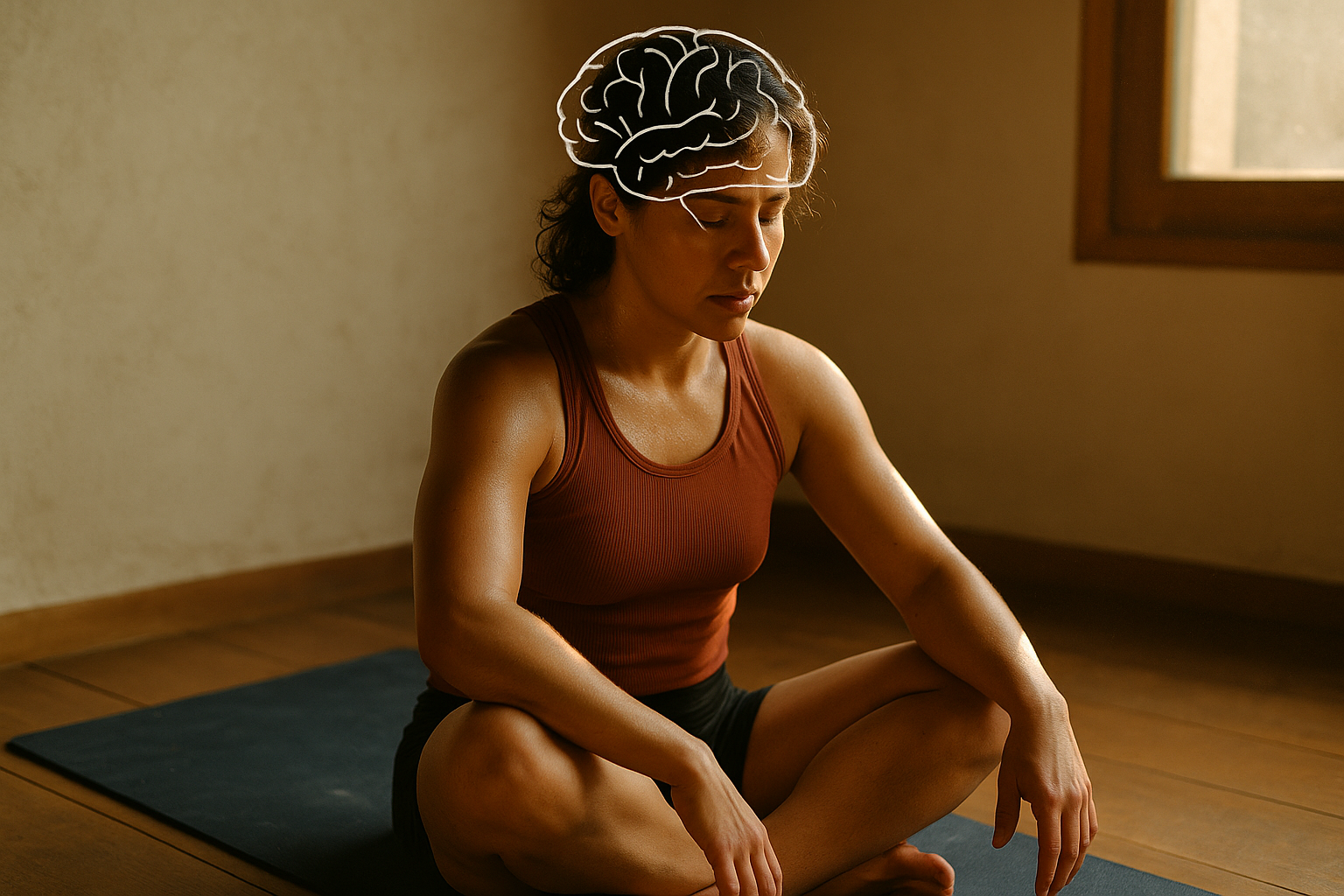
You have probably been told to exercise your way out of exhaustion.
Go for a run.
Hit the gym.
Move more.
And you have probably tried it. Maybe it helped for a day.
Maybe it made you feel worse.
Here is what nobody told you: the relationship between movement, brain healing, and women in burnout is nothing like the fitness industry describes it. It is not about output.
It is not about burning calories or pushing through.
It is about something happening inside your nervous system that most people never hear about until they are already in crisis.
Your brain is not a fixed organ.
It rewires itself in response to what you do with your body.
That process — neuroplasticity — is real, it is measurable, and it is directly relevant to why you feel the way you feel right now.
But it only works under certain conditions.
And most of the movement advice aimed at exhausted women misses those conditions entirely.
What High-Functioning Exhaustion Actually Does to Your Brain
When you are running on structural exhaustion — not tired from a hard week, but chronically depleted at a physiological level — your brain is operating under a different set of rules.
Cortisol, the primary stress hormone, is useful in short bursts.
It sharpens focus, mobilizes energy, prepares your body to respond to a real threat.
The problem is what happens when it stays elevated for months or years at a stretch.
Chronic cortisol exposure does specific, documented things to the brain:
- It shrinks the hippocampus — the region responsible for memory, learning, and context. This is why you cannot remember a single present moment from this week even though you were physically there for all of them.
- It hyperactivates the amygdala — the threat-detection center. This is why small things feel enormous. A spilled cup. A missed message. A child just being a child. Your amygdala is not overreacting because you are weak. It has been recalibrated by months of sustained cortisol exposure.
- It weakens the prefrontal cortex — the part of your brain that allows you to pause, reflect, and choose your response rather than just react. This is why the gap between stimulus and reaction feels like it has disappeared.
This is not a character flaw.
This is not a discipline problem.
This is what structural exhaustion does to a brain over time.
And here is the part that matters: it is reversible.
But not through willpower.
Through the body.
Why What You Have Already Tried Has Not Fixed It
Most women who arrive at this point have already tried most of the standard answers.
Therapy.
Supplements.
Meditation apps.
Better sleep hygiene.
Five AM workouts.
Weekend retreats.
Some of those things provided temporary relief.
None of them addressed the underlying structure.
And the retreat feeling fades within days of getting home, because the structure that caused the exhaustion is still intact.
The five AM workouts deserve a specific mention here, because they are often where well-meaning advice goes wrong for women in burnout.
High-intensity exercise under an already-stressed nervous system adds cortisol to a cortisol problem.
The body reads intense physical effort as another stressor.
For a woman who is already running on empty — chest tight before the day begins, sleep that does not restore, patience that vanishes without warning — a hard workout can temporarily feel like relief, but it does not produce the neurological conditions needed for the brain to actually heal.
More output was never the answer.
The answer is a different kind of signal entirely.
The Reframe: Movement Is a Neurological Signal, Not a Performance
Here is what changes when you understand what is actually happening.
Movement is not exercise.
Movement is information your nervous system receives about whether the world is safe.
When you move in a way that is slow, deliberate, and physically present — without the pressure of performance, without the goal of output — your body sends a specific neurological signal: the emergency is over.
That signal does something measurable.
It triggers the parasympathetic nervous system.
It activates the vagus nerve.
It begins the process of cortisol clearance.
And over time, with repetition, it literally changes the structure of your brain.
The hippocampus grows back.
Research on exercise and neuroplasticity consistently shows that sustained, moderate movement increases BDNF — brain-derived neurotrophic factor — the protein that supports new neural growth.
The amygdala starts to recalibrate.
The prefrontal cortex regains function.
This is why the entry point for real recovery is not intensity. It is presence.
This is also why movement is the front door — not because it solves everything, but because it creates the physiological conditions under which everything else becomes possible.
What Kind of Movement Actually Heals the Brain?
Not all movement creates the same neurological conditions.
The type matters, and the internal state you bring to it matters even more.
For women in structural exhaustion, the most effective movement for brain healing shares a few common characteristics:
It is rhythmic and repetitive. Walking, swimming, dancing, flowing bodyweight movement.
Rhythm naturally entrains the nervous system toward a calmer state.
It is not accidental that many traditional healing practices across cultures involve rhythmic movement.
It involves body awareness, not body performance. The question is not how fast, how heavy, or how many.
The question is: what do I notice?
Where is there tension?
What does this feel like from the inside?
That internal orientation — called somatic attention — is itself a neurological exercise.
It reactivates the interoceptive pathways that go quiet under chronic stress.
It is done without a metric for success. No calories burned, no personal records, no class leaderboards.
A woman who has spent years performing competence in every arena of her life does not need movement that asks her to perform.
She needs movement that asks her to arrive.
It includes breath. Movement without conscious breath is just physical effort.
Movement paired with slow, deliberate breathing activates the vagal braking mechanism — the physiological pathway that directly counters the stress response.
The combination is exponentially more powerful than either one alone. Breathwork changes the brain through overlapping mechanisms, and pairing it with movement amplifies both.
This is the logic behind KINES — the movement pillar in the three-phase methodology.
Not fitness.
Not optimization.
Regulated movement that signals safety to the nervous system.
What This Looks Like in a Real Body
Let's make this concrete, because it is easy for neuroplasticity to remain an abstract idea that does not touch your actual Tuesday morning.
The woman who locks herself in the bathroom after exploding at her kids over something small — she is not having a character failure.
Her amygdala crossed a threshold, her prefrontal cortex was not available to intervene, and the cortisol that had been accumulating all day finally found an exit.
That pattern is physiological.
It has a structure.
And that structure can be changed — not by trying harder to stay calm, but by consistently sending the nervous system different signals through the body.
The woman who lies awake at 2 AM running her own performance review — she is not anxious because something is wrong with her thinking.
Her nervous system has been running at high alert for so long that it has stopped treating the alert as a response to anything specific.
The emergency has become the baseline. That is what chronic stress does to the nervous system — it reorganizes around the assumption that the threat is permanent.
Both patterns respond to the same intervention: consistent, present-state movement that gives the nervous system real evidence that the emergency is not permanent.
Not in one session.
Not as a dramatic breakthrough.
Over time, in small doses, as a practice.
What the Research Says — and What It Does Not
The science on movement and neuroplasticity is not new.
What is less often communicated is the specificity of the conditions required.
BDNF increases significantly with aerobic movement — but the threshold is lower than most fitness content suggests.
Moderate-intensity movement, sustained for 20 to 30 minutes, produces measurable neuroplastic effects.
More is not necessarily better, especially for a nervous system that is already overloaded.
Studies on trauma and somatic movement have shown that body-based interventions — ones that emphasize interoception, body awareness, and breath — produce outcomes that purely cognitive approaches do not.
This is why talk therapy validates the exhaustion without always touching what drives it. The driver is not a thought pattern.
It is a nervous system state.
And research on somatic movement versus yoga versus stretching makes clear that the internal orientation — whether the mover is paying attention to sensation or just executing physical tasks — changes the neurological outcome.
The same physical movement produces different brain effects depending on whether it is done with body awareness or on autopilot.
The implication for women in burnout is direct: it is not just what you do. It is how you inhabit what you do.
The Proof: What Happens When Women Actually Do This
This is not theoretical.
Marta arrived with seven months of severe depression — waking up in tears, estranged from her family, a relationship that had broken down.
She was not looking for movement.
She was looking for a way to get through the day.
The work started where it always starts: with the body.
Breathing protocols, physical movement, a daily morning practice that created a physiological foundation before anything else was possible.
Parts-work and identity reclamation came later, after the nervous system had enough stability to hold them.
She got her depression under control.
Moved from that really dark place to: all right, can do this. Retained agency through setbacks.
Started actively parenting again.
That is the sequence.
The body first.
The identity work second.
Not because the identity questions do not matter — they matter enormously — but because a nervous system in crisis cannot do identity work.
It can only survive.
Hannah arrived with daily panic attacks, low confidence, and an inability to say no at work.
The work started with the Quick Reset — a 20-second breath intervention — and built from there.
The panic attacks stopped.
Boundaries followed.
Her own words: "The biggest change is my confidence — to be assured of myself."
Neither of these transformations came from trying harder.
They came from starting with the body and letting the brain follow.
How to Begin — Without Adding Anything Else to Your List
The most common response to everything above is: that sounds right, and I do not have time for another practice.
That response makes sense.
It is also the nervous system talking.
A brain under chronic stress defaults to scarcity framing — not because you are pessimistic, but because threat-detection is its primary mode right now.
The entry point is smaller than you think.
Ten minutes of deliberate movement — slow, rhythmic, with conscious breath — done consistently produces measurable neuroplastic effects over weeks.
Not hours.
Not a retreat.
Ten minutes.
The breath matters as much as the movement.
Inhale through the nose, let the belly expand, exhale slowly for longer than the inhale.
That extended exhale directly activates the vagal brake.
You do not need a studio or a mat or a program.
You need your body and your breath and enough willingness to show up for ten minutes.
That is the beginning of movement brain healing for women in burnout.
Not the whole answer.
The door.
What Comes After the Door
Once the nervous system is stable enough to hold it, the identity work becomes available.
The woman who has been executing everyone else's life starts to find her own read on hers.
The one who could not remember a single present moment from last week starts to inhabit them.
The one who hated who she had become starts to recognize who she actually is.
That is not a linear process, and it does not happen on a schedule.
But it starts in the body.
Every time.
If you are ready to stop guessing which kind of movement and breathwork would actually work for you — given your specific nervous system, your specific patterns, your specific life — the quiz below maps exactly that in under two minutes.
Start Here
Take the six-question quiz at quiz.schangramos.com.
Ninety seconds.
No sales pitch.
Just a clear read on where your nervous system actually is — and what kind of movement and breathwork would give your brain what it needs to start healing.
The brain heals.
Movement is how it starts.
You just need to know which door to walk through.
Frequently Asked Questions
Can movement really heal the brain, or is that an exaggeration?
The neuroplasticity research is well-established — movement increases BDNF, supports hippocampal growth, and helps recalibrate the stress response over time.
For women in burnout specifically, the key is the type of movement: moderate-intensity, rhythmic, paired with breath and body awareness produces the most significant neurological effects.
Why does high-intensity exercise sometimes make burnout worse?
High-intensity exercise adds a cortisol load to a system that already has too much cortisol.
For a nervous system running at high alert as its baseline, intense physical effort reads as another stressor rather than relief.
Women in structural exhaustion generally respond better to moderate, present-state movement until the nervous system has stabilized enough to handle intensity again.
How long does movement brain healing actually take for women in burnout?
Research suggests measurable neuroplastic changes begin within weeks of consistent moderate movement — not months, and not dependent on marathon sessions.
The consistency matters more than the duration: ten deliberate minutes daily, paired with conscious breathwork, outperforms sporadic intense sessions from a nervous system regulation standpoint.
What is somatic movement and why does it work differently than regular exercise?
Somatic movement prioritizes internal body awareness — what you feel from the inside — over external performance metrics.
The internal orientation activates interoceptive neural pathways that go quiet under chronic stress, which is why it produces different brain effects than the same physical movements done on autopilot.
The question shifts from "how well am I performing?" to "what do I notice?"
Does breathwork actually need to be combined with movement, or does either one work alone?
Both breathwork and movement independently produce neuroplastic and nervous system effects.
Combined, they activate overlapping and complementary pathways — the vagal braking mechanism, cortisol clearance, BDNF production — and the combined effect is meaningfully greater than either alone.
Starting with breath and adding movement, or starting with movement and adding breath, both work; the pairing is what accelerates recovery.
I've tried yoga and stretching and they didn't help. Is this the same thing?
Yoga, stretching, and somatic movement share some physical overlap but produce different neurological outcomes depending on internal orientation and delivery.
If yoga felt like another thing to execute correctly rather than a way to inhabit your body, that is a signal about internal state, not a verdict on movement as a tool.
The research on somatic approaches versus yoga specifically shows that body-awareness orientation — not the physical form — is what drives the nervous system benefit.
Disclaimer
The content in this article — including any breathing protocols, somatic tools, nervous system frameworks, and physiological concepts — is provided for educational and informational purposes only. It is not medical advice and is not intended to diagnose, treat, cure, or prevent any condition.
The Chang Method™, including the SIC Protocol™ and the Neural Reset, are coaching tools developed through lived experience and long-term physiological study. They are designed to support high-functioning women in building physiological resilience — not to replace clinical care.
If you are managing a medical condition, a diagnosed anxiety or mood disorder, or are under the supervision of a licensed healthcare provider, please consult your provider before applying any protocol described here.
Client stories and outcomes shared on this platform reflect individual results. They are real, and they matter. They are not a guarantee that you will experience the same outcome. Your results will depend on your consistency, your starting point, and a range of factors unique to you.
All content on this platform is the intellectual property of Stephanie Chang Ramos / The Chang Method. All rights reserved.