You cannot think your way out of a nervous system response.
That is not a motivational line.
It is a physiological fact.
And it is the reason every journal prompt, every mindset reframe, every productivity system you have tried has left you exactly where you started — holding everything together on the outside while something quietly breaks down on the inside.
Breathwork for burnout is not the same as taking a deep breath to calm down.
It is not the breathing exercise your yoga teacher cued once at the end of class.
It is a deliberate, physiologically grounded intervention that works at the level of your autonomic nervous system — the part of your body that runs the emergency response you have been living inside of, possibly for years.
Here is what most people do not know: you have exactly one autonomic function you can consciously override.
Not your heart rate.
Not your cortisol production.
Not your digestive response.
Just one.
Your breath.
And because that one function is wired directly into every other stress response in your body, it is also the fastest lever you have for changing your internal state in real time.
This is not wellness content.
This is the science behind why it works — and why everything else you have tried probably did not.
Why Your Body Won't Calm Down No Matter What You Do
The exhaustion you are feeling is not seasonal. It is structural.
It is not caused by a bad week, a hard quarter, or a particularly overwhelming Tuesday.
It is caused by a nervous system that has been running at high alert for so long that high alert has become the baseline.
Not a response to stress anymore.
Your new normal.
Physiologically, here is what happens.
Your body has two primary operating modes: sympathetic activation (the stress response — fight, flight) and parasympathetic activation (the recovery response — rest, digest, repair).
In a healthy system, these two modes alternate.
Stress comes in, the sympathetic response fires, the stressor passes, the parasympathetic response brings you back down.
But when the stressors never stop — when the demands of work and family and the hundred invisible things you manage overlap continuously — the recovery phase never fully arrives.
Your nervous system stops cycling.
It just stays up.
And then something worse happens.
The body adapts.
It reorganizes itself around the assumption that the emergency is permanent.
Your baseline cortisol stays elevated.
Your sleep becomes lighter.
Your tolerance window shrinks.
The chest tightness before the day even begins.
The 2 AM mind that runs its own performance review.
The moment a spilled cup or a minor work interruption tips you into a reaction you do not recognize as yourself — and then the shame that crashes in right behind it.
That is not weakness.
That is a nervous system past its threshold.
It is a physiological pattern.
And it is solvable.
But not with more discipline.
Not with a better morning routine.
Not with a vacation that felt like a survival mission rather than recovery.
Those approaches address the output of a dysregulated nervous system, not the architecture driving it.
Why Rest, Therapy, and Meditation Apps Haven't Fixed It
You have probably already tried several of the standard recommendations.
Maybe therapy, which validated what you were feeling without giving you a tool to interrupt the pattern in your body in real time.
Maybe meditation apps, which required a calm you did not have as a prerequisite.
Maybe more sleep, more water, more supplements — all of which addressed the symptoms of a dysregulated nervous system without touching the mechanism driving it.
The reason none of it fully worked is that your exhaustion is structural.
It lives in your body's stress architecture, not in your schedule, your mindset, or your circumstances.
Cognitive approaches — talking, journaling, reframing — work at the level of the cortex.
The part of your brain responsible for language, logic, and perspective.
But the stress response does not originate there.
It originates in the limbic system and the brainstem — structures that are faster, older, and largely immune to persuasion.
You cannot argue your nervous system into safety.
You have to signal it there.
Through the body.
That is what breathwork for burnout actually does.
It does not ask you to think differently.
It uses the one pathway your conscious mind has direct access to — the breath — to send a physiological signal that the emergency is over.
That your body can stop running the silent emergency it has been running, possibly for months.
Read more about why your body won't relax even when circumstances improve.What Slow Breathing Actually Does to a Stressed Nervous System
The mechanism is not mysterious. It is anatomical.
Running along both sides of your spine and branching throughout your organs is the vagus nerve — the primary communication highway of the parasympathetic nervous system.
When the vagus nerve is active, your heart rate slows, your digestion resumes, your muscles release tension, your mind clears enough to think rather than react.
Slow, deliberate breathing — particularly with an extended exhale — directly stimulates the vagus nerve.
The longer exhale activates what is called vagal braking: a physiological downshift that begins happening in your body within seconds of the breath changing.
This is not metaphor.
This is measurable.
Heart rate variability — one of the most reliable markers of nervous system health — increases with slow, rhythmic breathing.
The more pliable your heart rate variability, the more resilient your nervous system.
The better you recover from acute stress rather than accumulating it.
Here is the part that matters most for someone running on structural exhaustion: the effect compounds.
A single session of slow breathing does not fix a nervous system that has been dysregulated for months.
But consistent, practiced breathwork changes the baseline.
It shifts the threshold.
Over time, it rebuilds the nervous system's capacity to cycle between activation and recovery the way it was designed to.
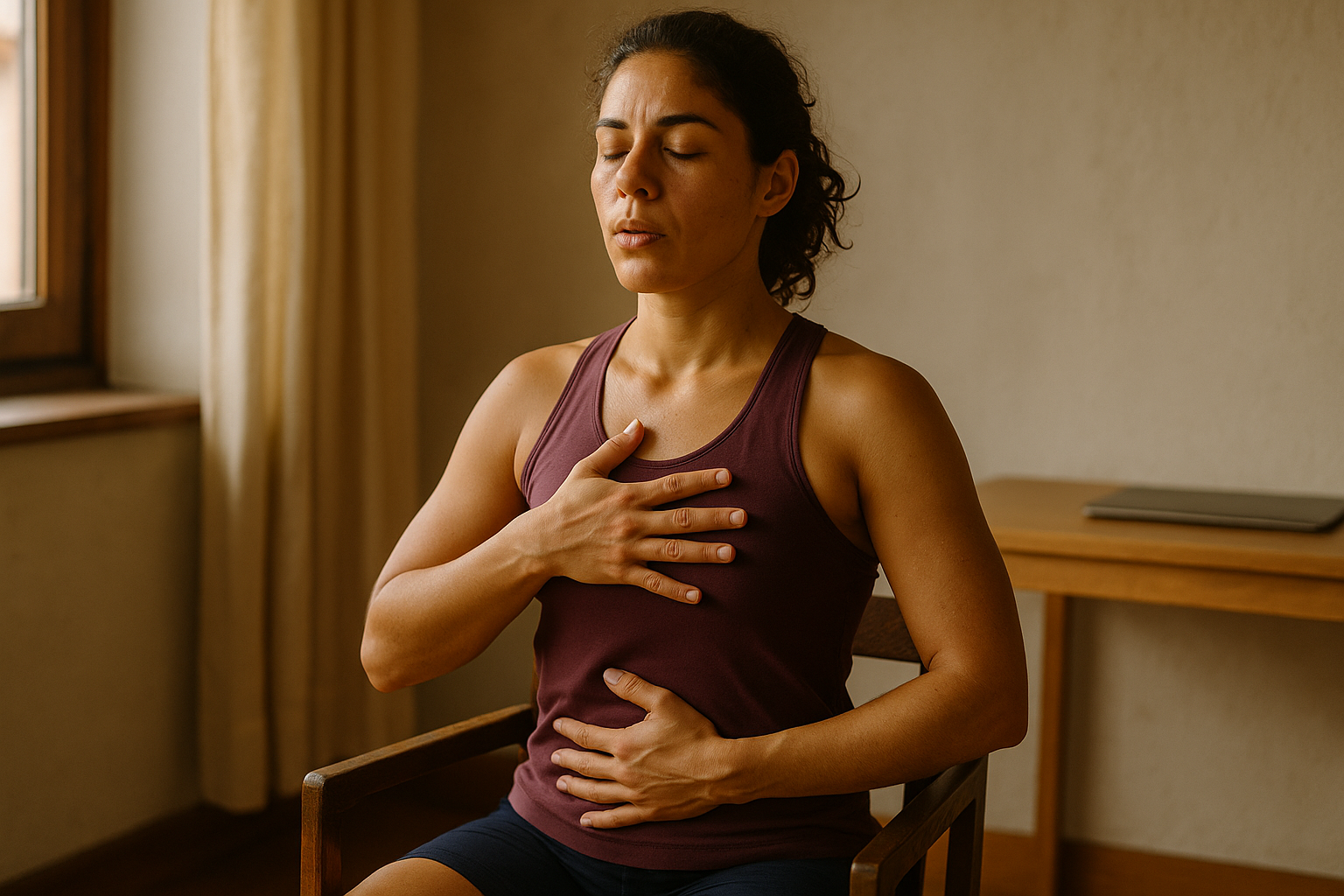
The Extended Exhale Practice — inhaling fully through the nose, exhaling for twice the length of the inhale — is one of the most direct tools for this.
Three to ten minutes.
No equipment.
Usable anywhere a chair and a moment of privacy exist.
The Quick Reset is even faster.
A full mouth exhale, a natural breath hold, a slow nasal inhale.
Twenty to thirty seconds.
Usable between meetings, before walking back into your house at the end of the day, in the moment you feel the pressure building toward a reaction you will regret.
These are not breathing exercises in the casual sense of that phrase.
They are precision physiological interventions.
And the science behind them is the same science used in elite athletic recovery, trauma-informed care, and cardiac rehabilitation.
Here is what a nervous system reset actually feels like when it starts working.What Happens in the Body When You Start Breathing Differently
The first thing most people notice is not calm. It is sensation.
When you have been running at high alert long enough, the body's signals get louder the moment you slow down enough to hear them.
Tension you did not know was there.
Tightness across your chest or your shoulders or your jaw.
Sometimes emotion that surfaces without obvious cause.
This is not the breathwork making things worse.
It is your nervous system finally getting the signal that it is safe enough to process what it has been holding.
After the initial adjustment, what people typically report is a physical release of tension, a slower heartbeat, a mind that feels less crowded.
Not euphoric.
Not dramatic.
Present.
Quieter inside.
Like the background noise turned down several notches.
Over consistent practice — days, not weeks — the changes become structural.
The threshold for the snap point rises.
Small disruptions stay small instead of triggering a cascade.
Sleep improves not because you are more tired but because the nervous system is actually cycling into recovery the way it should.
The chest tightness before the day begins starts to ease.
The thing breathwork for burnout restores is not calm as a mood.
It is the physiological capacity to move between states — activated and recovered, engaged and rested — that chronic stress had worn away.
The Protocols That Work — And When to Use Them
There is no one-size-fits-all breath practice.
Different nervous system states need different interventions.
For acute moments — before a difficult meeting, when the pressure is rising, right after something throws you off: The Quick Reset.
Exhale fully through the mouth.
Hold naturally, without forcing.
Inhale slowly through the nose.
Repeat two to three cycles.
This activates vagal braking within seconds.
It interrupts the automatic stress cascade before it completes.
Twenty to thirty seconds.
That is it.
For the daily practice that rebuilds the baseline: The Extended Exhale Practice.
Full yogic breath — inhale through the nose, body expanding fully, exhale for twice the duration of the inhale.
Three to ten minutes.
Morning works well.
So does the transition between work and home, which is often the moment where accumulated stress either gets discharged or gets carried into your evening and taken out on the people who did nothing to cause it.
For the transition between work and the rest of your life: The Coming-Home Practice.
Five minutes of physical movement — walking, shaking, stretching — to discharge accumulated cortisol from the body first.
Then five minutes of Extended Exhale breathing.
Then a brief body scan, noticing where residual tension still lives.
Then two minutes of intentional arrival — consciously choosing who you are entering the next context.
Fifteen minutes total.
The workday does not automatically leave your body when you close the laptop.
This practice moves it.
For deeper restoration on weekends or recovery days: Oceanic Breath.
Continuous circular breathing with no pause between inhale and exhale.
Ten to twenty minutes.
Used for sustained calm and somatic processing — working through something in the body rather than the head.
Each of these operates at a different depth and serves a different function.
The Quick Reset interrupts.
The Extended Exhale restores.
The Coming-Home Practice transitions.
The Oceanic Breath integrates.
Used consistently and appropriately, they address the full cycle of a stressed nervous system — not just the acute moments but the structural pattern underneath them.
Five breathwork techniques you can use in under sixty seconds when you're overwhelmed.What Happens When Real People Actually Use This
Stacy came in dealing with chronic cortisol spikes.
She wanted a natural solution — no medication.
What shifted for her was simpler than she expected: awareness of her own stress response changed everything.
Once she could see the pattern, the breath protocols gave her something to do at the moment the pattern fired.
She went from reactive to intentional.
The chronic spikes did not disappear overnight.
But she stopped being ambushed by them.
Brad came in with work anxiety and a persistent tension he carried into every meeting.
He left more relaxed.
He reported genuinely enjoying his work more.
The mechanism was the same: breath first, so the nervous system is not already in threat-response mode before the situation even starts.
Hannah was experiencing daily panic attacks when she started.
Low confidence.
An inability to say no at work.
Through consistent Neural Reset practice — the same foundational breath protocol — the panic attacks stopped.
The ability to set boundaries followed, almost automatically, from a nervous system that was no longer running at emergency baseline.
Her own words: "The biggest change is my confidence — to be assured of myself."
None of these outcomes came from a single session.
They came from consistent, practiced use of the same tools this article describes.
The tools are not complicated.
The commitment to using them is the work.
Where to Start If Your Nervous System Is Already Past Its Limit
If you are reading this from a place of genuine exhaustion — not a hard week but a sustained, structural kind of tired — the answer is not to add a complex new protocol to an already overloaded system.
Start with the Quick Reset.
One tool.
Twenty to thirty seconds.
Use it before the meeting that makes your shoulders climb toward your ears.
Use it at the threshold of your front door before you walk in. Use it at 2 AM if the mind decides that is a good time for a performance review.
Do not wait until you feel ready.
You will not feel ready.
You feel exhausted.
Start anyway.
The nervous system does not need you to be calm to begin regulating.
It needs the signal.
The breath is the signal.
And you can send it right now, in the middle of whatever is happening, without privacy, without equipment, without anyone in the room knowing you did anything at all.
That is the point.
This is not a practice you do when your life settles down.
It is a practice that works inside the life you already have.
Ready to Know What Your Nervous System Actually Needs?
If you want to understand what pattern is driving your exhaustion — not in general terms but specifically — take the six-question quiz.
It takes ninety seconds and tells you exactly where your system is leaking and what kind of intervention your nervous system type actually responds to.
Take the quiz here — ninety seconds, six questions, no email wall.
Not another thing to add to your list.
A starting point that is already built for the woman who does not have time for a starting point.
Frequently Asked Questions
Is breathwork for burnout actually scientifically backed, or is it just wellness trend content?
The physiological mechanism is well-established.
Slow breathing, particularly with extended exhales, directly stimulates the vagus nerve and activates the parasympathetic nervous system — measurably increasing heart rate variability and reducing cortisol.
Breathwork for burnout works because it addresses the autonomic nervous system, which is where stress dysregulation actually lives.
How long does it take to feel a difference from breathwork?
The acute effect — a shift in your internal state — can happen within twenty to thirty seconds using the Quick Reset protocol.
The structural change — a raised threshold for stress reactions, better sleep, reduced baseline tension — typically develops over consistent daily practice across several weeks.
Can I use breathwork during a panic attack or in the middle of a stressful moment?
Yes, and that is exactly what the Quick Reset is designed for.
Exhale fully through the mouth, hold naturally without forcing, inhale slowly through the nose.
It activates vagal braking within seconds and interrupts the automatic stress cascade before it completes.
You do not need privacy or time — it works anywhere.
Why doesn't regular deep breathing seem to help when I'm really stressed?
Most casual deep breathing focuses on the inhale, which can actually increase sympathetic activation.
The key variable in breathwork for burnout is the exhale — specifically, making it longer than the inhale.
The extended exhale is what triggers vagal braking and signals safety to the nervous system.
Without that ratio, you may be breathing deeply without sending the right signal.
I've tried meditation apps and they haven't worked. Why would breathwork be different?
Meditation apps typically require a baseline of calm to be effective, and they work at the cognitive level.
Breathwork operates at the physiological level — it changes your autonomic state first, which then makes mental clarity possible.
It does not ask your nervous system to settle down through willpower or thought.
It signals it there through the breath.
Do I need to do long breathwork sessions to get results?
No. The Quick Reset takes twenty to thirty seconds.
The Extended Exhale Practice takes three to ten minutes and is the core daily practice for rebuilding nervous system baseline over time.
Longer sessions like Oceanic Breath (ten to twenty minutes) are for deeper restoration, not daily necessity.
Consistency with shorter practices outperforms occasional long sessions.
Disclaimer
The content in this article — including any breathing protocols, somatic tools, nervous system frameworks, and physiological concepts — is provided for educational and informational purposes only. It is not medical advice and is not intended to diagnose, treat, cure, or prevent any condition.
The Chang Method™, including the SIC Protocol™ and the Neural Reset, are coaching tools developed through lived experience and long-term physiological study. They are designed to support high-functioning women in building physiological resilience — not to replace clinical care.
If you are managing a medical condition, a diagnosed anxiety or mood disorder, or are under the supervision of a licensed healthcare provider, please consult your provider before applying any protocol described here.
Client stories and outcomes shared on this platform reflect individual results. They are real, and they matter. They are not a guarantee that you will experience the same outcome. Your results will depend on your consistency, your starting point, and a range of factors unique to you.
All content on this platform is the intellectual property of Stephanie Chang Ramos / The Chang Method. All rights reserved.