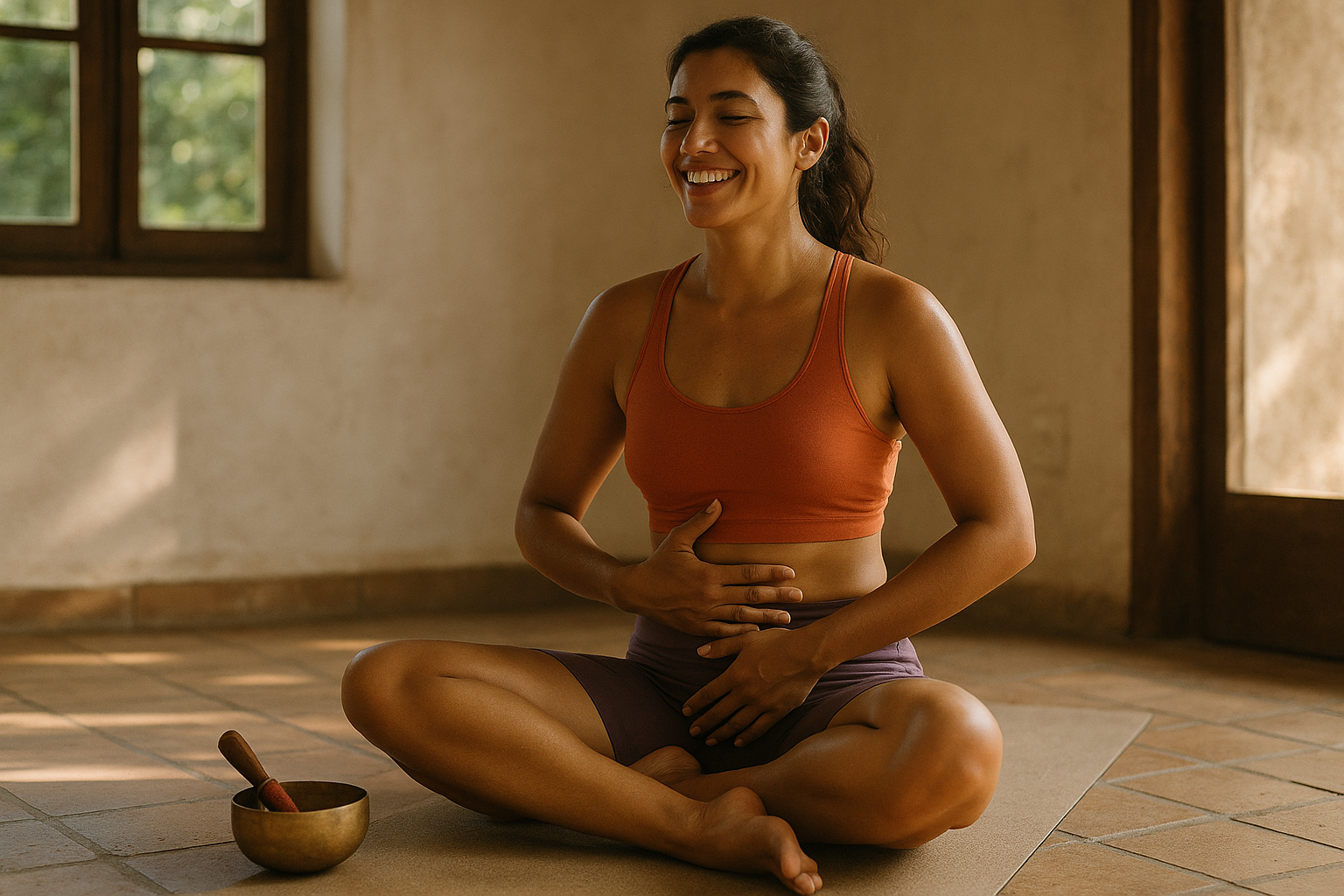
You have breathed approximately 20,000 times today.
None of them changed anything.
That is not an insult.
That is just how automatic breathing works.
Your nervous system runs it in the background, calibrated to keep you alive, not to help you feel like yourself again.
Somatic breathwork is different.
It is the only breathing that talks back to your nervous system — and it is why a single session can shift something that months of therapy, supplements, and 5am workouts never touched.
This is not about breathing deeper.
It is about breathing deliberately — in a way that sends a specific signal to the part of your body that decides whether you are safe or not.
Once you understand what somatic breathwork actually does inside your nervous system, the question stops being "does this work?" and starts being "why didn't anyone tell me sooner?"
The Problem Is Not That You're Not Trying Hard Enough
There is a specific kind of exhaustion that has nothing to do with how much sleep you got.
You wake up already bracing.
The chest tightness shows up before the first email.
You make it through the day on sheer will, then detonate over something small — a spilled drink, a misplaced item, a child being a child — and the shame that follows is almost worse than the explosion itself.
You are present in body. Quietly disappearing in spirit.
And the worst part is that you cannot point to a single reason why.
Nothing catastrophic is happening.
You have built something real.
And yet the low-grade panic underneath everything refuses to lift, no matter what you do.
That is not a mindset problem.
That is not a scheduling problem.
That is your nervous system running a silent emergency — and it has been doing it long enough that the emergency has become your baseline.
This is what exhaustion that persists even when you're doing everything right actually looks like from the inside.
And it is why the standard fixes keep failing.
Why What You've Already Tried Hasn't Fixed It
You have probably tried some version of the following: meditation apps, therapy, better sleep hygiene, cutting caffeine, more exercise, less exercise, journaling, a retreat, a really long vacation that felt more like a survival mission than a recovery.
None of it stuck.
Not because you did it wrong.
Because none of it addressed the actual mechanism.
Your nervous system is not a mindset.
You cannot think your way out of a nervous system response.
It does not respond to insight, intention, or information.
It responds to physical signals — and specifically, to breath.
Here is what most breathing exercises miss: they address the symptom (shallow breathing) without targeting the cause (a nervous system locked into fight or flight).
Deep breathing without the right technique can actually increase arousal if done incorrectly.
Breathing fast, breathing too big, holding tension in the chest — these patterns keep the stress cycle running even when your intention is to calm down.
Somatic breathwork works differently because it targets the vagus nerve directly — the one pathway that can actually override the stress response from inside the body.
What Somatic Breathwork Actually Does to Your Nervous System
Your autonomic nervous system has two main states: sympathetic (threat mode — fight, flight, or freeze) and parasympathetic (safety mode — restore, repair, connect).
When you have been under sustained pressure for months or years, your nervous system stops oscillating naturally between the two.
It gets stuck.
Sympathetic becomes the default.
And rest — real rest — stops being possible, because your body cannot access the state that produces it.
Breath is the one autonomic function you can consciously override.
Your heartbeat is automatic.
Your digestion is automatic.
But you can choose to exhale slowly right now, and that choice will send a direct signal through your vagus nerve to your brainstem, telling your body that the threat is over.
Somatic breathwork uses this pathway intentionally.
The techniques are not random — they are calibrated to specific physiological outcomes.
A longer exhale than inhale activates vagal braking, slowing your heart rate and shifting your nervous system toward parasympathetic dominance.
This is why the Extended Exhale Practice — inhaling through the nose with full body expansion, exhaling for twice as long — produces a measurable calm within minutes, not weeks.
A full exhale followed by a natural breath hold triggers a vagal reset.
This is the mechanism behind the Quick Reset: exhale fully through the mouth, hold without forcing it, inhale slowly through the nose.
Twenty to thirty seconds.
It works anywhere — before a meeting, after an argument, in a locked bathroom when you need to find yourself again before walking back out.
Circular breathing without pause — the Oceanic Breath — sustains an altered physiological state that allows the body to process what it has been storing.
Not analyze it. Process it somatically, which is different and faster.
The somatic part is what distinguishes this from ordinary deep breathing. Somatic means body-based.
The practice asks you to stay inside the physical sensations — the warmth, the tingling, the release of tension in a specific spot — rather than narrating the experience from above it. That body-first attention is what allows the nervous system to actually shift, rather than just being observed while it stays stuck.
For a grounded look at the neuroscience behind why this works, this piece on how breathwork actually changes your brain goes deeper into the mechanism.
Why It Feels Different — And Why That Difference Matters
People often describe their first somatic breathwork session the same way: something shifted that I did not expect to shift.
Not a breakthrough.
Not a dramatic release.
Just — something moved.
And the thing that moved had been fixed in place for a long time.
That is not a spiritual experience. That is physiology.
When the vagus nerve activates, you may feel warmth moving through the body, a sudden heaviness in the limbs, involuntary sighing, or a strange urge to cry without knowing why.
These are all signs that your nervous system is transitioning out of sympathetic overdrive — and the unfamiliarity of the sensation is often because you have not been in that state for a while.
Ordinary breathing does not produce this because ordinary breathing is unconscious.
It matches your current state.
If your current state is low-grade panic, your breathing will reflect that: shallow, slightly fast, chest-led.
Somatic breathwork reverses the direction.
Instead of breath reflecting your state, breath sets your state.
This is why clients who have spent years in talk therapy — successfully understanding their patterns — still feel the bodily shift for the first time in a breathwork session.
Understanding why you are stuck and knowing how to get unstuck from inside your own body are two different things.
One happens in the mind.
The other happens in the tissue.
As one client described it: "No therapist got me further than her." Not because therapy failed — but because it was addressing a different level of the problem.
How the Techniques Work in Real Life
The value of somatic breathwork is not just in dedicated sessions.
It is in having tools that work inside the actual shape of your life.
The Quick Reset is twenty to thirty seconds.
You can use it between back-to-back meetings, standing in a school pickup line, sitting in your car before you walk through your front door.
Exhale through the mouth, hold naturally, inhale through the nose.
Two to three cycles.
It interrupts the automatic stress cascade before it reaches the surface.
The Extended Exhale Practice — three to ten minutes — works as a morning practice, as a midday reset, or as preparation before something high-stakes.
Full yogic breath with the exhale twice as long as the inhale.
This is the practice that begins to shift your baseline over time, not just your moment-to-moment state.
The Oceanic Breath — ten to twenty minutes of continuous circular breathing — is for deeper work: weekend restoration, processing something the body has been holding, restoring physiological reserves after an extended difficult period.
And for the specific challenge of leaving work at work — actually landing in your evening instead of carrying the whole day in your chest — the Coming-Home Practice builds breathwork into a fifteen-minute transition that makes the boundary real. That practice is here if you want to understand how it works.
What Changes When the Nervous System Actually Shifts
Brad came in with work anxiety and tension that had become his constant background state.
After working with the nervous system regulation protocols — including the Quick Reset and the OODA Pause — he stopped bracing before meetings.
He described it simply: relaxed, genuinely enjoying work more.
Not managing it. Actually in it.
Hannah had daily panic attacks.
Low confidence.
A body that could not stop running the emergency.
After consistent breathwork practice and Snap Point recognition, the panic attacks stopped.
What came back was something more important: her trust in her own judgment. "The biggest change is my confidence — to be assured of myself."
Stacy wanted to manage her stress response without medication.
Through the Extended Exhale Practice and the awareness it builds, she moved from reactive to intentional. "Awareness of my stress response changed everything."
These are not breakthroughs born from insight.
They are shifts born from repetition — from a nervous system that learned, breath by breath, that the emergency was over.
If you want to understand more about why slow breathing calms a fried nervous system, the science behind these outcomes goes deeper than it might seem from the surface.
This Is the Front Door
Somatic breathwork is not a treatment.
It is not a replacement for anything you are already doing.
It is the entry point that makes everything else work better, because everything else requires a nervous system that can actually receive it.
You cannot build boundaries from a body that is still in threat mode.
You cannot reconnect with who you are outside your roles when your nervous system is still scanning for danger.
You cannot inhabit the life you built when you are white-knuckling through every day just to stay upright.
The body comes first.
Not as a wellness concept.
As a physiological requirement.
When the body has a way back to safety — a real, repeatable, anywhere tool — everything else becomes possible.
The identity work, the boundaries, the presence with your kids that you have been trying to manufacture through willpower alone.
None of it requires a perfect schedule.
It requires a breath you actually know how to use.
Start Here — Ninety Seconds to Know Where You Are
If you have been reading this and recognizing yourself — the exhaustion that rest does not touch, the reactions that surprise even you, the sense that you are present in body but quietly disappearing in spirit — the first step is understanding what is actually happening in your specific nervous system.
The quiz at quiz.schangramos.com takes ninety seconds and six questions.
It identifies where your nervous system is currently stuck and gives you a starting point that is specific to you — not a generic breathing tip, but a real read on what your body is dealing with.
No email maze.
No pitch waiting on the other side.
Just the clearest possible picture of where to start.
Frequently Asked Questions
What is the difference between somatic breathwork and regular deep breathing?
Regular deep breathing is unconscious or casually intentional — it addresses the symptom of shallow breathing without targeting the nervous system mechanism.
Somatic breathwork uses specific techniques calibrated to activate the vagus nerve and shift the autonomic nervous system from sympathetic to parasympathetic dominance, which is a different physiological outcome entirely.
How quickly does somatic breathwork work on the nervous system?
The Quick Reset — a complete exhale, natural hold, and slow nasal inhale, repeated two to three times — produces a measurable shift in twenty to thirty seconds.
Longer practices like the Extended Exhale or Oceanic Breath shift your baseline over days and weeks of consistent repetition, not just your state in a single moment.
Do I need to be experienced with breathwork to start?
No. The Quick Reset requires no equipment, no training, and no dedicated time — you can use it standing in a parking lot.
Starting there and building familiarity with how your body responds is more valuable than jumping straight to longer, more intensive sessions.
Why does somatic breathwork sometimes make people cry or feel unexpected emotions?
When the vagus nerve activates and the nervous system begins to shift out of sympathetic overdrive, the body releases what it has been holding in a braced state.
That release can surface as tears, warmth, heaviness, or involuntary sighing — none of which is a sign that something is wrong.
It is a sign that the transition is actually happening.
Can somatic breathwork really help with things like panic attacks or explosive reactions?
The client results are real: Hannah eliminated daily panic attacks through consistent Neural Reset practice and breathwork.
The mechanism is physiological — somatic breathwork interrupts the cortisol cascade before it reaches the behavioral surface, which is what makes it effective for patterns like the Snap Point.
It does not suppress the reaction; it catches it upstream, before it happens.
How is somatic breathwork different from meditation?
Meditation typically asks you to observe your mental state from a slight distance — to notice thoughts without attaching to them.
Somatic breathwork keeps attention inside the body, tracking physical sensation directly.
For nervous systems that are highly activated, the body-first approach often works faster because it bypasses the analytical layer and speaks to the part of the brain that actually runs the stress response.
Disclaimer
The content in this article — including any breathing protocols, somatic tools, nervous system frameworks, and physiological concepts — is provided for educational and informational purposes only. It is not medical advice and is not intended to diagnose, treat, cure, or prevent any condition.
The Chang Method™, including the SIC Protocol™ and the Neural Reset, are coaching tools developed through lived experience and long-term physiological study. They are designed to support high-functioning women in building physiological resilience — not to replace clinical care.
If you are managing a medical condition, a diagnosed anxiety or mood disorder, or are under the supervision of a licensed healthcare provider, please consult your provider before applying any protocol described here.
Client stories and outcomes shared on this platform reflect individual results. They are real, and they matter. They are not a guarantee that you will experience the same outcome. Your results will depend on your consistency, your starting point, and a range of factors unique to you.
All content on this platform is the intellectual property of Stephanie Chang Ramos / The Chang Method. All rights reserved.