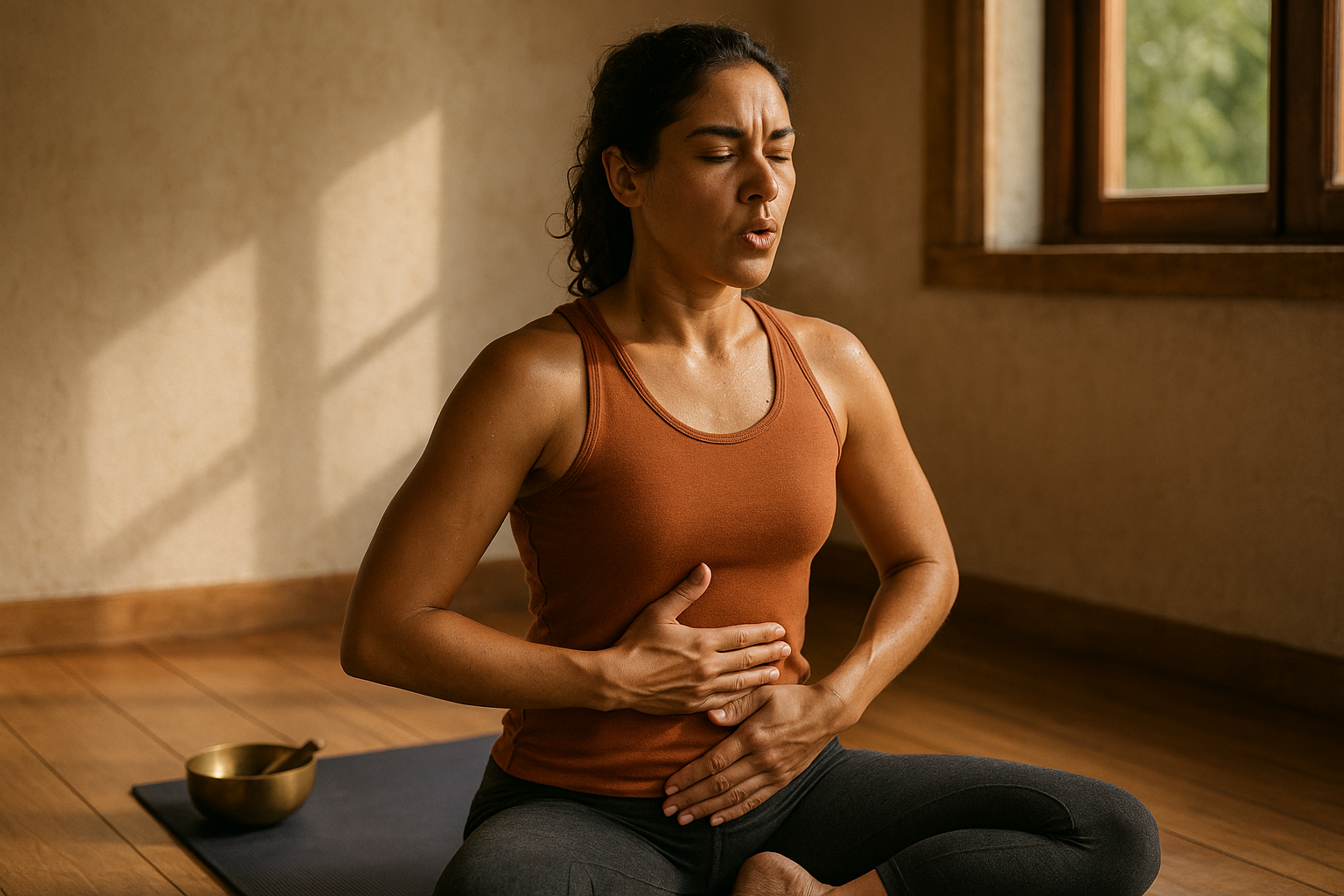
You already know breathing is supposed to help.
You've heard it a hundred times.
Breathe deeper.
Slow down.
Just breathe.
And yet here you are — still running at full internal alert, still white-knuckling through the day, still collapsing into the evening with nothing left.
The problem isn't that breathwork doesn't work.
The problem is that nobody teaches you how to actually build a daily breathwork habit inside a life that's already at capacity.
This isn't about adding one more thing to your schedule.
It's about understanding why the practice keeps slipping — and what actually makes it stick.
Why You Can't Seem to Make It a Habit (Even Though You Want To)
You've probably tried.
A meditation app.
A guided breathing video.
Maybe a weekend workshop that felt genuinely transformative — until Tuesday.
The vacations feel like survival missions rather than recovery.
The workshops feel the same way.
You arrive exhausted, you leave feeling something, and then the ordinary week swallows it whole.
This isn't a discipline problem. It's a design problem.
Most breathwork instruction is built for people who have time — a quiet morning, a clear schedule, a dedicated cushion in a dedicated corner.
That's not your life.
Your life is a back-to-back calendar, a child who needs something the moment you sit down, and a body that hasn't fully rested in longer than you can remember.
So the practice never lands.
Not because you're failing at it. Because it was never designed for you.
The Real Reason Rest Doesn't Restore You
Here's the thing most breathwork content won't tell you: your exhaustion isn't seasonal.
It's structural.
When your nervous system has been running at high alert long enough, it stops being a response to stress.
It becomes your baseline.
You're not anxious because of what's happening right now — you're anxious because your body has quietly decided the emergency is permanent.
In that state, rest doesn't restore.
Sleep doesn't repair.
Even a good weekend away doesn't touch it.
Because the thing driving the exhaustion isn't your schedule.
It's your stress axis.
And you cannot think your way out of a nervous system response.
That's where breath comes in — not as a relaxation technique, but as the one autonomic function you can consciously override.
Change your breath and you change your physiological state in real time.
Which changes what you do next.
But only if the practice actually happens.
Which brings us back to the real question: how do you build something that sticks when you're already running on empty?
Why Every Breathwork Habit You've Built Has Fallen Apart
Most habit-building advice is built on a false assumption: that you have a stable, reliable daily structure to attach a new behavior to.
Maybe you used to. Not anymore.
Your mornings get hijacked.
Your evenings get consumed.
The windows you thought you had close before you reach them.
And then you miss a day, and then two, and then the guilt of missing it becomes its own kind of weight.
There's also a subtler problem.
When you're in a dysregulated nervous system state, your brain is wired for immediate threat-response — not long-horizon habit-building.
The part of your brain that plans and follows through is running on fumes.
So the intention is real, and the follow-through keeps failing, and you start to wonder if you're just someone who can't do this.
You're not. You've been solving the wrong problem.
The answer isn't more discipline.
It isn't a better app or a stricter morning routine.
It's understanding how to work with your nervous system state instead of fighting it.
The Reframe: Start Smaller Than You Think You Should
The biggest mistake is starting with a ten-minute practice when you don't yet have the neural groove for a thirty-second one.
Your nervous system learns through repetition, not duration.
A twenty-second breath reset done every single day builds more structural change than a forty-minute practice done twice a month.
This is the core principle behind building a daily breathwork habit that actually survives contact with a real, demanding life: start with what you can actually do, not what sounds impressive.
That means the first target isn't a morning ritual.
It's one breath.
Consciously taken.
Before you pick up your phone, before you respond to the first message, before the day gets its hands on you.
One breath. Every day. Until it's automatic. Then you build.
The Three-Layer Framework for a Breathwork Habit That Holds
Layer One: Anchor It to Something That Already Happens
Don't try to find new time. Find existing moments and insert breath into them.
The moment before you open your laptop.
The pause before you start the car.
The thirty seconds after you close the bathroom door.
These moments already exist in your day — you're just not using them intentionally yet.
Choose one. Just one. And put a breath practice there.
The Quick Reset works here perfectly.
Exhale fully through your mouth.
Hold naturally — don't force it. Inhale slowly through the nose.
Repeat two or three times.
That's twenty to thirty seconds.
It fits anywhere. You can do this in under sixty seconds and your nervous system will register it as a real intervention.
Anchor it to the same existing moment every day.
Same trigger, same response.
That's how the neural groove forms.
Layer Two: Match the Practice to the Moment
Not all breath practices serve the same function.
Part of why breathwork habits fail is that people use the wrong tool at the wrong time and then wonder why it didn't help.
Here's a simple map:
Morning — before the day grabs you: The Extended Exhale Practice.
Three to five minutes.
Inhale through the nose with the whole body expanding, exhale slow and long — twice the length of the inhale.
This sets the physiological tone for the day and begins clearing accumulated cortisol from overnight.
Midday — when you're hitting a wall or a meeting just threw you off: The Quick Reset.
Twenty to thirty seconds.
No privacy needed.
No equipment.
The fastest shift from reactive to present.
Evening — when the day needs to stop following you home: The Coming-Home Practice.
Fifteen minutes.
Movement, then breath, then a body scan, then a deliberate arrival into your evening. The boardroom doesn't follow you through your front door — but only if you build a physiological boundary, not just a physical one.
You don't need all three at first.
Pick one layer.
Get consistent there.
Then add the next.
Layer Three: Remove the Performance Pressure
This is the layer nobody talks about.
The reason most women drop their breathwork practice isn't time.
It's the feeling that they're doing it wrong, or that it should be producing more dramatic results, or that they should be further along by now.
You're applying the same perfectionism to your recovery that you apply to everything else.
And it's breaking the habit the same way perfectionism breaks everything — by making good enough feel like failure.
A two-minute practice done imperfectly is worth more than a ten-minute practice done perfectly once.
The nervous system doesn't grade you.
It just responds to what you actually give it.
So when you miss a day, you don't restart from zero.
You just take one breath right now.
And you've already begun again.
What This Looks Like in a Real Life
Brad came in with work anxiety — tense in meetings, unable to decompress at the end of the day.
He wasn't looking for a spiritual practice.
He wanted something that actually worked in the middle of a real workday.
The starting point wasn't a morning ritual.
It was one deliberate breath before each meeting — just one cycle of the Quick Reset before entering the room.
Nothing more than that for the first two weeks.
What shifted wasn't dramatic.
He stopped bracing before meetings.
He started actually hearing what people were saying instead of managing his own internal noise.
The anxiety didn't vanish — it became something he could interrupt before it took over.
That's what a consistent daily breathwork habit actually produces.
Not a transformation.
A practice.
One that compounds over time into something that feels, eventually, like calm.
Hannah built hers differently.
She'd been having daily panic attacks — not occasionally, daily.
The entry point for her was the Quick Reset used specifically at the moment she felt the panic beginning to rise.
Same practice.
Different anchor point.
She wasn't adding a new ritual to a structured morning; she was installing a tool that interrupted a specific physiological pattern at the exact moment it started.
Within weeks, the panic attacks stopped being daily.
Then they stopped being frequent.
The practice held because it was attached to a real, recurring need — not to a aspirational morning she couldn't always access.
How Long Before You Feel a Difference?
Honestly?
Some people feel the shift in the first session. One breathwork session won't heal everything — but the physiological response to a slow, conscious exhale is immediate.
Your heart rate drops.
Your cortisol curve bends.
Your nervous system registers that the emergency, right now, is not actually happening.
That immediate response is real.
But the structural change — the one that means you don't need to white-knuckle through the day anymore, the one that means rest actually restores you — that takes consistent repetition over weeks.
Three to four weeks of daily practice, even at the micro level, starts to rebuild the physiological baseline. The science behind slow breathing is clear: it's not placebo.
It's measurable change in your autonomic nervous system function.
Which means this isn't about believing it will work.
It's about doing it long enough for the evidence to become undeniable.
The One Thing That Makes It Non-Negotiable
There's a difference between a practice you add to your life and a practice your life is organized around.
The ones that stick are the ones that become non-negotiable — not because you're disciplined enough to force them, but because you've experienced enough times what happens when you skip them.
You know what it feels like to walk into a difficult conversation without the Quick Reset first.
You know what the evening looks like when you skip the Coming-Home Practice and bring the whole workday into dinner with you.
That knowing becomes the motivation. Not willpower. Evidence.
Start small enough that evidence accumulates fast.
Make it almost impossible to miss in the first two weeks.
Let the results do the persuading.
This is how a daily breathwork habit stops being something you're trying to build and becomes something you actually do — because you've already seen what it gives you, and you're not willing to go back to not having it.
Where to Start Right Now
Not next Monday. Not when the schedule clears. Now.
Before you close this tab, take one breath.
Exhale fully through your mouth.
Hold for a moment — naturally, no forcing.
Inhale slowly through your nose.
That's it. That's the whole first step.
If you want to know which layer of practice fits where you actually are right now — what your nervous system is doing and what it needs — the quiz below takes ninety seconds and gives you something real to start with.
Not a generic recommendation. A direction that fits your actual state.
One breath. Then one more. That's how it begins.
Frequently Asked Questions
How long do I need to practice each day to build a real daily breathwork habit?
You need less time than you think.
Twenty to thirty seconds of a conscious breath reset, done every single day, builds more lasting change than a long practice done sporadically.
Consistency beats duration — especially at the start.
What if I forget or miss a day?
Missing one day doesn't break the habit — it's what you do after that matters.
Don't restart from zero or punish yourself.
Take one breath right now and you've already begun again.
The nervous system doesn't penalize gaps; it responds to what you actually give it.
Is there a best time of day for a daily breathwork habit?
The best time is the one that actually happens.
Morning works well for setting a physiological baseline before the day takes over, but an anchored midday reset or an evening Coming-Home Practice can be just as effective.
Match the practice to a moment that already reliably exists in your day and attach it there.
I've tried breathwork before and felt nothing. Why didn't it work?
Most likely you were using the wrong practice for your nervous system state, or the practice wasn't consistent enough for the effect to accumulate.
A dysregulated nervous system sometimes needs several sessions before it feels safe enough to shift — that's not failure, that's physiology.
Start with the Quick Reset (a simple exhale, hold, and slow inhale) and repeat it in the same anchored moment daily before expecting a dramatic result.
Can breathwork really help with anxiety and emotional reactions?
Yes — and the mechanism is physiological, not psychological.
Slow, conscious breathing activates the vagus nerve and shifts the autonomic nervous system from a threat-response state toward a regulated one.
This is measurable, not metaphorical.
The key is using it at the right moment: before the reaction, not after.
Do I need any special equipment or training to start?
Nothing.
The Quick Reset — exhale through the mouth, hold naturally, inhale through the nose — requires no equipment, no app, no quiet room.
You can do it at your desk, in your car, or standing in your kitchen.
That's the point: a daily breathwork habit has to survive contact with your real life, not depend on perfect conditions.
Disclaimer
The content in this article — including any breathing protocols, somatic tools, nervous system frameworks, and physiological concepts — is provided for educational and informational purposes only. It is not medical advice and is not intended to diagnose, treat, cure, or prevent any condition.
The Chang Method™, including the SIC Protocol™ and the Neural Reset, are coaching tools developed through lived experience and long-term physiological study. They are designed to support high-functioning women in building physiological resilience — not to replace clinical care.
If you are managing a medical condition, a diagnosed anxiety or mood disorder, or are under the supervision of a licensed healthcare provider, please consult your provider before applying any protocol described here.
Client stories and outcomes shared on this platform reflect individual results. They are real, and they matter. They are not a guarantee that you will experience the same outcome. Your results will depend on your consistency, your starting point, and a range of factors unique to you.
All content on this platform is the intellectual property of Stephanie Chang Ramos / The Chang Method. All rights reserved.