You do not need another workout.
You need your body to stop running a silent emergency.
Walking for nervous system regulation sounds almost embarrassingly simple.
That is the point.
Not a HIIT class.
Not a 5am gym session.
Not a streak on a fitness app.
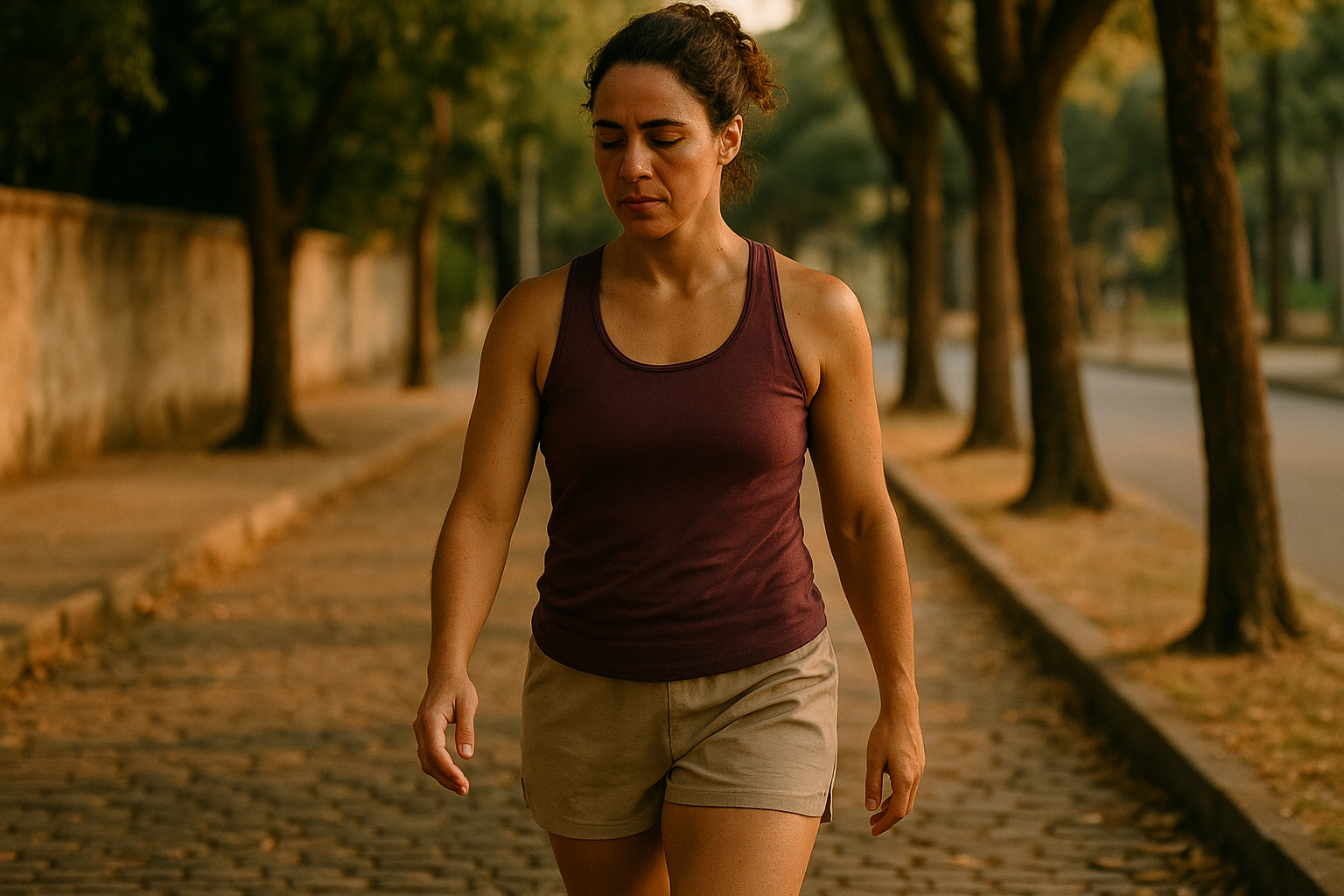
A walk — the kind that does not require a plan, a playlist, or a performance review at the end — is one of the most direct inputs you can give a dysregulated nervous system.
And most high-functioning women have been skipping it in favor of things that feel more deserving of their effort.
This is about why that matters, and how to use walking as an actual regulation tool instead of a consolation prize for days when you skipped the real workout.
The Real Problem Isn't Your Fitness Level
Here is what is actually happening when you feel wrecked by midweek, even though nothing catastrophic has occurred.
You wake up already behind.
There is a low-grade pressure in your chest before the first message comes in. By evening, you are present in body and quietly disappearing in spirit.
You are not lazy.
You are not weak.
You are not failing at balance.
Your nervous system has reorganized itself around the assumption that the emergency is permanent.
That is a physiological state, not a scheduling problem.
And it does not respond to willpower.
It does not respond to a productivity audit.
It does not respond to pushing harder through a workout that your body reads as one more demand on a system that is already at capacity.
Chronic activation of your stress response means your body is running in sympathetic overdrive — elevated cortisol, shallow breathing, muscles braced, mind scanning for threats.
Rest does not fully restore it. Sleep helps but does not undo it. And intense exercise, when your system is already flooded, can actually reinforce the pattern.
What a dysregulated nervous system needs is a signal that it is safe to downshift.
Not more output.
A signal.
Walking, done with a specific quality of attention, is one of the most reliable ways to send that signal.
Why the Solutions You've Already Tried Haven't Fixed This
You have probably tried things.
The 5am workouts.
The meditation apps.
The supplements.
The weekend that was supposed to be recovery and felt like a survival mission.
None of them touched the underlying structure.
Because none of them were designed to.
Intense exercise works by stressing the body deliberately and letting it recover stronger.
That is a useful mechanism — when your baseline is regulated.
When your baseline is chronic activation, another stress load on top of it can push cortisol higher, not lower.
You finish the class exhausted rather than energized and cannot figure out why.
Meditation apps are asking you to be still with a mind that does not feel safe being still.
For women running at full internal alert as a permanent baseline, sitting quietly can actually increase the feeling of agitation rather than reduce it. The body needs to move before it can soften.
Rest without transition does not reset anything.
Lying on the couch still wired is not recovery.
It is just wired horizontal.
The missing piece in most approaches is bilateral, rhythmic movement — the kind that activates both hemispheres of the brain, regulates breathing naturally, and gives the nervous system something low-stakes and predictable to anchor to. That is not a description of a HIIT class.
That is a description of a walk.
What Walking Actually Does to Your Nervous System
Walking for nervous system regulation is not a metaphor.
There are specific physiological mechanisms at work.
The rhythmic, alternating movement of walking — left, right, left, right — engages bilateral brain activity in a way that is associated with emotional processing and stress reduction.
It is the same principle used in certain trauma therapies that incorporate bilateral stimulation.
Your body does it automatically when you walk, with no technique required.
Walking also naturally regulates breath.
You cannot sustain a full sprint pace while breathing slowly through your nose.
But at a walking pace, nasal breathing is easy, and nasal breathing is one of the fastest ways to shift your autonomic state toward parasympathetic — the rest-and-restore branch of your nervous system.
The predictable rhythm matters too.
When your nervous system is on high alert, unpredictability reads as threat.
A walk that repeats the same basic movement pattern, in a familiar direction, with consistent sensory input — ground under your feet, air on your skin, sound around you — gives the brain evidence that this moment is safe.
That safety signal compounds over the duration of the walk.
And because walking does not require exertion beyond a comfortable pace, it does not spike cortisol the way intense exercise does.
You get the movement benefit without adding to the load your system is already carrying.
This is why slow movement heals what hard workouts can't when your nervous system is depleted.
It is not about earning less.
It is about choosing the right input for the state you are actually in.
How to Walk for Regulation — Not Just for Steps
There is a difference between walking to hit a number and walking to shift your state.
The mechanics of the walk matter less than the quality of attention you bring to it.
Here is the basic framework.
No earphones, at least for the first ten minutes. This is the hardest part for most women who use walking time to catch up on podcasts, calls, or audiobooks.
Audio input keeps your attention directed outward and keeps your nervous system partially engaged in processing content.
The regulation happens when you give your senses something real and present to land on — the sound of your own footsteps, the temperature of the air, what you can see at eye level.
Nasal breathing, at whatever pace allows it. If you have to open your mouth to breathe, slow down.
The goal is not cardio.
The goal is a sustained signal to your parasympathetic nervous system.
Slow nasal breathing is that signal.
You can learn more about how slow breathing calms a fried nervous system — the same principle applies here, just embedded in the walk itself.
Deliberate noticing. This is not a mindfulness performance.
It is just pointing your attention at what is actually in front of you.
One thing you can see.
One thing you can hear.
The texture of the ground under your feet.
This keeps your attention in the present, which is where the nervous system evidence of safety lives.
Not in your inbox.
Not in what happened this morning.
Here.
Duration over intensity. Twenty minutes of this quality of walking will do more for your nervous system than five minutes done anxiously and fast.
If you only have ten minutes, ten minutes is useful.
But if you are choosing between a twenty-minute walk and a forty-five-minute class your body is too depleted to benefit from, choose the walk.
The transition function. One of the highest-value uses of a walk is as a deliberate boundary between two contexts — specifically between work and home.
The same logic behind the Coming-Home Practice applies here: the boardroom does not automatically leave your body when you close the laptop.
A walk between those two states helps the nervous system register that one context has ended and another has begun.
Not a productivity hack.
A physiological transition.
Does It Have to Feel Like More Than a Walk?
No. That is the whole point.
One of the patterns that keeps high-functioning women locked in structural exhaustion is the belief that if something does not cost them significant effort, it does not count.
That rest is only valid if it is structured.
That movement is only valid if it burns something.
That belief is part of what keeps the nervous system in overdrive.
Because every input gets filtered through the same lens: is this enough?
Am I doing enough?
The walking-for-regulation practice deliberately sidesteps that filter by being, on its face, a modest thing.
You do not need to earn it. You do not need to track it. You do not need to tell anyone you did it. You go, you come back, and your nervous system is measurably different than it was before.
That is the mechanism. Not the mileage.
What Changes When You Make This a Consistent Practice
The first walk will feel small.
That is accurate — one walk does not rebuild a nervous system that has been running a silent emergency for months or years.
But the nervous system responds to repetition.
Every time you walk in this way — present, breathing slowly, not demanding output from yourself — you give your system another data point that this is what low-alert actually feels like.
Over days and weeks, that baseline shifts.
The chest tightness before the day starts becomes less automatic.
The explosive reaction to the small thing — the spilled cup, the missed message, the child being a child — has a slightly longer fuse, and then a longer one still.
The evenings start to feel like evenings instead of a continuation of the emergency.
These are not dramatic transformations from a single practice.
They are the compound result of giving your nervous system consistent evidence that it does not have to stay at full alert.
Several women in the Chang Method work have described this kind of shift — not from a single breakthrough moment, but from showing up consistently for small, unglamorous regulation practices.
Hannah, who had daily panic attacks before working through the nervous system fundamentals, described the biggest change as learning to trust her own internal signals again.
That trust does not come from dramatic interventions.
It comes from repeated small ones.
Liliya, whose sleep was disrupted by chronic nervous system activation, found that structured transitions — including movement — shifted her baseline toward something she could actually rest from.
Walking was part of that.
The body keeps the evidence. Every regulated moment adds to it.
Where to Start If You Haven't Moved in a While
Start with ten minutes.
Not because ten minutes is the goal — because ten minutes is real and the forty-five-minute plan is not happening today, and you know it.
Leave your phone in your pocket.
Walk at a pace where nasal breathing is easy.
Notice something outside your head.
Come back.
That is it. That is the entry point.
Not a program.
Not a commitment.
One walk, today, that is genuinely about walking for nervous system regulation rather than hitting a metric.
If you want more structure — if you want to understand what is actually happening in your body and what practices will move the needle for your specific pattern — the quiz below takes ninety seconds and gives you a starting point built around where you actually are.
The Next Step
If walking is the front door, understanding your nervous system pattern is what helps you know what to do once you're inside.
The six-question quiz at quiz.schangramos.com takes ninety seconds.
It tells you what is actually driving your exhaustion pattern and what kind of regulation practice fits your specific baseline — not a generic prescription, but a real starting point for the woman who is done white-knuckling through her days and wants to know what will actually help.
Go take it. It is ninety seconds.
You have been carrying this long enough to spend ninety seconds finding out what it actually is.
Frequently Asked Questions
How long do I need to walk for it to actually regulate my nervous system?
Even ten to fifteen minutes of walking for nervous system regulation — done with nasal breathing and present-moment attention — produces a measurable shift in autonomic state.
The quality of attention matters more than the duration.
Longer walks compound the effect, but a short, intentional walk beats a longer walk done anxiously or distracted.
Does it matter where I walk — indoors or outdoors?
Outdoors has the edge, because natural sensory input (variable light, sound, texture underfoot) gives the nervous system more present-moment data to anchor to. That said, an indoor walk with the same quality of attention is still useful.
The mechanism is the bilateral rhythm and the slow nasal breathing — those work regardless of location.
Can I listen to music or podcasts while I walk?
For the regulation effect, aim for at least the first ten minutes without audio input.
Podcasts and calls keep your attention in content-processing mode, which is the same mode you are trying to step out of. If music helps you slow down and stay present, instrumental or ambient music at low volume is a better option than spoken content.
I already walk every day but still feel wrecked. Why isn't it helping?
Walking for nervous system regulation is different from walking as a transit or fitness activity.
If you are walking quickly, mouth-breathing, on a call, or mentally running your to-do list the entire time, the walk is not sending a downshift signal — it is just more of the same output.
Try the same walk with nasal breathing, no audio, and deliberate noticing for a week and see what changes.
Is this instead of breathwork, or alongside it?
Alongside it. Walking and breathwork address the nervous system through different inputs that reinforce each other.
Walking gives the body bilateral rhythm and environmental grounding.
Breathwork gives the autonomic system a direct override signal through the breath.
They compound — a walk followed by a few minutes of slow breathwork is more effective than either alone.
You can read more about building a breathwork habit that holds even when you are running on empty.
What if I cannot make myself go outside when I am really depleted?
Start smaller.
Walk to the end of your street and back.
Walk around the inside of your home for five minutes with the same quality of attention.
The regulation mechanism does not require a particular distance or destination — it requires the bilateral rhythm and the present-moment attention.
Meet yourself where you are, not where you think you should be.
Disclaimer
The content in this article — including any breathing protocols, somatic tools, nervous system frameworks, and physiological concepts — is provided for educational and informational purposes only. It is not medical advice and is not intended to diagnose, treat, cure, or prevent any condition.
The Chang Method™, including the SIC Protocol™ and the Neural Reset, are coaching tools developed through lived experience and long-term physiological study. They are designed to support high-functioning women in building physiological resilience — not to replace clinical care.
If you are managing a medical condition, a diagnosed anxiety or mood disorder, or are under the supervision of a licensed healthcare provider, please consult your provider before applying any protocol described here.
Client stories and outcomes shared on this platform reflect individual results. They are real, and they matter. They are not a guarantee that you will experience the same outcome. Your results will depend on your consistency, your starting point, and a range of factors unique to you.
All content on this platform is the intellectual property of Stephanie Chang Ramos / The Chang Method. All rights reserved.